
$1.2T+ in Cloud Commits. GCP +63%. Q1 Cloud AI Race in Numbers
AWS $364B backlog. Azure +40%. Microsoft’s $37B AI business is moving to seats + usage. The Q1 numbers that matter for your cloud GTM.

Hi, it’s Roman Kirsanov from Partner Insight newsletter, where I deconstruct winning Cloud GTM strategies and the latest trends in cloud marketplaces.
This week’s issue is all about the hyperscaler cloud, AI, and commits race — and what the latest AWS, Microsoft, and Google Cloud earnings reveal for alliance, marketplace, and partner leaders.
In this issue:
$1.2T+ in cloud commits: AWS, Azure, and Google Cloud now sit on the largest pool of pre-committed enterprise software budget ever created.
GCP grew 63% to $20B — partner-sold Gemini seats surged 9X YoY, signaling Google’s ecosystem-led AI distribution engine is now at full speed.
AWS accelerated to 28% growth: AWS hit a $150B run rate, backlog reached $364B, and Bedrock spend grew 170% QoQ.
Microsoft AI crossed $37B ARR as Azure grew 40%. Microsoft is moving AI monetization toward seats + usage.
But before we dive in, our next cohort of the Cloud GTM Leader Course starts June 2nd. In five weeks, we’ll work through how to turn marketplace from an end-of-deal scramble into a repeatable growth system across AWS, Microsoft, and GCP. Scroll below for details.
Cloud Commits Cross $1.2T: What Partners Need to Know
AWS, Azure and Google Cloud reported staggering revenue growth numbers last week.
Combined cloud backlog exceeds $1.2 Trillion. All three are capacity constrained. Here’s a quick breakdown.
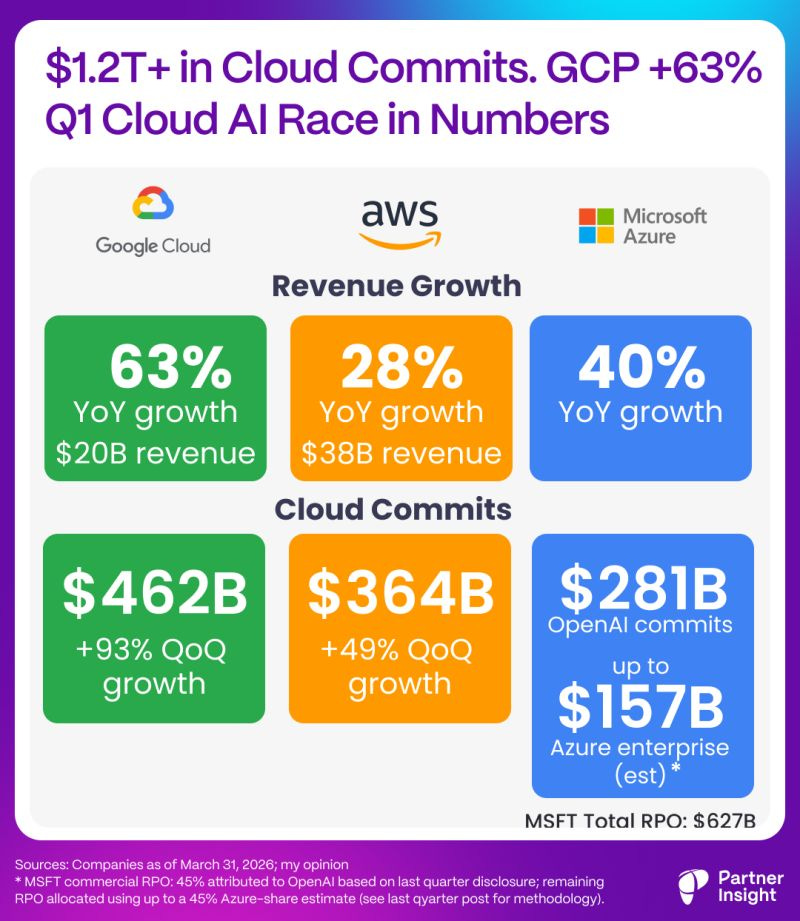
The hyperscaler AI race is accelerating, and the numbers are extraordinary. I’ll do detailed breakdowns shortly, but here are the key figures tech leaders need to know.
Revenue Growth
Google Cloud grew 63% to $20B - by far the fastest of the three.
AI solutions built on Google’s own models grew ~800% and became Cloud’s primary growth driver for the first time.
AWS grew 28% to $37.6B, its fastest growth rate in 15 quarters. The last time AWS grew this fast, the business was roughly half its current size. AWS is now at $150B annual run rate.
Microsoft Azure grew an impressive 40%.
All three said revenue would have been higher if they had more capacity.
Cloud Commits
This is where it gets really interesting for anyone selling through marketplaces.
Google Cloud backlog nearly doubled in a single quarter to $462B.
AWS backlog reached $364B - and that excludes the recently announced $100B+ Anthropic commitment.
Microsoft RPO remained roughly the same as last quarter at $627B. We estimate Azure commitments at $430B-$440B, including Open AI.
Add it up and customer cloud commits across the big three now exceed $1.2T. While not all are marketplace-addressable, the potential budget that ISVs can tap through the marketplace is rapidly expanding.
AI Revenue
Microsoft disclosed the largest number: $37B annual run rate for AI, up 123% YoY (likely across the business).
AWS said AI revenue is growing triple digits with a run rate exceeding $15B.
Google didn’t share an absolute figure but the 800% growth rate on AI-model-based products tells the story.
CapEx
The investment race is breathtaking.
Google raised 2026 guidance to $180–190B and said 2027 will be “significantly” higher.
Microsoft guided to ~$190B for calendar year 2026.
AWS spent $43.2B in Q1 alone, planning to spend ~$200B this year.
Combined, these three companies are guiding ~$570B+ of 2026 CapEx/ AI infrastructure investment. All three expect to remain capacity constrained through at least the end of 2026.
What this means for alliance leaders:
$1.2T in cloud commits is the largest pool of pre-committed enterprise software budget ever created. If your product is available on marketplaces, the addressable wallet is growing faster than at any point in history.
All three clouds are adding AI capacity as fast as they physically can and still can’t meet demand. Cloud sellers are under enormous pressure to show returns on this investment. That creates co-sell leverage for ISVs who help drive consumption.
The partner signals are incredibly strong. Google reported 9x growth in partner-sold Gemini seats.
GCP’s explosive 63% growth. 9X partner-sold AI seats
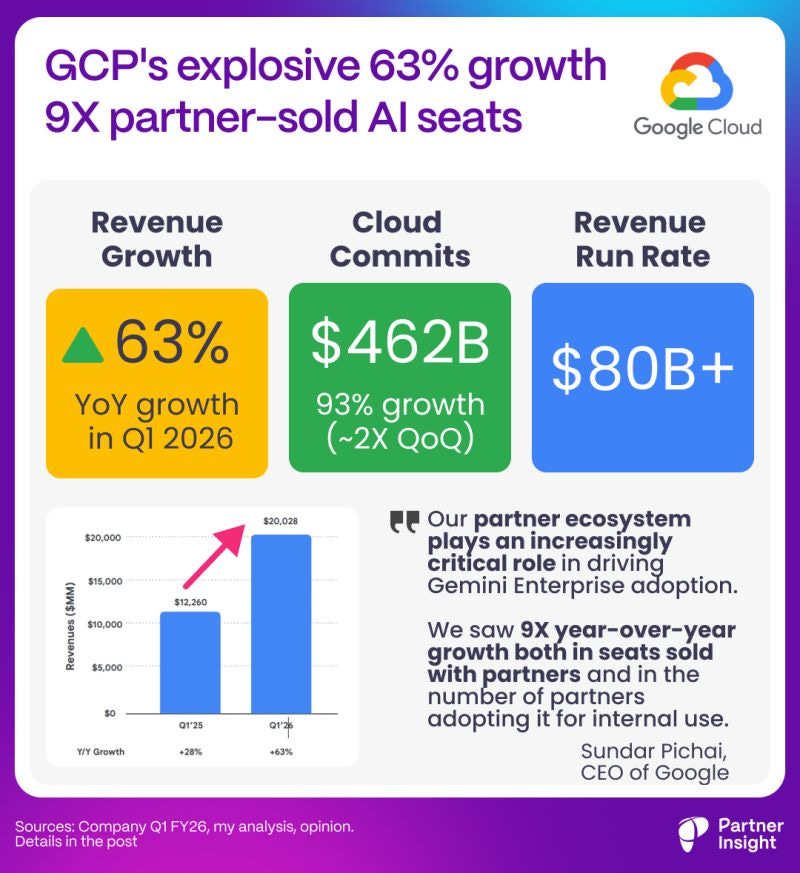
Google Cloud’s revenue grew a stunning 63% YoY. Commit backlog hit $462B (~2X in a single quarter). But the key partner signal was this: partner-sold Gemini Enterprise seats grew 9X YoY.
Enterprise AI is now the primary growth driver for Google Cloud - for the first time
Google Cloud revenue reached $20B in Q1, up 63% YoY. That’s from 28% growth a year ago. GCP is growing faster than any hyperscaler in recent memory.
Enterprise AI is now the main growth lever:
Revenue from GenAI-model products grew ~800% YoY
New customer acquisition 2X
Deals between $100M and $1B doubled YoY, with multiple $1B+ contracts signed.
Existing customers are outpacing their initial commitments by 45% - accelerating over the prior quarter. When customers spend faster than they planned, the product is delivering real value.
Gemini Enterprise is becoming Google’s partner-led AI adoption engine
Sundar Pichai: “Our partner ecosystem plays an increasingly critical role in driving Gemini Enterprise adoption.”
Partner-sold seats grew 9X YoY.
Partners adopting Gemini Enterprise for their own internal use also grew 9x.
This matters, because partners are not just reselling Gemini Enterprise. When partners deploy the product internally first, they sell it better afterward.
Gemini Enterprise paid MAUs grew 40% QoQ.
The usage depth signals are striking:
330 GCP customers each processed over 1T tokens in the past 12 months.
35 reached 10T tokens.
Gemini-powered workflows in BigQuery grew 30X YoY.
AI adoption is also pulling security into the stack
Wiz acquisition closed in March and is now reported inside GCP. Sundar said early performance has “exceeded our expectations,” as demand grows for Google’s cybersecurity and AI products.
They also highlighted Gemini-powered agents for threat detection, continuous red teaming and automated remediation.
GCP message: we’re building the secure enterprise AI stack - models, data, agents, infra and security.
CapEx tells you where this is heading
CEO was direct: “We are compute constrained in the near term. Our cloud revenue would have been higher if we were able to meet the demand.”
Q1 CapEx reached $35.7B, up an incredible 107% YoY.
Alphabet raised full-year 2026 guidance to $180–190B, and signaled 2027 CapEx will increase “significantly” again.
Google is now selling TPU hardware directly into select customers’ own data centers - a new revenue stream. Those agreements are already reflected in backlog, though the majority remains typical GCP contracts.
Key takeaways for alliance leaders:
9x partner growth signals Google’s ecosystem-led AI distribution engine is now moving at full speed
$462B in backlog => massive commit pools for marketplace transactions. The addressable budget nearly doubled in one quarter.
Position your solution as one that drives actual consumption and you’ll earn co-sell attention.
What’s your take on GCP momentum?
Amazon Hits Record High: AWS +28%, $364B backlog
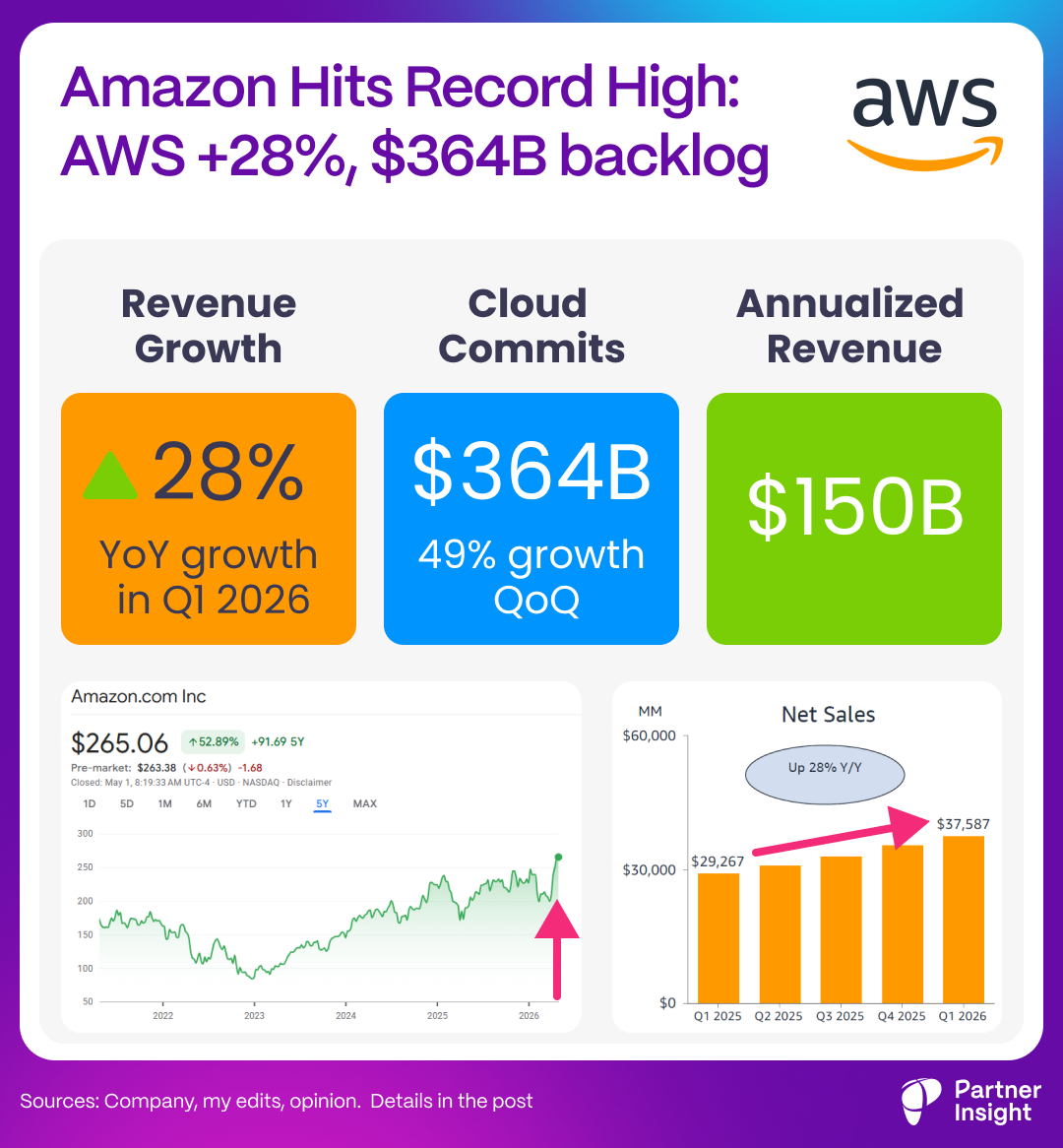
Amazon shares hit an all-time high last week after reporting AWS’s fastest growth in 3+ years. AWS backlog reached record $364B.
AWS grew 28% in Q1 on a $150B annual run rate. Acceleration like that on a base this large is almost impossible.
Signals that stand out from Q1:
$364B in committed customer spend
Amazon Web Services (AWS) backlog reached $364B in Q1, growing 49% or $120B in just 3 months.
CEO Andy Jassy added that the number “does not include the recent deal that we announced with Anthropic for over $100 billion.
There is reasonable breadth in that as well - it is not just one customer or two customers.”
The bigger this customer commits pool grows, the more procurement gravitates to AWS Marketplace.
Bedrock is now the enterprise AI distribution layer
125,000+ customers
~80% of Fortune 100 use it
Q1 customer spend on Bedrock grew 170% QoQ
Tokens processed in Q1 exceeded all prior years combined
OpenAI’s GPT-5.4 landed in Bedrock last week, with 5.5 coming.
AWS also previewed Bedrock Managed Agents powered by OpenAI - a stateful runtime Jassy called a “big deal” for production-scale agents.
Jassy on where enterprise AI is monetizing:
“The largest absolute place that we see enterprises having success is in projects that are around cost avoidance and productivity — things like business process automation or fraud or things of that sort.”
AI spend is now pulling core cloud growth with it
Amazon said AWS AI revenue is already above a $15B annualized run rate after only three years. AI revenue is growing triple digits year over year.
As customers spend more on AI, AWS sees a corresponding increase in demand for core services.
CFO Brian Olsavsky: “a strong correlation between AI spend and core growth.”
Post-training, agentic tool use, and inference all pull CPU, storage, and networking with them. AI expands the entire AWS footprint inside an account.
CapEx supports it - $43B in Q1, $151B trailing twelve months, up from $93B a year ago. AWS is building ahead of demand it has already sold
Memory shortage is quietly accelerating cloud migrations
Insight from the CEO: Memory and component prices have spiked, and suppliers prioritize hyperscalers for capacity. On-prem customers watching refresh cycles slip are now accelerating migration plans that had been stuck for months.
3 takeaways for alliance leaders:
Lead with the customer’s AWS budget growth
If your target accounts have committed AWS spend, marketplace and co-sell should be part of the deal strategy early.
Tie your AWS story to AI-driven core growth.
The best partner positioning will show how your product expands, secures, governs, or accelerates AWS workloads.
Build for the Bedrock and agent ecosystem.
Enterprise AI buying is moving toward platforms where models, data, agents, and governance come together.
AWS just reported one of its strongest quarters in years. Are you positioned to ride the next AWS growth wave?
Microsoft’s $37B AI Business is Shifting to Seats + Usage
Microsoft’s latest earnings call revealed how it’s rethinking AI monetization. Microsoft’s AI business crossed $37B in annual revenue run rate, up 123%.
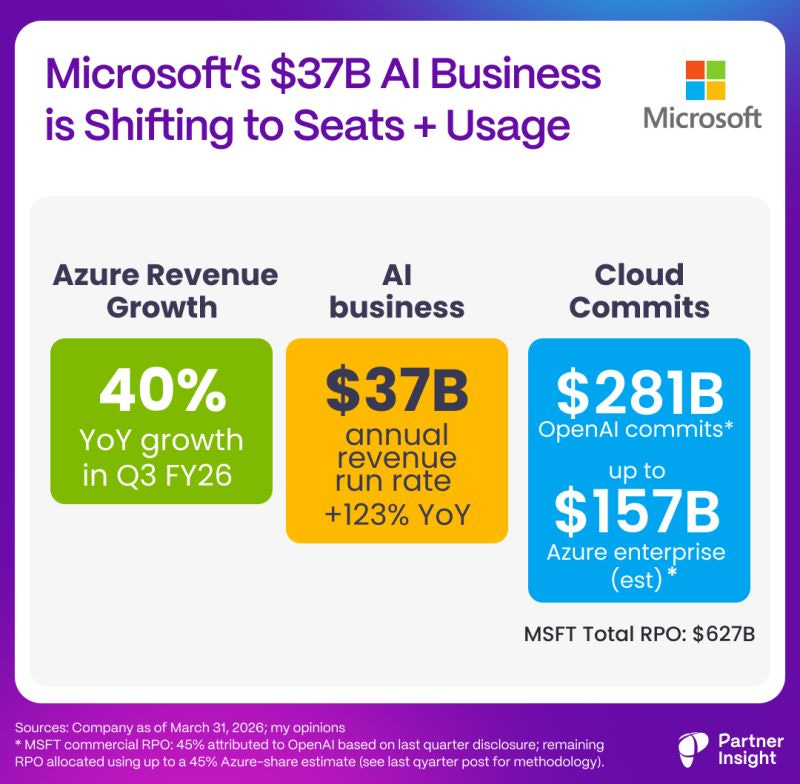
Last quarter Azure grew 40%, ahead of 37-38% guidance
AI is now one of Microsoft’s largest growth engines, as its AI business surpassed $37B.
Copilot paid seats crossed 20M.
GitHub Copilot reached ~140,000 orgs, with enterprise subscribers ~3X.
Security Copilot customers 2X.
AI monetization is increasingly tied to usage, not just seat expansion
Amy Hood framed it directly: “if you think about getting work done and being more productive, it’s thinking about being a seat or a worker plus an agent.
And when I think about that model, I start to think about it as a license business plus a consumption business, and really applying far more broadly than I think people have thought about that.”
Satya Nadella reinforced: “The basic transformation of, I’ll say, any per-user business of ours, whether it’s productivity, coding, security, will become a per-user and usage business.”
This is already happening.
GitHub Copilot moves to usage-based pricing on June 1.
~60% of Dynamics 365 service customers already purchase usage-based credits. Copilot Credit consumptive offer ~2X QoQ as customers extend Copilot with custom agents.
When Microsoft moves its own products to include consumption, it normalizes usage-based purchasing across its entire customer base.
Azure’s AI platform story is moving beyond “Azure OpenAI”
Microsoft is now positioning Foundry as the enterprise multi-model platform. 10,000+ customers used more than one model on Foundry. 5,000 used open source models. The number using both Anthropic and OpenAI 2X QoQ.
The strongest Azure AI partner story is no longer about integrating with one model. It is helping customers orchestrate the right models, data, governance, and workflows across the platform.
The data layer reinforces this.
Cosmos DB grew 50% YoY driven by AI workloads. Fabric reached 35,000 paid customers, up 60%.
15,000+ customers now use both Foundry and Fabric, connecting agents to operational and analytical data.
Microsoft’s commercial RPO remained roughly flat QoQ at $627B
We estimate Azure commits at ~$430–440B, including OpenAI. For the split see the slide and our last quarter breakdown.
CapEx was $31.9B last quarter. Microsoft still expects demand to exceed supply through 2026, as it guided $190B for CY2026 - one of the largest AI infra bets.
Three takeaways for alliance leaders:
Prepare for usage-based pricing, as Microsoft and others are making consumption the default language of enterprise AI purchasing
Build your Azure partner story around multi-model orchestration and data integration, not a single model dependency
Show how your solution drives Azure consumption and moves AI into production to get more attention
Are you rethinking your Azure strategy given 40% growth?
Turn Marketplace Into a Real Revenue Driver: 5-week course for Alliance & Cloud GTM Leaders
If Marketplace only shows up at the end of the deal, it is not a GTM motion.
It is firefighting.

And that is where many Cloud GTM teams get stuck.
A rep pulls alliances in late
A private offer becomes urgent
The cloud rep gets a vague ask
Procurement shows up in the final week
The “win” depends on one person who knows the maze.
It may save the deal.
But it does not compound.
That is the pattern I keep seeing across SaaS and AI companies trying to scale on AWS, Microsoft, and Google Cloud.
They are “doing marketplace.”
But they are not building a repeatable Cloud GTM growth system.
The teams pulling ahead do a few things differently:
they identify marketplace as a buying path earlier, not at the end
they train sales to use it, instead of treating it as an alliances side project
they make co-sell structured: real context, clear asks, better timing
they connect channel, marketplace, and cloud field into one motion
they build internal support across finance, ops, product, and leadership
That is what turns marketplace from extra work into leverage.
And it matters more now than it did even a year ago.
Cloud commitments across Amazon Web Services (AWS), Microsoft, and Google Cloud have crossed $1.2T.
Customers are more open to buying software digitally.
But they are also more selective.
Co-sell is getting more competitive.
And AI is reshaping how software gets discovered, packaged, and sold through hyperscaler ecosystems.
So the gap is widening: between teams that are listed and teams that turned marketplace into a repeatable revenue driver.
David Mauer — who helped drive $100M+ in marketplace revenue at GitLab and is now rebuilding the motion at LucidLink — put it well in our recent webinar:
”You never want a customer to tell you how they want to buy and have to say no.”
Over the past 2.5 years, 300+ alliance and Cloud GTM leaders have gone through our Cloud GTM Leader course to build that capability.
Some launched from zero marketplace motion to $200K revenue + $7M pipeline in 8 weeks.
Others closed their first $1M+ marketplace deal and turned it into a repeatable motion.
Some scaled marketplace revenue 4X YoY from an already high base.
That is not because they found one trick.
It is because they built the growth system.
Our next cohort starts on June 2
If you want to turn marketplace into a real growth driver — not just push isolated deals through it — this is what we work on for 5 weeks.
P.S. Thanks for reading! If this issue sparked an idea, please forward it to your alliance lead or cloud counterpart — it’s how this community shares what works.