
14/14 wins ran through partners + Marketplace SPIF plan

Hi, it’s Roman Kirsanov from the Partner Insight newsletter, where I deconstruct winning Cloud GTM strategies and the latest trends in cloud marketplaces.
In today’s newsletter:
Workiva’s CEO highlighted 14 key enterprise wins. Every single one ran through a partner. The company is on track to cross $1B ARR with 21% growth — here’s how they’re running GTM so partners are the default, not the exception.
A practical SPIF framework to get your reps transacting on marketplace in 90 days. Nicole Napiltonia (VP Alliances at TeamDynamix, ex-Barracuda) shares the exact phase-by-phase incentive structure — copy and adapt it.
JFrog’s cloud engine is accelerating: cloud revenue hit $243M (+45% YoY) and now represents 46% of total — with “deeper marketplace partnerships” called out as a growth driver.
Tomorrow: Michael Levy — the AWS Marketplace leader who helped scale Salesforce from $0 → $2B+ in marketplace revenue in 18 months — is joining our online workshop. He’ll share how top partners scale, and how AI is reshaping marketplace motions.
Before we dive in:
Join our free, tactical workshop tomorrow Feb 24, 9–10 AM PT — we’re covering the leadership alignment playbook for CEO/CFO buy-in, comp design, what top companies are doing differently in 2026 to scale marketplace revenue, and 5 templates you can implement this quarter.
Workiva: 14/14 enterprise key wins ran via partners
Workiva is the type of SaaS company AI could disrupt. Reporting + compliance + governance is where AI is moving fast.
Yet they just delivered 21% growth YoY with partner-driven GTM. They are on track to cross $1B ARR.
What’s accelerating their growth?
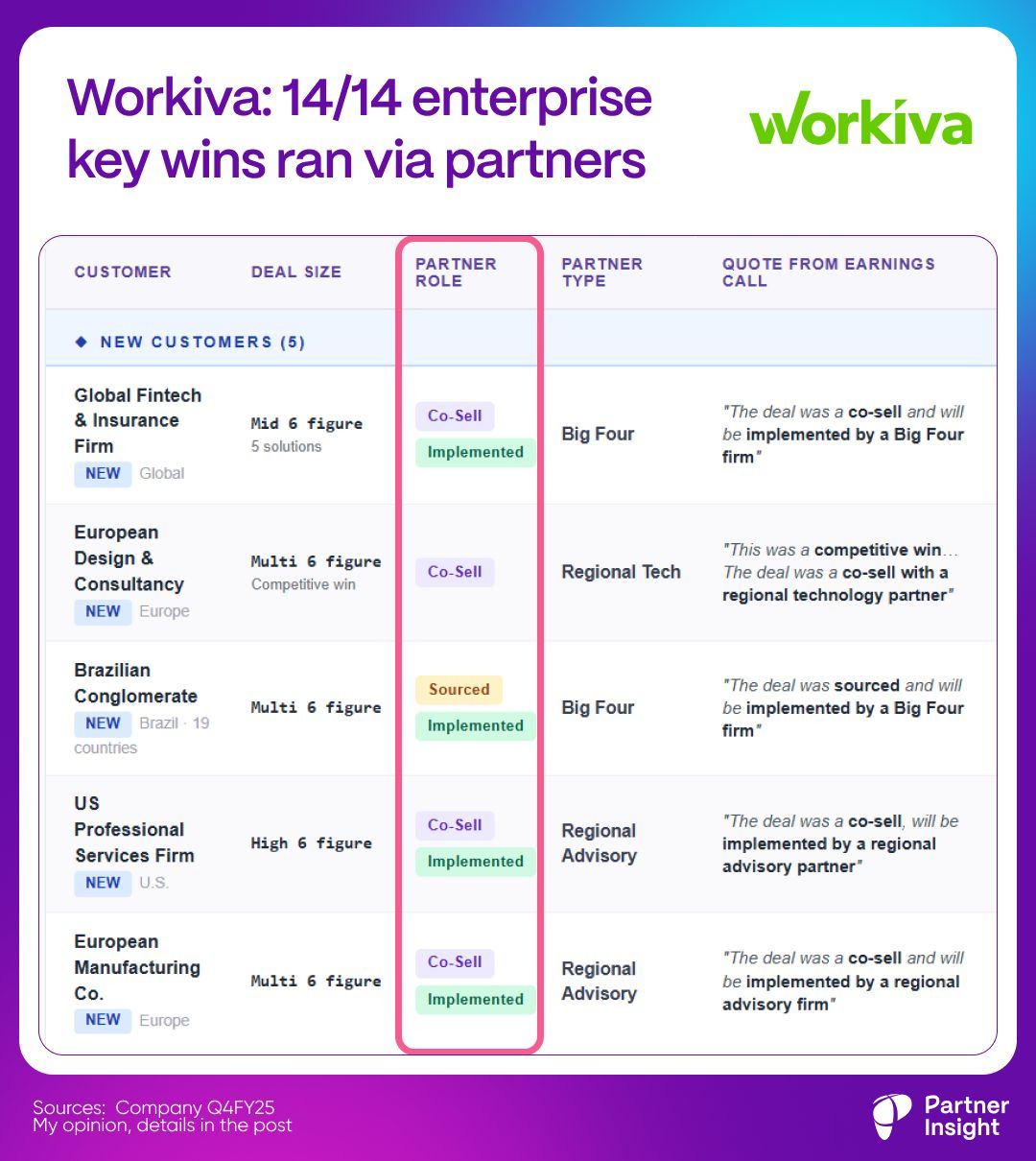
One pattern jumped out in their recent earning call:
Every single enterprise deal the CEO highlighted involved a partner.
Not “most.” Not “the majority.”
All 14 out of 14 — co-sold, partner-sourced, and/or partner-implemented.
Big Four. Regional advisory firms. Technology platform partners.
This isn’t accidental. Workiva lists the partner ecosystem as a core growth pillar, and calls out 250+ advisory, technology, and service partners that extend reach and accelerate delivery.
What’s interesting is how partners show up in the mechanics of the wins:
Co-sell + implemented by a Big Four firm” (repeated across multiple deals)
Sourced and implemented by a regional advisory partner”
Co-sell with a technology platform partner”
Even competitive rip-and-replace deals (legacy GRC) routed through partners
In other words: partners aren’t just helping close deals. They’re finding opportunities and owning implementation at scale.
Workiva is also designing the business model around this leverage:
“We shifted lower-margin setup and consulting services to our partners.”
Translation: more delivery capacity through the ecosystem, better margins for Workiva, and more attach opportunity for services partners.
And they’re aligning leadership to it
Their new CRO, Michael Pinto (ex-AWS and Databricks), was brought in with an explicit mandate to “strengthen our partner ecosystem” and deepen Workiva’s position in the data ecosystem.
Now back to the AI disruption question
Workiva’s CEO Julie Iskow addressed the threat directly: “AI does not replace this foundation. It depends on it.”
Their bet: as more content becomes AI-generated, buyers care even more about data being trusted, traceable, defensible, and audit-ready — the “system of truth” layer underneath automation.
Cloud dependence + spend alignment
On the cloud infrastructure side, Workiva’s platform is built primarily on AWS.
They also disclosed $121.4 M in non-cancelable cloud infrastructure commitments through 2029 — a real signal of deep hyperscaler dependency and spend alignment.
3 lessons for alliance & marketplace leaders:
Design GTM so partner involvement is the default path to enterprise deals.
Treat services-to-partner migration as a scale + margin strategy (not just coverage).
Hire and promote partnership/cloud native sales leaders to bring cloud ecosystem instincts and accelerate co-sell/marketplace GTM
In your org, are partners involved in every enterprise deal — or only after the deal is already real?
Speaker Reveal: Michael Levy (AWS Marketplace) — How Top ISVs Scale Marketplace Revenue
$0 → $2B+ in AWS Marketplace revenue in 18 months. That’s how fast the Salesforce partnership scaled — and Michael Levy led the marketplace strategy behind it.
Many ISVs never get past seven figures on marketplace. Michael knows exactly why.

He’s joining our Feb 24 workshop to share what he’s learned about what separates marketplace revenue engines from strategies that go nowhere.
Michael is a Senior Manager at Amazon Web Services (AWS) Marketplace, where he leads feature launch and adoption — the team driving business outcomes on AWS marketplace for partners and customers.
He also designed the engagement framework that AWS uses to scale its most strategic marketplace partnerships into repeatable revenue.
What makes Michael’s perspective unique:
Michael works directly with top ISVs and technology partners to accelerate their GTM execution on AWS Marketplace.
He knows what “good” looks like from AWS’s vantage point — what gets support from AWS field teams, what gets prioritized, what stalls.
He also leads GTM strategy for AI agents and tools in AWS Marketplace. This means he’s at the intersection of the fastest-growing category in cloud and the fastest-growing procurement channel.
If you’re wondering how AI-native companies are approaching marketplace differently — or how traditional ISVs should position AI capabilities on marketplace — Michael is tracking this closer than almost anyone.
Before AWS, he spent 10+ years at Bloomberg LP building enterprise technology solutions for financial services.
That combination — strategic partner scaling, AI marketplace trends, product-led adoption, and deep enterprise experience — is exactly why his insight in this session is a must
Join us Feb 24, 9–10 AM PT as we break down:
What top companies are doing differently in 2026 to scale marketplace revenue
The leadership alignment playbook that gets CRO and CFO buy-in
How to structure your marketplace motion so sellers actually use it (not work around it)
Partner engagement patterns: what AWS sees top partners do differently when they scale
Templates you can implement this quarter
Michael Levy will be joined by:
Drew Zurek — Senior Director, Global Cloud Marketplaces at Qlik (ex-AWS)
Trunal Bhanse — CEO, Clazar
Fabrizio Chen-Cataldo — Business Development & Partnerships, Supabase
And myself
If you want to hear directly from the person who helped build one of the largest marketplace partnerships in AWS history — and who now shapes how AWS launches AI agents and scales marketplace features for partners — this is the session.
Marketplace Incentive Framework: Fast-Track Sales Adoption
Many companies are still debating whether marketplace should be comp neutral. Top alliance leaders—backed by their exec team—have moved past that.
They design short-term SPIF programs to build the sales muscle fast.
Nicole Napiltonia just helped list TeamDynamix on Microsoft Marketplace. As VP of Alliances, she brings serious marketplace muscle — she previously scaled Barracuda into one of the top partners across hyperscalers.
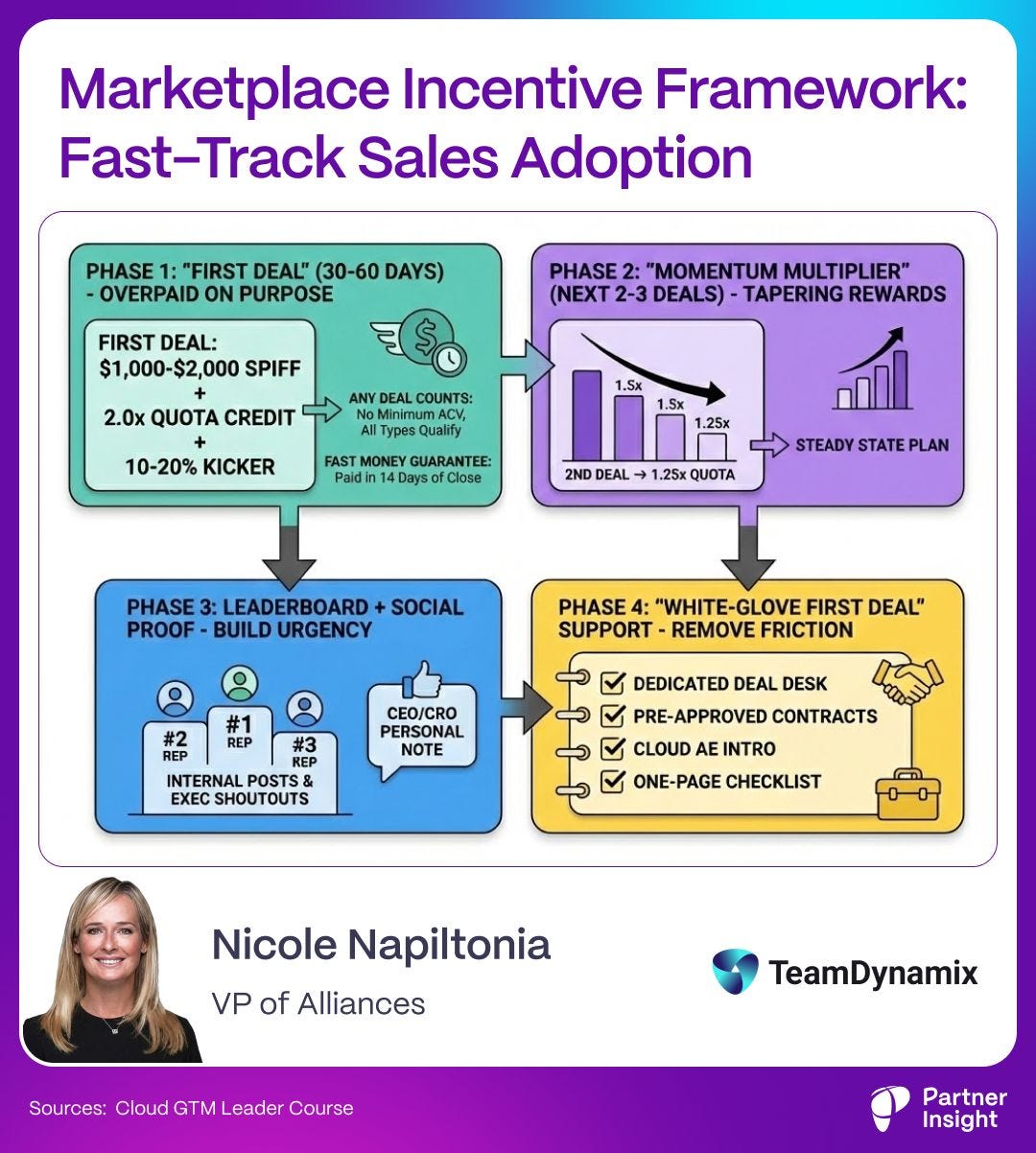
She shared a practical incentive framework to fast-track marketplace adoption across the sales org. It over-rewards early deals on purpose — then tapers as the behavior becomes habit.
Here’s the structure (copy / adapt):
PHASE 1: “FIRST DEAL” (30–60 days)
First deal = overpaid on purpose
$1,000–$2,000 SPIFF for the first marketplace deal per rep
2.0x quota credit (one-time)
+10–20% commission kicker (stacked)
Use competition: reps don’t want to be the last one to get their first deal.
“Any deal counts” rule (lower the barrier)
No minimum ACV (even $1–5K counts)
New logo, expansion, renewal — all qualify
Pilot / POC / partial workload qualifies
Co-sell encouraged, not required
Fast money guarantee (speed builds trust)
SPIFF paid within 14 days of close
No revenue recognition dependency
Simple validation: marketplace invoice submitted
If finance can’t support this → reduce amount, not speed.
PHASE 2: “MOMENTUM MULTIPLIER” (next 2–3 deals)
1st deal → 2.0x quota
2nd deal → 1.5x quota
3rd deal → 1.25x quota
Then move to steady state plan.
Optional: cap at 90 days to create urgency.
PHASE 3: Leaderboard + social proof
Post every first deal win internally (rep name + deal size)
Leaderboard (first rep, second rep, etc.)
15-second exec shout out at all-hands for first-deal reps
Personal note from CEO/CRO for first deal reps
PHASE 4: “WHITE-GLOVE FIRST DEAL” support
Dedicated marketplace deal desk
Pre-approved contract language
Cloud AE intro offered automatically
One-page checklist: “How to close your first {hyperscaler} deal”
Reps should feel like the company wants them to try.
Early success metrics (don’t focus on revenue initially)
Reps with ≥1 marketplace deal
Time to first deal per rep
% of pipeline now Marketplace-eligible
Target: 50–60% of reps transact in the first 90 days.
Launch language (internal):
“For the next 60 days, your first Microsoft Marketplace deal earns a $1,000 SPIFF, 2x quota credit, and a commission accelerator — regardless of size. No minimum ACV. We are intentionally over-rewarding first deals to help everyone build momentum.”
Here is why I think it’s worth it:
Often hyperscaler MDF can offset the SPIF cost.
Every marketplace deal you close today compounds into access to billions of cloud budgets tomorrow. ROI on a short-term SPIF is hard to argue against.
JFrog’s Cloud GTM Playbook: Marketplace as a Growth Lever
JFrog’s cloud business crossed $243M in revenue (up 45% YoY) driving overall growth to 24%.
Cloud partnerships and marketplace were called out as key growth drivers.
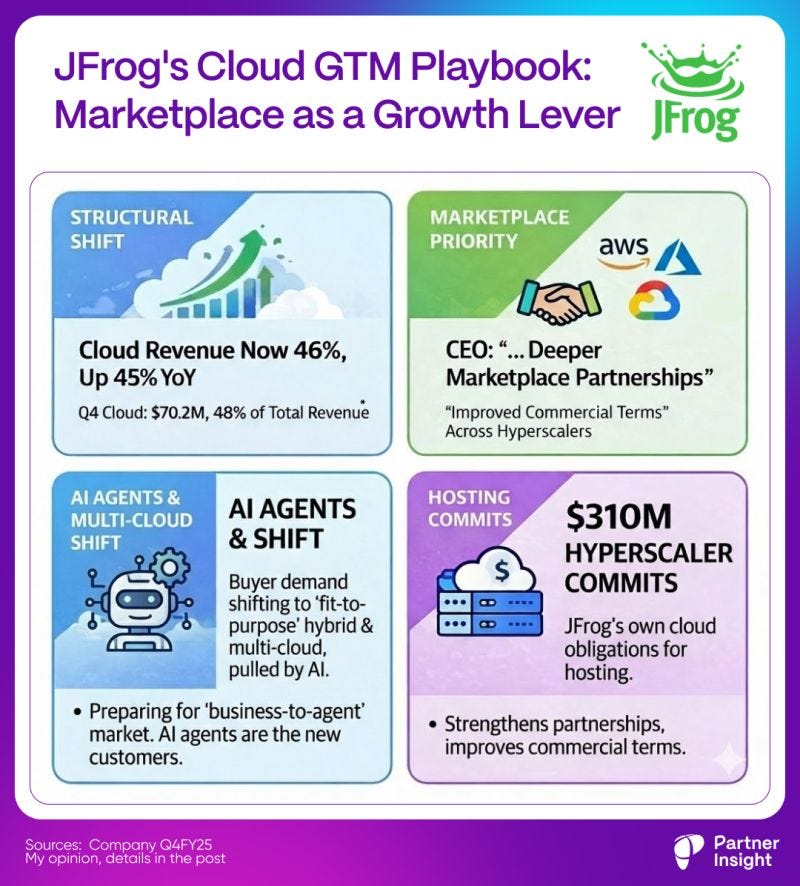
Here is what alliance leaders should study.
The shift to cloud is structural
Cloud now represents 46% of JFrog’s revenue, up from 39% a year ago.
Q4 cloud revenue: $70.2M = 48% of total
What stands out is how CEO Shlomi Ben Haim framed the drivers:
“We drove a higher volume of security deals in the cloud, strong new logo wins, and deeper marketplace partnerships.”
Marketplace partnerships named as one of the growth pillars.
JFrog further explained its Cloud GTM strategy:
“Specifically with public cloud providers, we believe that enhancing our partnership relationships and channel strategy may be a significant contributor to JFrog’s growth.”
This language signals board-level commitment.
JFrog is backing words with dollars
The company revealed $310M in commits “primarily for hosting services” - that’s JFrog’s own obligations to hyperscalers.
They will spend $56-73M per year on cloud infrastructure in 2026–2030. This is ~10% of their revenue locked into cloud spend.
CEO also noted they “strengthened partnerships with all major cloud providers, improved commercial terms, and established a stronger long-term growth margin strategy.”
When your own cloud spend crosses $300M in commitments, you earn negotiating power to improve commercial terms.
Buyer demand is shifting to multi-cloud (pulled by AI)
CEO noted: “Customer purchasing decisions changed in 2025, as CIOs were less focused on mega-cloud migration initiatives and instead increasingly emphasized building fit-to-purpose, hybrid, and multi-cloud architectures as they adopted new AI solutions.”
This signals that the era of “all-in on one cloud” may be giving way to multi-cloud by design.
Speaking of AI:
JFrog sees what the CEO calls a “tsunami of binaries” driven by coding agents. Millions of developers powered by millions of AI agents creating far more software artifacts. That consumption tailwind is real. JFrog is even preparing for a “business-to-agent” market where AI agents interact directly with its platform via MCP servers.
Three lessons for alliance leaders:
Cloud GTM is a board-level priority
JFrog describes its cloud partnerships as a growth strategy. That is the level of commitment that unlocks real resources and executive alignment.
Your own cloud spend is a partnership asset
Millions of commits give JFrog commercial leverage with hyperscalers. If you are spending tens of millions on cloud infrastructure, use that as a starting point for partnership negotiations.
Prepare for business-to-agent
If B2B shifts to B2A as CEO predicts, are your products and marketplace listings ready for agent-driven procurement?
P.S. If you found these insights valuable, please forward this newsletter to your alliance lead or cloud/GTM counterpart - it’s how this community shares what works.