
$3B in Under a Year: Salesforce Rewrites Marketplace Math
Salesforce’s $5B+ milestone proves cloud marketplaces have moved far beyond technical buyers. Plus: why Bain put partnerships at the center of AI strategy

Hi, it’s Roman Kirsanov from Partner Insight newsletter, where I deconstruct winning Cloud GTM strategies and the latest trends in cloud marketplaces.
In today’s edition:
Salesforce crossed $5B+ on AWS Marketplace - adding ~$3B in less than 12 months and proving marketplace is no longer just for technical buyers.
Bain says AI advantage now depends on ecosystems - learning speed, trust, and partner execution are becoming core to competitive strategy.
Google Cloud Next is here - and in 3 days we’re bringing senior marketplace and Cloud GTM leaders together to break down key announcements and what matters for 2026 execution.
Are you at Google Cloud Next? We’re gathering senior marketplace leaders Thursday morning with Dai Vu (MD, GCP Marketplace), John Jahnke (Tackle), and operators scaling on GCP. Last chance to request an invite.
Salesforce added $3B on AWS Marketplace in less than a year
Salesforce quietly became AWS Marketplace’s fastest-growing ISV - and just crossed $5B+. A line-of-business software company is now setting the new cloud marketplace benchmark.
Not cybersecurity. Not infra. Not dev tools.
It is CRM, sales, marketing, data and AI software.
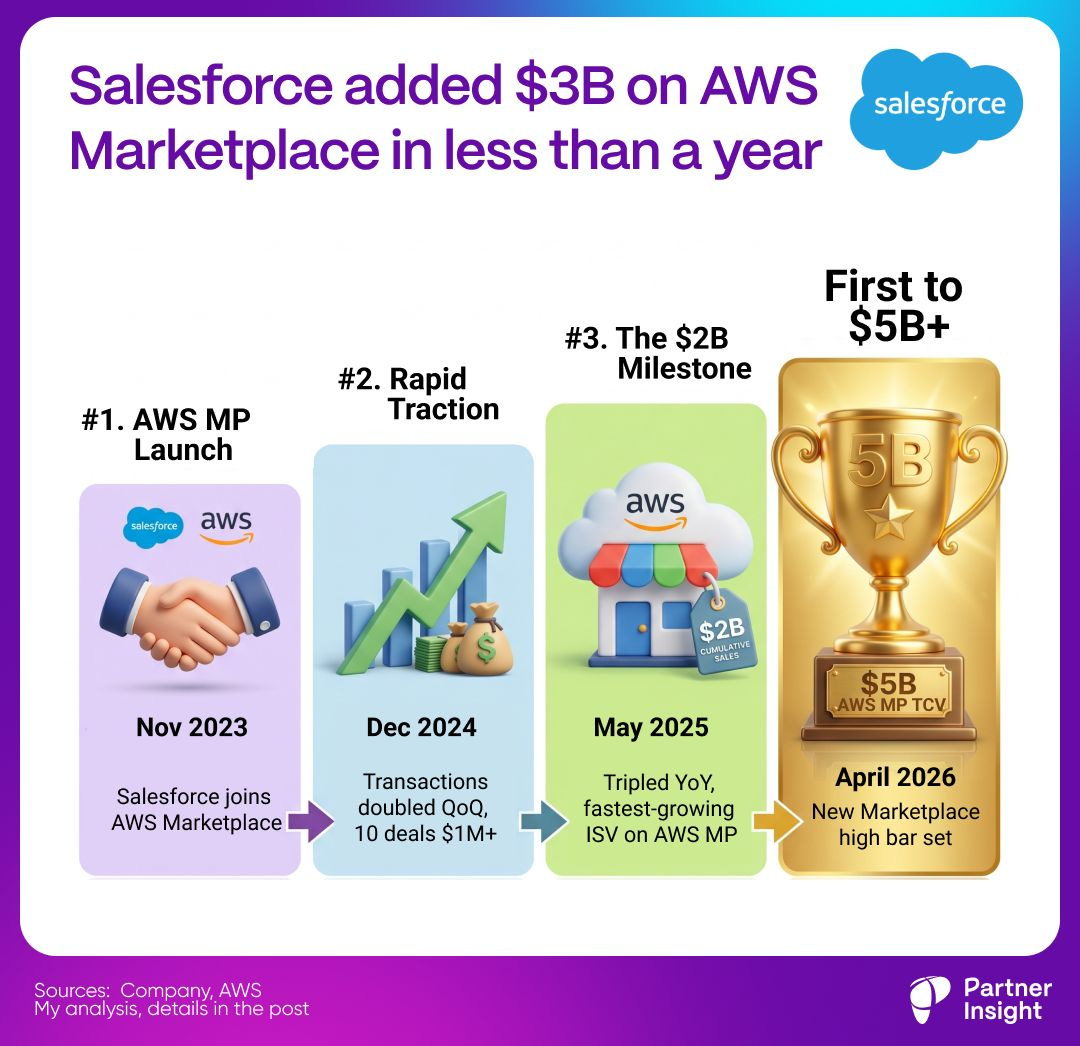
Salesforce resets the marketplace growth timeline
Nov 2023: Salesforce announces AWS Marketplace listing
Early 2024: First products go live
Dec 2024 (Q3 FY25): Marketplace transactions double QoQ, 10 deals of $1M+
May 2025 (Q1 FY26): Hit $2B total, tripling YoY, fastest-growing ISV on AWS
April 2026: Matt Yanchyshyn, VP of AWS Marketplace, confirms publicly: “Salesforce publicly says that they did over $5 billion with marketplace”
That is ~$3B added in less than 12 months.
To put it in perspective: the incremental $3B equals ~7% of Salesforce’s FY26 $41.5B revenue - through a channel they didn’t have 30 months ago.
The “$2B Marketplace Club” now extends beyond cybersecurity and data
Snowflake: $2B on AWS in 2025 alone (~45% of revenue)
Datadog: crossed $2B cumulative on AWS
Palo Alto Networks: $2B on Google Cloud MP (+$500M in 8 months)
CrowdStrike: $1.5B on AWS, $150M in Year 1 on GCP
Okta: ~$750M/year on AWS - next to join the $2B club
Now Salesforce is on top of this list.
But the bigger story is what Salesforce sells.
For years, many assumed cloud marketplaces were mostly for technical buyers. AWS itself is now saying otherwise.
Matt Yanchyshyn on the buyer shift in a recent interview:
“We’re seeing increasingly new categories of line-of-business buyers… business applications like ServiceNow, Workday, Adobe and Salesforce are attracting different types of customers to the marketplace.”
That’s the shift. Marketplace is moving higher up the stack - closer to business workflows, closer to AI agents, closer to how enterprises actually want to buy.
The timing is not coincidental
Salesforce is rebuilding for the agentic era under heavy investor pressure (stock down 30%+ YTD).
Marketplace helps on three fronts:
Lower cost of sales: marketplace motion can reduce friction, shorten procurement, and support operating leverage.
Larger enterprise deal flow: Marketplace pulls procurement, finance, cloud commitments, and co-sell into the same motion.
Agent monetization: Agentforce-style usage pricing maps natively to consumption-based Marketplace billing, which marketplaces handle far better than legacy enterprise contracts.
This is Salesforce rebuilding part of one of the world’s strongest direct sales machines around a new buying motion.
3 takeaways for alliance leaders
Treat marketplace as an operating motion. Salesforce is embedding Marketplace thinking into 10K+ AEs, partners, procurement, and AI GTM.
Reset the benchmark. $5B is the new ceiling - until someone breaks it.
Don’t assume your buyer “isn’t a marketplace buyer.” If LOB software sells this way, Marketplace is no longer a technical channel.
Is $5B the new $2B for cloud marketplace winners?
Last Chance: GCP Marketplace Strategic Breakfast at Next
Google Cloud Next is here, and this will be a big week for GCP Marketplace, AI, and ecosystem strategy.
By Thursday morning, the announcements will be out. We’re bringing alliance and Cloud GTM leaders together to compare notes on what actually matters for 2026 execution.
That’s what our GCP Marketplace Strategic Breakfast is built for.
3 days out. Last chance to request an invite.

Featured speakers
Dai Vu - Managing Director, Google Cloud Marketplace. GCP Marketplace has sustained triple-digit annual growth for years. Billions in GTV. $240B in customer cloud commits that increasingly flow through Marketplace to ISVs. Dai leads it globally.
Subhash Jawahrani - Principal BDM, Data Platform & AI, GCP Marketplace. Google Cloud view on where AI and data workloads are landing, and what that means for ISV co-sell and marketplace growth.
John Jahnke - CEO, Tackle.io. $20B+ processed across hyperscaler marketplaces. $1B/month today. John’s line: “Most ISVs who failed at cloud marketplace weren’t strategic.” Expect him to unpack what that looks like on GCP specifically.
David Mauer - VP of Channel & Alliances, LucidLink. Helped drive $100M+ in hyperscaler marketplace revenue at GitLab. A year into LucidLink, he has rebuilt the partner program for scale around one thesis: channel, marketplace, and technology alliances should work together, not against each other.
Rolf Heimes - Head of Ecosystems, Incorta. 20+ years scaling partner ecosystems. At Talend, he led partnerships to >50% of ACV. At Incorta, he is working on one of the core data problems blocking enterprise AI: getting live Oracle, SAP, and Salesforce data into Gemini and BigQuery in a form companies can actually use.
Roman Kirsanov - CEO, Partner Insight.
Beyond the speakers, expect a high-quality room: senior alliance, marketplace, and Cloud GTM leaders from ISVs, ecosystem partners, and GCP. The kind of group where the conversations before and after the sessions may be as useful as the sessions themselves.
The backdrop, in numbers
Google Cloud revenue grew 48% YoY last quarter
Annual run rate crossed $70B
Customer cloud commitments reached $240B
Revenue from partner-built AI solutions grew ~300% YoY
Commitments from Google’s top 15 software partners increased 16x+ YoY
The co-sell and marketplace math is shifting fast.
This breakfast is where we process it with the people shaping the strategy and the operators scaling on GCP.
📅 April 23, 7:30–9:30 am PT at Hakkasan Restaurant Las Vegas (near Mandalay Bay)
Spaces are limited and confirmation is required.
Brought to you in partnership with:
Tackle.io (Presenting Partner) - the leading Cloud GTM platform helping software companies generate revenue through the hyperscalers. From co-sell automation to marketplace analytics, Tackle gives ISVs all they need to turn marketplaces into a strategic revenue channel.
LucidLink - enables teams to access, collaborate on and stream large files in real time without moving data or breaking workflow.
Incorta - giving enterprise AI the live operational context, by connecting Oracle, SAP, and Salesforce data directly to BigQuery and Gemini.
Bain: Partnerships Just Became Core to Winning in AI
Bain put partnerships at the center of competitive strategy for the AI era.
Not just as a growth lever. As part of how companies will build, learn, and scale.
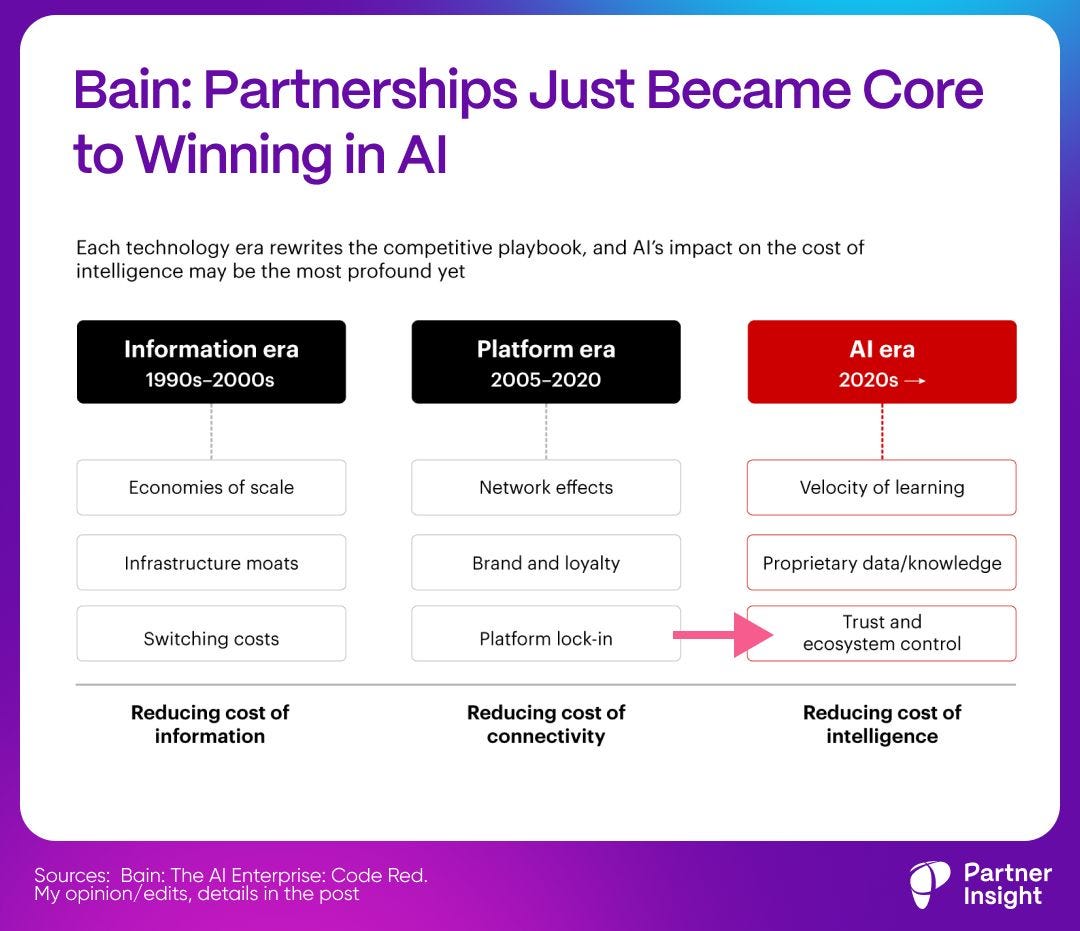
In a new report, Bain & Company maps three tech eras of competition:
Information era rewarded scale
Platform era rewarded network effects
AI era? It rewards three things: velocity of learning, proprietary data, and trust-based ecosystem control.
In AI, advantage will come from learning faster, embedding deeper into customer workflows, and earning enough trust to help orchestrate how work gets done.
“Ecosystem partnerships provide the scale and experience needed to compete”
Competing in AI now requires capabilities that are hard to build in isolation.
AI now spans data, governance, workflows, orchestration, evaluation, and deployment. That creates a much bigger role for ecosystems.
Four implications for alliance leaders:
1. Partnership value now includes learning speed, not just reach
The old question was often: which partners help us sell more?
Now another question matters just as much: which partners help us learn faster?
Who helps you improve implementation?
Who brings reusable patterns across customers?
Who helps your teams adapt as AI capabilities change every quarter?
The strongest partners in the AI era may be the ones that accelerate learning, not just distribution.
2. Trust becomes a real control point
As AI agents start orchestrating more decisions and workflows, the company that earns trust to run those agents gains the control point.
For ecosystem leaders, trust is built through governance, reliability, security and transparency.
This is especially important in enterprise software, where customers will not let AI touch critical processes without strong controls.
3. The services opportunity gets bigger and more operational
Bain also argues that AI has to be industrialized through an “agent factory” — a repeatable process for building, testing, deploying, and governing agents at scale.
That is a major opening for SIs, GSIs, cloud partners, and specialist ecosystem players.
The value will not sit only in access to models. It will sit in workflow design, orchestration, evaluation, governance, and repeatable delivery.
This is why every hyperscaler launched AI agent platforms in the past year.
4. Differentiation moves higher up the stack
Advantage will come from proprietary knowledge, personalized workflows, and strong user communities.
For alliance leaders, that is a signal when choosing where to invest.
The best partnerships will not just add another integration.
They will deepen workflow fit, improve outcomes, and make the ecosystem harder to replace.
3 Lessons:
Treat ecosystem strategy as a company-level competitive asset
Prioritize partners with high learning speed
Build trust and repeatable delivery into your AI strategy early
Where is your org on the AI partnership curve?
P.S. Thanks for reading! If this newsletter sparked an idea, please forward it to your alliance lead or cloud counterpart — it’s how this community shares what works.