
AWS Made Marketplace Easier with AI. Then Cut Pro Services Fees to 0.5%
AWS is putting AI deep into the seller workflow. Plus: OpenAI spent $5.73B selling AI — 44% of revenue — then invested $150M in partners. And 5 takeaways from our NYC breakfast.

Hi, it’s Roman Kirsanov from Partner Insight newsletter, where I deconstruct winning Cloud GTM strategies and the latest trends in marketplaces and partnerships.
This week, the economics of selling software through the clouds shifted again — fees dropped, AI moved deeper into the co-sell pipeline, and the AI labs quietly admitted they can’t scale without partners.
In today’s edition:
AWS cut services Marketplace fees from 2.5% to 0.5% and put AI to work across every marketplace and co-sell stage — now that entry is easier, what sets partners apart?
OpenAI spent $5.73B selling AI last year (44% of revenue), then committed $150M to partners. Why distribution is still the moat.
5 takeaways from our NYC breakfast with 100 alliance leaders — including how ServiceNow scales from $1B toward $2B on AWS Marketplace, and why co-sell wins on simplicity.
Before we dive in: if this newsletter helps to sharpen your thinking on cloud marketplaces, forward it to one alliance or GTM leader on your team who should be reading it.
AWS Made Marketplace Easier to Enter. What Sets Partners Apart Now?
AWS cut Marketplace fees for professional services from 2.5% to 0.5% last week. It also made AWS Marketplace easier to enter and faster to transact through. Will it be harder to stand out?
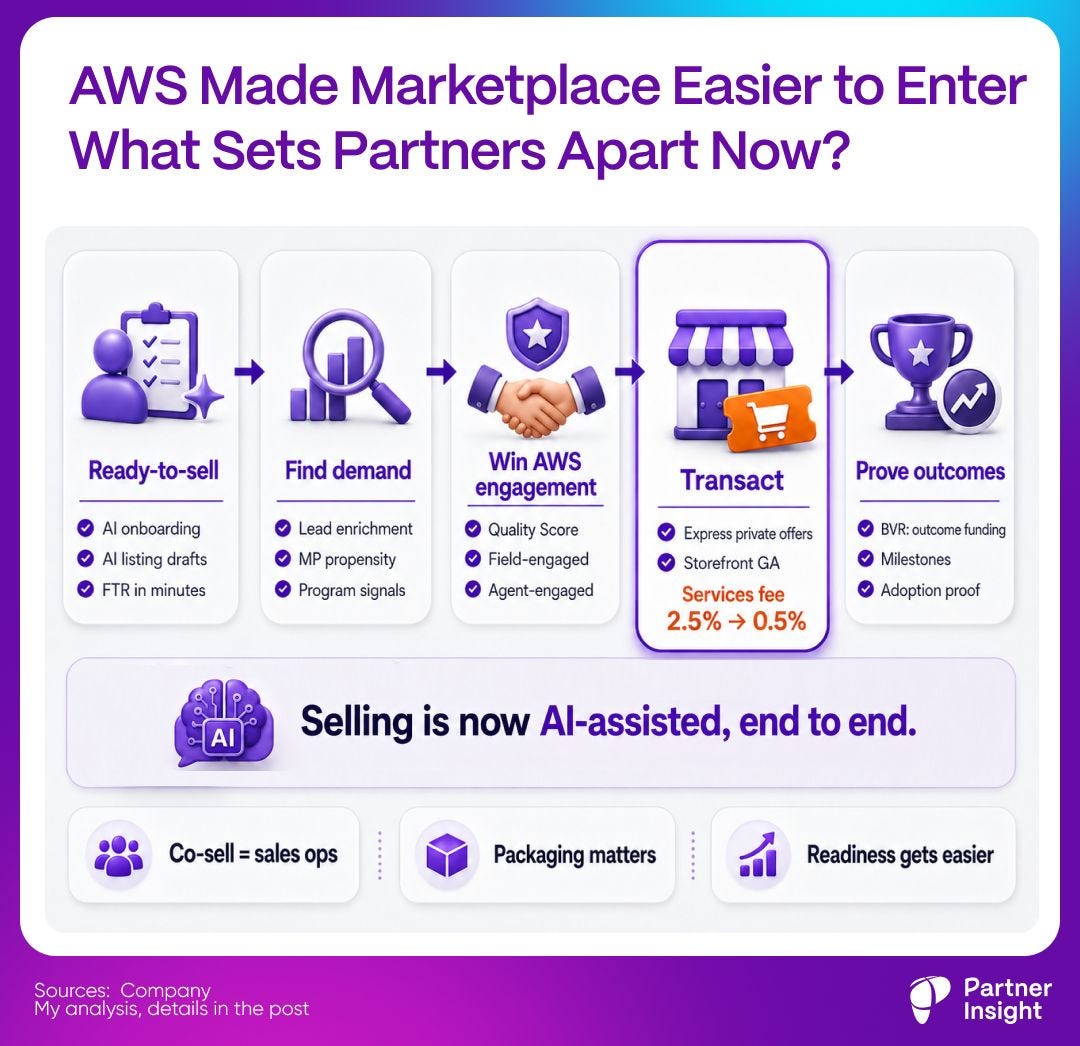
At AWS Summit NYC, AI agents were the headline. But for partners, Amazon Web Services (AWS) also put them to work inside the Marketplace in a string of launches that compress the partner GTM into a faster, AI-run pipeline.
Here’s what’s new, by stage:
Onboard (get to “ready-to-sell”)
Partner Central can now prefill a company profile from its website and guide seller-account, tax and compliance setup.
It can turn a website and product docs into a publish-ready Marketplace listing: descriptions, features, use cases, keywords and categories.
Foundational Technical Review now accepts existing SOC 2 Type II audits or AWS Well-Architected Framework reviews, returning approval or targeted feedback in minutes instead of days.
Find demand (fill the pipeline)
All ACE-eligible partners can now upload their own leads and receive AWS signals: propensity to buy through Marketplace, solution-category fit, and eligibility for Partner Greenfield Program, Pioneer Credits and Partner-Led Sales Motion.
Win AWS engagement
Every ACE opportunity now receives a Quality Score - visible to AWS sellers - and is routed in real time into one of 3 motions:
Field-engaged: AWS sales team collaborates directly
Agent-engaged: AWS guidance strengthens the submission toward field engagement
Partner-led: partner owns the deal
This makes co-sell hygiene a sales discipline. Customer outcome, AWS-service mapping, deal stage, and next step all affect the score.
Transact and distribute
AWS sellers can now invite customers into Express Private Offers for products with preconfigured pricing rules, shortening partner path to revenue.
Storefront is now generally available: a no-code, branded Marketplace catalog on a partner’s own domain (especially relevant for SIs, channel). Inbound leads feed directly into the AWS co-sell pipeline, billing stays on AWS invoices.
AWS also cut the fee for professional services private offers from 2.5% to 0.5%.
Prove outcomes
The new Business Value Realization (BVR) motion gives qualified services partners funding tied to customer outcomes, plus adoption playbooks, milestone tracking and post-sales support.
The finish line moves from implementations to measurable adoption.
3 insights for alliance leaders:
Sales operations are now part of co-sell. Just submitting to ACE is no longer best practice. Quality Score rewards clean data, clear outcomes and correct AWS-service mapping
Treat packaging and pricing as co-sell assets. Pre-approved offers, discount guardrails and terms help AWS sellers create a buying path faster
Marketplace readiness is now easier. As onboarding and listing get automated, differentiation moves to proven use cases, outcome evidence and repeatable delivery
As AI is now Marketplace on the seller side, how are you leveraging it?
OpenAI Spent $5.73B Selling AI and Still Needs Partners to Scale
OpenAI reportedly spent $5.73B on sales and marketing last year - 44% of revenue.
Why OpenAI is spending Salesforce-like money to sell AI and still invest $150M in partners?
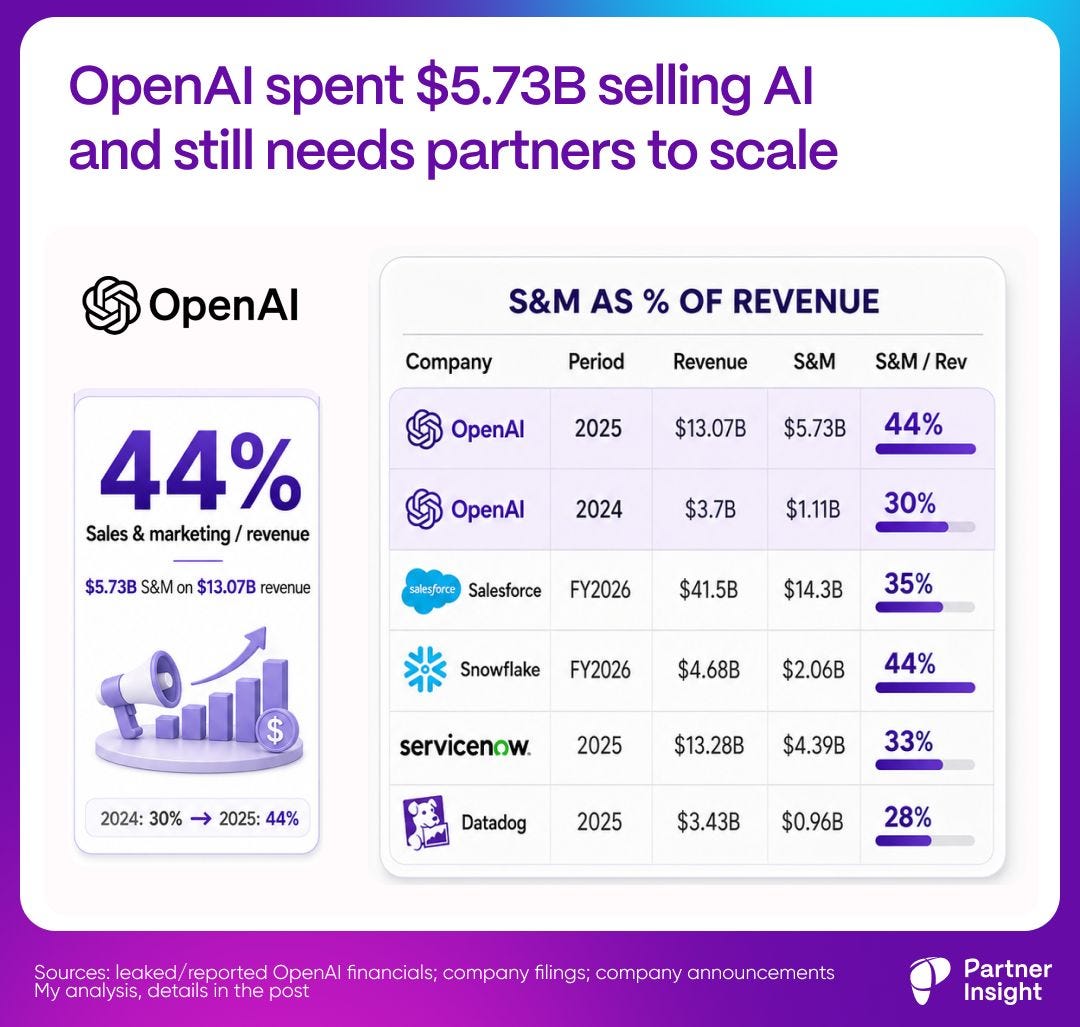
Leaked OpenAI financials show what the AI business is becoming underneath the product excitement
OpenAI’s revenue grew from $3.7B to $13.07B in a year. But sales and marketing grew even faster: from $1.11B to $5.73B. That moved selling costs from 30% of revenue to 44%.
For context:
Salesforce spent 35% of revenue on sales and marketing in FY2026.
Snowflake spent 44%
Datadog was 28%.
ServiceNow ~ 33%.
So OpenAI’s number is not absurd for high-growth enterprise software.
Then watch what every AI lab did next
In launching the OpenAI Partner Network earlier this month, OpenAI says the enterprise bottleneck is no longer model capability, but identifying use cases, redesigning workflows, integrating with systems, and driving adoption.
It is putting $150M into the partner ecosystem and aiming for 300,000 certified consultants by the end of 2026.
Anthropic is doing the same thing. Its Claude Partner Network commits $100M for 2026, including training, technical support, sales enablement, market development, co-marketing, and partner certifications.
Anthropic says partners help customers navigate deployment, compliance, and change management.
Cohere and Mistral built formal programs around consultancies, cloud providers, and systems integrators.
Hiring confirms the GTM direction
OpenAI and Anthropic are reportedly hiring heavily from Salesforce.
One report says Anthropic hired more than 45 former Salesforce employees since early 2026, while OpenAI hired nearly 40, concentrated in sales, marketing, GTM, and revenue roles.
That is not “AI replacing sales”; that is AI labs importing enterprise-sales DNA
So is selling AI different from selling enterprise software?
The benchmarks say no.
The foundation model was supposed to collapse the enterprise software stack.
Instead, the go-to-market stack is re-forming around the model.
AI has pull, but pull is not the same as enterprise adoption.
Customers do not just buy intelligence. They buy a changed operating model, with the risk carried by someone they trust.
Three lessons for alliance leaders:
Distribution is still the moat, just like it was - the labs are adopting familiar partner GTM playbooks
Own the last mile. Workflow redesign, compliance, and change management are exactly where labs admit they need help
Move early. With 300,000 certification slots and co-sell motions opening at once, the first movers set the terms.
Is AI distribution following the SaaS playbook, or writing a new one? What’s your take?
5 Takeaways From Our AWS Marketplace Strategic Breakfast at NYC Summit
100 alliance and cloud GTM leaders joined us last Wednesday morning in New York to discuss one major shift:
AWS Marketplace is becoming commercial infrastructure for AI and enterprise software GTM, not just a procurement path.

Five themes stood out:
1. Agentic AI changes discovery and distribution
Michael Levy (AWS Marketplace) framed the shift: AI agents will change how software is discovered, accessed, and consumed.
For ISVs, your data, workflow, customer context, and differentiated IP still matter, but the access layer changes. Software needs to be usable by humans and increasingly by agents - through APIs, MCP servers, structured product context, and agent-ready packaging.
Marketplace listings, product metadata, integrations, and commercial models now need to serve human buyers, AWS field teams, and agents.
2. Pricing is moving closer to outcomes
The agentic model puts pressure on traditional seat-based pricing. If an agent is completing work, the commercial question becomes: what is the unit of value? A customer service ticket resolved. A security incident remediated.
The emerging pattern is hybrid: predictable base revenue from human seats, then layer consumption pricing on agent-driven outcomes on top.
3. Marketplace scale is an operating-model problem
The best sellers do not treat Amazon Web Services (AWS) Marketplace as a listing or a late-stage procurement path. They build it into the operating model: sales workflow, co-sell, RevOps, finance, legal, partner operations, and customer expansion.
This came up repeatedly. If the marketplace creates extra work for the field, adoption slows. If it fits into how sellers already work, it becomes part of the standard GTM motion.
This is where Clazar is helping companies operationalize marketplaces with automations to scale without creating manual overhead.
4. Global marketplace growth depends on local buying experience
Arif Razvi’s insight: global marketplace growth isn’t only a sales question. Currency, entities, tax, and buyer trust all matter.
Selling in local currency signals you understand the market — and it shows up in larger deals and ~400% YoY growth in non-USD private offers in Europe.
5. Co-sell wins on simplicity and specificity
Whitney Bragg-Sabins shared what comes after ServiceNow crossed $1B on AWS Marketplace — and how they’re scaling toward $2B.
The lessons:
Co-sell messaging has to be simple enough for the field to execute
“Better together” needs to become specific customer outcomes
SI partners should be treated as part of the distribution motion, not only implementation capacity
Vertical industry use cases matter because they give sellers, partners, and customers a concrete reason to engage
Thank you to our partners - Clazar, ServiceNow and LucidLink for making this possible.
Thank you to everyone who joined. The quality of the insight reflected the quality of the room.
We’ll be back.
Turn Marketplace Into a Real Revenue Driver: 5-week course for Alliance & Cloud GTM Leaders
If Marketplace only shows up at the end of the deal, it is not a GTM motion. It is firefighting.

And that is where many Cloud GTM teams get stuck.
A rep pulls alliances in late
A private offer becomes urgent
The cloud rep gets a vague ask
Procurement shows up in the final week
The “win” depends on one person who knows the maze.
It may save the deal.
But it does not compound.
That is the pattern I keep seeing across SaaS and AI companies trying to scale on AWS, Microsoft, and Google Cloud.
They are “doing marketplace.”
But they are not building a repeatable Cloud GTM growth system.
The teams pulling ahead do a few things differently:
they identify marketplace as a buying path earlier, not at the end
they train sales to use it, instead of treating it as an alliances side project
they make co-sell structured: real context, clear asks, better timing
they connect channel, marketplace, and cloud field into one motion
they build internal support across finance, ops, product, and leadership
That is what turns marketplace from extra work into leverage.
And it matters more now than it did even a year ago.
Cloud commitments across Amazon Web Services (AWS), Microsoft, and Google Cloud have crossed $1.2T.
Customers are more open to buying software digitally.
But they are also more selective.
Co-sell is getting more competitive.
And AI is reshaping how software gets discovered, packaged, and sold through hyperscaler ecosystems.
So the gap is widening: between teams that are listed and teams that turned marketplace into a repeatable revenue driver.
David Mauer — who helped drive $100M+ in marketplace revenue at GitLab and is now rebuilding the motion at LucidLink — put it well in our recent webinar:
“You never want a customer to tell you how they want to buy and have to say no.”
Over the past 3 years, 300+ alliance and Cloud GTM leaders have gone through our Cloud GTM Leader course to build that capability.
Some launched from zero marketplace motion to $200K revenue + $7M pipeline in 8 weeks.
Others closed their first $1M+ marketplace deal and turned it into a repeatable motion.
Some scaled marketplace revenue 4X YoY from an already high base.
That is not because they found one trick.
It is because they built the growth system.
Our next cohort starts in September
If you want to turn marketplace into a real growth driver — not just push isolated deals through it — this is what we work on for 5 weeks.
P.S. Thanks for reading! If this issue sparked an idea, please forward it to your alliance lead or cloud counterpart — it’s how this community shares what works.