
Channel Hit 31% of B2B Software Revenue. GTM Is Tilting to Partners
Plus: C-suite pitch that wins marketplace buy-in. What Cisco’s $2B to $9B hyperscaler surge reveals about AI partnerships.

Hi, it’s Roman Kirsanov from Partner Insight newsletter, where I deconstruct winning Cloud GTM strategies and the latest trends in cloud marketplaces.
In today’s edition:
The marketplace pitch that wins CEOs may fail with CFOs or CROs — learn exact language that resonates with each C-suite role.
Channel jumped from 21% to 31% of B2B software revenue in one year — ICONIQ’s 2026 GTM data shows partners are now the second-largest revenue driver.
Cisco’s hyperscaler AI orders surged from $2B to $9B in one year, revealing how AI demand is pushing partnerships deeper into co-design and architecture.
Cloud GTM Leader course returns June 2: what separates teams “doing marketplace” from teams building a repeatable revenue system
Before we dive in:
Cloud commits just crossed $1.2T+. AWS alone is at $364B, up $120B in a single quarter, accelerating marketplace momentum.
On May 27, we’re hosting a tactical online workshop with AWS, LangChain, Grafana Labs and Clazar - we'll break down 5 Marketplace playbooks AI and SaaS teams are using to scale revenue.
CEO to CFO: How to Win Marketplace Buy-In
CEO, CRO, CFO and CPO do not buy into marketplace strategy for the same reason. Many alliance teams learn this the hard way.
Cloud marketplace pitches often fail internally when companies repeat the same message to every executive.
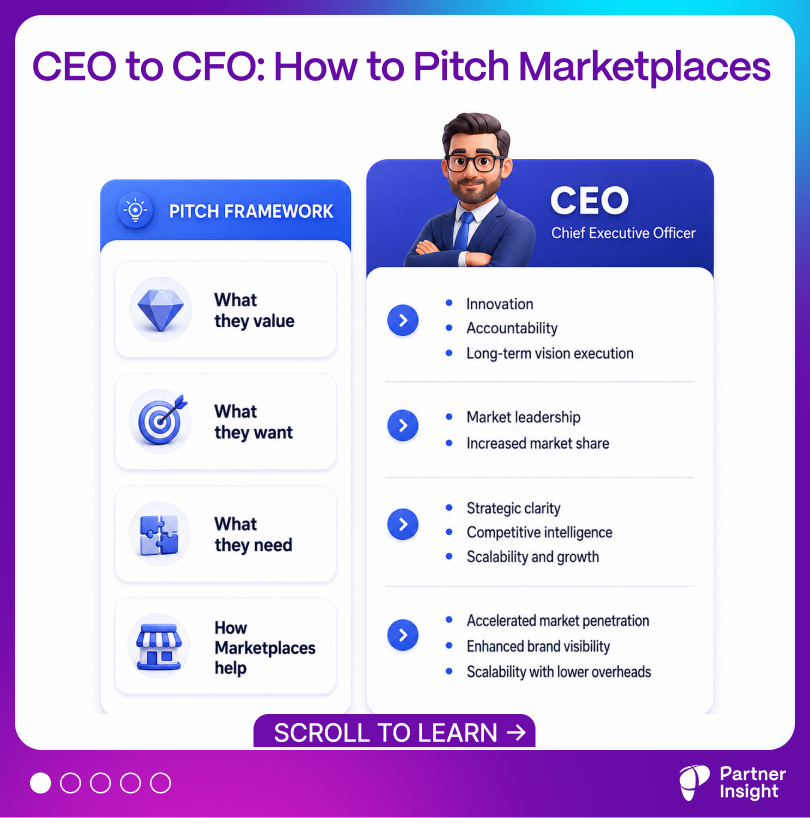
That was one clear takeaway from our workshop with leaders from AWS, Qlik and Clazar, who have driven billions in marketplace traction.
CEO: Growth and Market Positioning
CEOs need to see why marketplaces can be a major route to enterprise buyers, unlock cloud budgets and joint GTM with hyperscalers.
CEO pitch must answer:
Will this grow total revenue?
Will this improve strategic distribution?
Will this make us more relevant to cloud partners?
But first, correct the misconceptions:
Many leaders still assume marketplace works like Amazon.com: list the product, buyers discover it, revenue follows. In reality, the largest marketplace deals are still enterprise-sales-led and private-offer-driven.
Another CEO concern is channel shift. Our data proves that the marketplace done right grows the pie, not just moves it.
CRO: Sales acceleration
For CROs, marketplace matters only if it helps sellers win. Introducing it as a new tool/workflow is the fastest way to lose them.
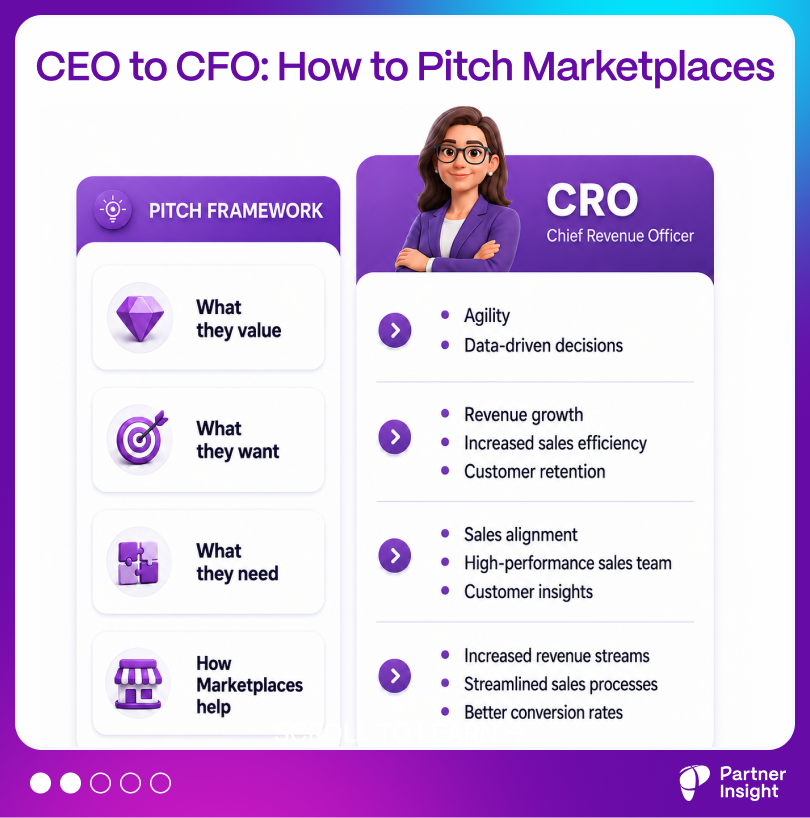
So the CRO pitch: bigger deals, faster closes, higher seller productivity and co-sell leverage.
When the CRO is on board, co-sell and growth accelerate much faster.
Michael Levy from AWS highlighted that sales alignment is the single most important factor in ISV marketplace success.
Comp neutral used to be the goal. ISVs now run comp positive SPIFs to kickstart the motion. Once reps see bigger deals and faster closes, the behavior sustains.
CFO: Dollar impact, not partnership stories
CFOs do not fund “strategic relationships.” They need measurable impact.
Drew Zurek recommends using Marketplace Impact Analysis: compare marketplace vs. direct deals on velocity, win rate, deal size and realized revenue impact.
In usage-based SaaS, closing a $1M deal on January 15 vs. March 31 can mean $200K more revenue.
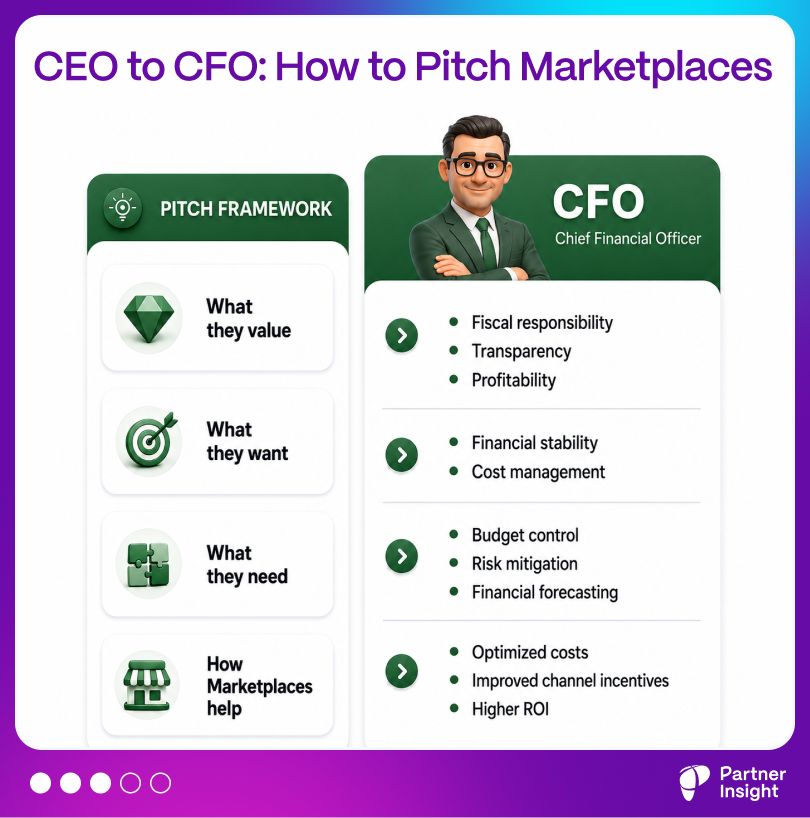
Trunal Bhanse from Clazar added a powerful reframe: position marketplace as helping buyers retire committed cloud spend before it expires.
That shifts the conversation from “why pay a listing fee?” to “we help customers use budget they already allocated.”
CPO: Product architecture as distribution
Product leaders should see marketplaces as part of discovery, packaging and buying experience.
AWS is pushing this direction with AI-assisted discovery, Express Private Offers, multi-product solutions, agents, etc.
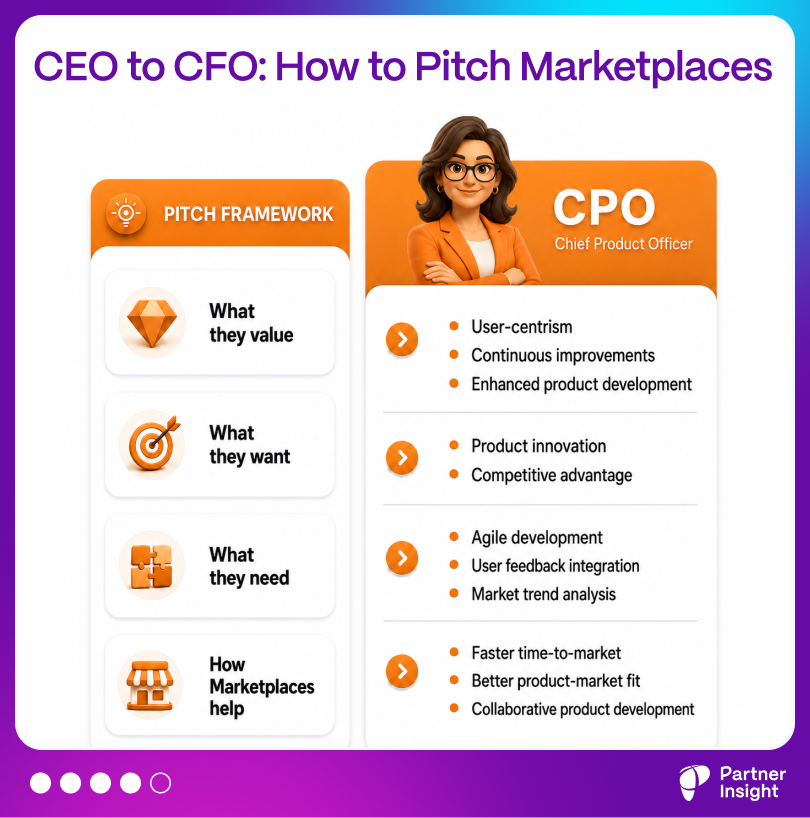
CPO questions become:
Is our product easy to discover?
Is our packaging marketplace-ready?
Can we support free trials, PLG, and bundled partner solutions?
For alliance leaders:
To win buy-in, translate marketplace into C-suite language:
CEO: show market leverage
CRO: higher sales velocity
CFO: financial impact
CPO: product distribution
We’ll go deeper into the AWS Marketplace playbooks on May 27:
Meet the AWS and Grafana Leaders Joining Our Marketplace Workshop on May 27
Cloud commits just crossed $1.2T+. AWS alone is at $364B, up $120B in a single quarter.
That creates one of the largest pools of pre-committed enterprise technology budget ever created — and a growing share can be routed to software purchases through cloud marketplaces.
The opportunity is obvious. The playbook is not.
Many AI and SaaS teams know cloud marketplaces should become key revenue drivers. Fewer know how AWS evaluates AI partners, how co-sell actually works with the field, or what top operators are doing differently to scale.
That’s exactly what our May 27 online workshop will break down.
This week, meet two of the leaders joining the panel.
Nate Stecz — Sr. Partner Development Manager — Artificial Intelligence, AWS
Nate covers AI model providers delivering solutions through both AWS Marketplace and Amazon Bedrock — the cornerstone of every GenAI solution being built today, and the layer most AI platforms are fitting into.

His day job: helping AI partners build strategy across these channels and prioritize different GTM motions to reach customers faster.
Why Nate’s perspective is unique:
Nate spent 8+ years on AWS Marketplace before moving to the AI partner development role. From technical account management to business development to partner development, he’s been part of every major stage of AWS Marketplace evolution and partner adoption.
He’s managed partner portfolios generating $100M+ in cloud software sales. In his BDM role, sellers in his portfolio grew 5X in 12 months.
He is a major contributor to the AWS Marketplace SaaS playbook on product-led growth, and authored a PLG blog — “Guide to executing a SaaS PLG strategy in AWS Marketplace” — and previously led the PLG adoption strategy for AWS Marketplace across the Americas.
That combination — marketplace and partner strategy, PLG expertise, and a direct line into how AWS thinks about AI partners — is exactly why his insight on this panel is unique.
Rob Weidner — Director, Global Cloud Alliances, Grafana Labs
$100M+ via AWS Marketplace in just 6 months. Multiple 8-figure deals with AWS sellers. That’s the Cloud GTM motion at Grafana Labs — AWS Top 10 DevOps Marketplace ISV.
Rob is a hands-on operator who runs Grafana’s go-to-market across marketplaces — a company with $400M+ ARR and 7,000+ customers. Many AI leaders — including Anthropic and Lovable — run their observability on Grafana.
And in January, Grafana and AWS signed a 5-year Strategic Collaboration Agreement to deepen marketplace and AI alignment.

Why Rob’s perspective is unique:
He’s one of the few operators who has repeatedly built and scaled Cloud GTM — and hit the top partner tier across all three hyperscalers.
On AWS, where the volume is: Grafana is a Top 10 DevOps Marketplace ISV, driving multiple 8-figure transactions through AWS co-sell.
They’ve also reached the highest tier on GCP (320% marketplace growth in 2024) and Azure (150%+ average YoY growth over the last 3 years) — proving the expertise translates across hyperscalers.
That combination — deep AWS marketplace execution, scaling across hyperscalers, and insights into AI customer base — is what makes his playbook a must-learn for any team scaling marketplace revenue in 2026.
Join Us on May 27
Nate and Rob will be joined by:
Karan Singh, Partnerships Lead at LangChain
Trunal Bhanse, CEO at Clazar
Roman Kirsanov, CEO at Partner Insight
In 60 minutes, we’ll break down:
Latest market data: why cloud commits crossed $1T+ and what it means for AI GTM and marketplace acceleration
Operator tactics: how top AI-native teams scale revenue on AWS Marketplace
5 marketplace playbooks: Better Together framing for AI, co-sell outreach, seller enablement, and more
Scaling tactics: how smart operations and workflows remove friction and drive marketplace revenue
Join us May 27, 9–10 AM PT
Thanks to our partner for supporting this workshop:

Clazar is the leading Cloud Sales Acceleration Platform for Go-to-Market teams to scale revenue on AWS, Azure, and Google Cloud marketplaces. From listing to co-selling to revenue reconciliation and recognition, it helps companies streamline and automate their entire cloud sales journey from a single, unified platform—with zero operational overhead.
Top AI companies like Cursor, Perplexity, Replit, Zapier, and n8n trust Clazar to power their success on cloud marketplaces. To learn more, please visit www.clazar.io
Channel Drives 31% of SaaS Revenue. GTM Is Tilting to Partners
In one year, channel and partnerships went from 21% to 31% of B2B software revenue.
Direct sales dropped from 73% to 57%. The GTM mix is shifting fast.
ICONIQ, one of the largest VC/PE funds, surveyed 150+ B2B software CROs, CEOs and sales leaders for their 2026 State of GTM. The channel signal is one of the loudest findings in the report.
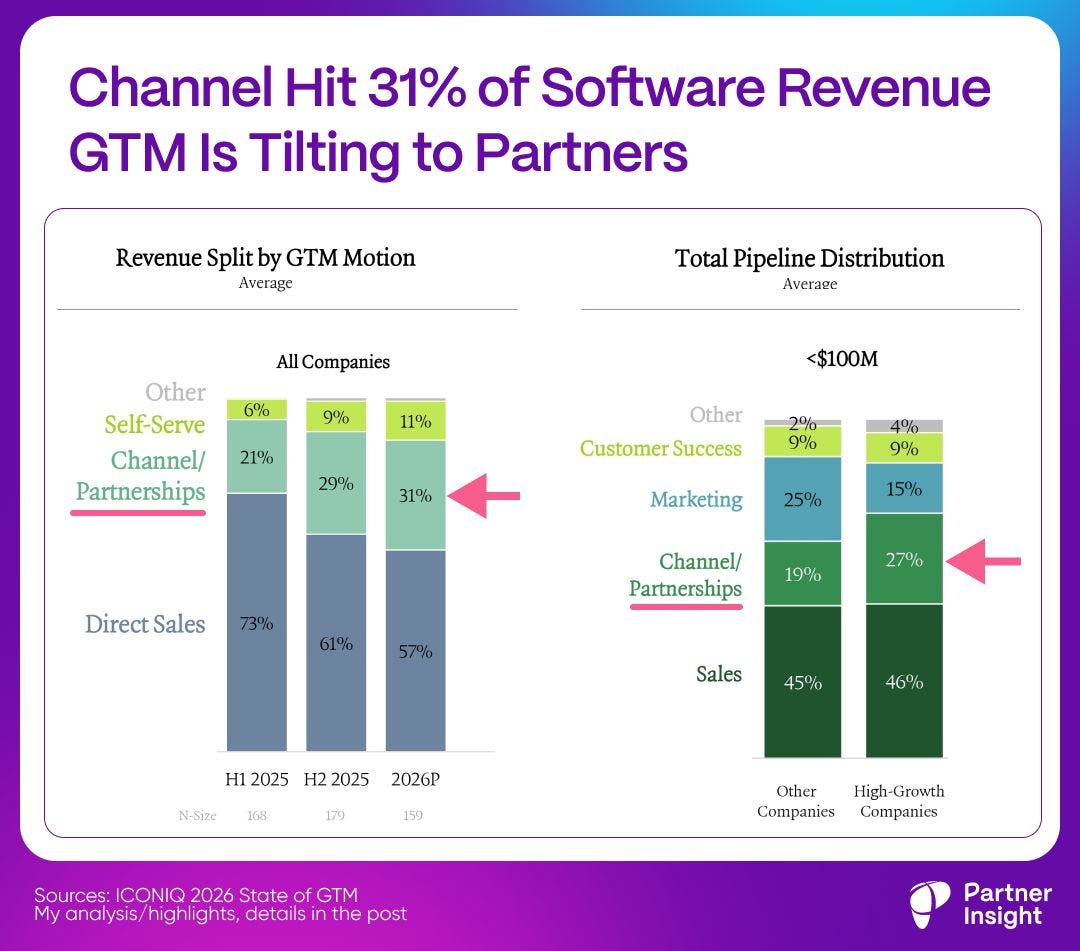
Channel is now second largest revenue driver
2026 revenue split across all companies:
Direct Sales: 57% (was 73%)
Channel/Partnerships: 31% (was 21%)
Self-serve: 11%
10-point swing to partners in 12 months
Partners are now a real lever well before $100M ARR
For sub-$100M high-growth companies, channel drives 27% of total pipeline.
For non-high-growth peers at the same scale, it’s 19%.
Fastest-growing smaller companies aren’t waiting for enterprise scale to build partner motions.
Full pipeline mix for sub-$100M high-growth:
Sales: 46%
Channel/Partnerships: 27%
Marketing: 15%
CS: 9%
Partners are ~2x marketing as a pipeline source in this cohort.
Partners outpace marketing on new logos too
New logo pipeline for <$100M high-growth:
Sales: 62%
Channel/Partnerships: 19%
Marketing: 12%
Sales still drives most new logo origination, but partners are now the #2 source.
Channel beats marketing on win rates by 12 points
Win rates by opportunity source in 2026:
Sales: 43%
Channel/Partner: 39%
Marketing: 27%
CS: 52% (a winner or an outlier?)
Channel-sourced deals convert better than marketing-sourced ones.
PAYG and Short contracts are gaining ground
Sales cycles compressed from 25 to 19 weeks - great news.
But contracts moved the other way:
Under 1-year contracts: 2% - 13% in one year
3+ year contracts: 40% - 29%
Free Trial/POC conversion also jumped from 36% to 50% - buyers want to try more, commit less, and keep options open as AI evolves.
AI is producing leaner GTM teams — and shifting their KPIs to retention
At $100M–$250M ARR, high AI adopters run 125 GTM FTEs vs 165 for low adopters.
At $250M–$500M: 275 vs 350.
At the same time, 40% of companies now measure customer retention as AI ROI, up from 26% a year ago.
Leaner direct teams mean partners cover more of the field. And retention — through implementation, renewal, and expansion — is exactly where strong partner ecosystems pull ahead.
Shorter contracts, PAYG, free trials, leaner sales teams, and a channel motion that beats marketing on win rate — are all structural tailwinds for cloud marketplaces.
Takeaways for alliance leaders:
Build partner pipeline well before $100M ARR
Treat free trials and POCs as deal-accelerators, pair them with marketplace GTM
Track retention KPIs in addition to net new — that’s where AI ROI is now being measured
Source: Research
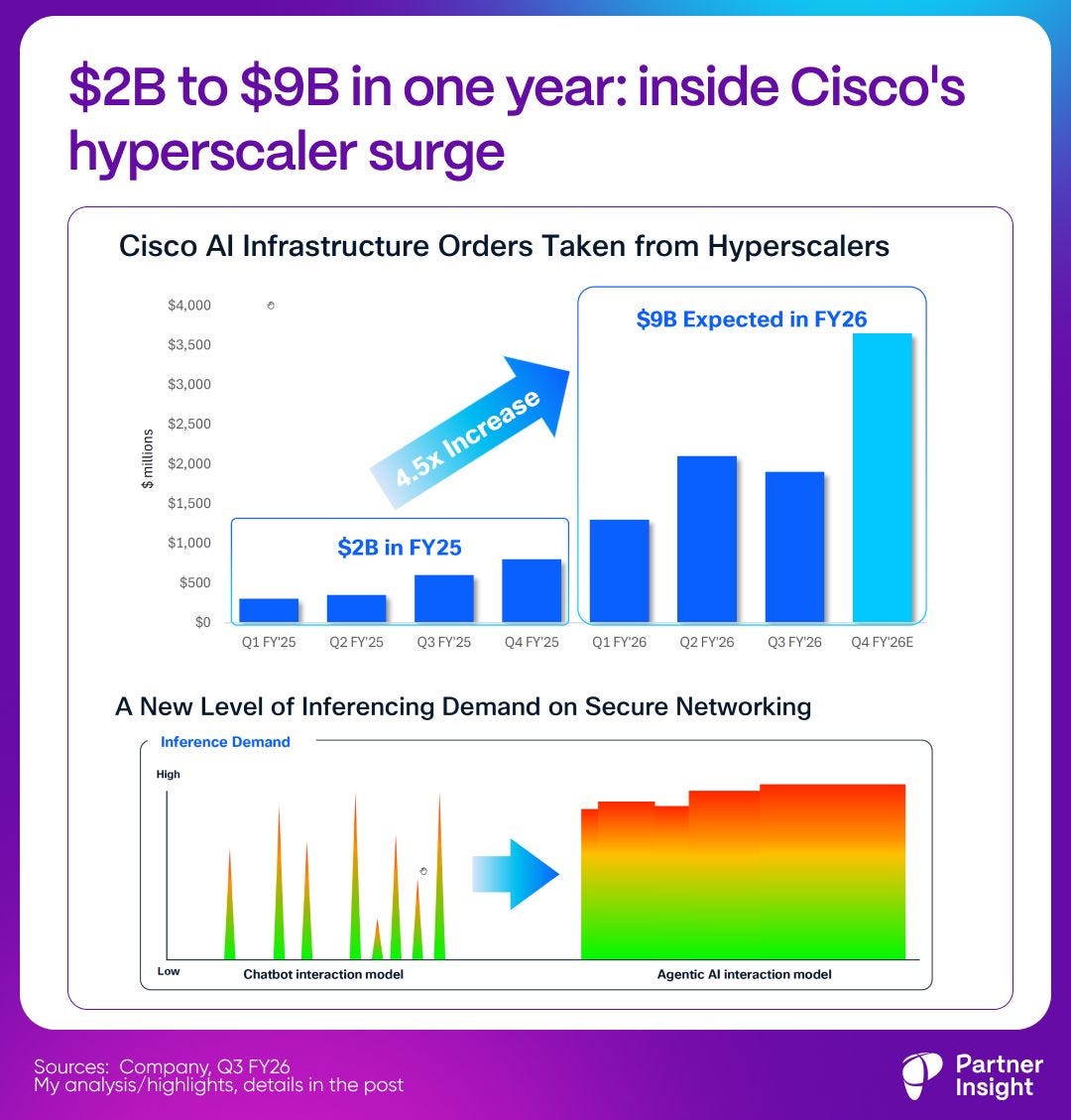
$2B to $9B in one year: inside Cisco's hyperscaler surge
Last week Cisco added ~$70B in market cap in a single day — its biggest move in ~20 years. The AI infrastructure numbers grabbed the headlines. What’s underneath them is an important signal for the cloud ecosystem.
Three takeaways from Cisco’s Q3 FY26 print and Chuck Robbins’ CNBC interview:
Extreme co-design is becoming the default
Cisco landed 5 new hyperscaler design wins in Q3 — 2 in optics, 3 in systems — including the first wins for its Silicon One P200 chip in scale-across workloads.
Robbins, Cisco’s CEO, said hyperscalers want “silicon diversity,” meaning they want multiple trusted options at very deep technical layers.
The lesson is not only about hardware.
It shows where strategic partnerships are heading when AI demand gets large enough: customers and suppliers work together much earlier, much deeper, and much closer to the architecture.
The same dynamic is starting to show up in software.
Joint engineering, co-built reference architectures, and deep technical integration are becoming the price of entry for any serious AI partnership across the stack.
The AI buildout is spreading from hyperscalers into the enterprise
Cisco raised FY26 hyperscaler AI infrastructure orders to $9B, up from $5B at the start of the year. The bigger signal for ISVs is what’s happening downstream:
Enterprise data center switching orders up >40% YoY
Nexus switches tagged for AI deployments up ~50% sequentially
Cisco reported ~$900M of AI orders YTD from neocloud, sovereign, and enterprise customers, separate from hyperscalers
Robbins called it the “AI acceleration we’re starting to see in the enterprise.” This is no longer a 2027 story.
AI demand is starting to pull forward modernization across networking, security, observability, data, and cloud operating models.
A single security narrative reshaped customer roadmaps in 90 days
Robbins said Anthropic’s Claude Mythos was not even on the radar 90 days ago. Now it’s “the number one topic that we talk about with almost every customer on the planet.”
The effect is concrete: refresh and security projects that customers had been delaying are now getting rapidly pulled forward.
Meanwhile, Splunk shows continued shift from on-prem to cloud subscriptions, with 1,000+ new logos expected in FY26.
Three lessons for alliance leaders:
Co-design is becoming the norm. The deepest AI partnerships now begin in engineering, often before commercial terms are on the table
Enterprise AI demand is showing up in pipelines already
Customer priorities can flip in just 90 days. Alliance teams need to be ready to change just as fast.
Cisco showed a broader hyperscaler ecosystem story: when AI demand accelerates, the impact spreads across the stack.
Turn Marketplace Into a Real Revenue Driver: 5-week course for Alliance & Cloud GTM Leaders
If Marketplace only shows up at the end of the deal, it is not a GTM motion. It is firefighting.

And that is where many Cloud GTM teams get stuck.
A rep pulls alliances in late
A private offer becomes urgent
The cloud rep gets a vague ask
Procurement shows up in the final week
The “win” depends on one person who knows the maze.
It may save the deal.
But it does not compound.
That is the pattern I keep seeing across SaaS and AI companies trying to scale on AWS, Microsoft, and Google Cloud.
They are “doing marketplace.”
But they are not building a repeatable Cloud GTM growth system.
The teams pulling ahead do a few things differently:
they identify marketplace as a buying path earlier, not at the end
they train sales to use it, instead of treating it as an alliances side project
they make co-sell structured: real context, clear asks, better timing
they connect channel, marketplace, and cloud field into one motion
they build internal support across finance, ops, product, and leadership
That is what turns marketplace from extra work into leverage.
And it matters more now than it did even a year ago.
Cloud commitments across Amazon Web Services (AWS), Microsoft, and Google Cloud have crossed $1.2T.
Customers are more open to buying software digitally.
But they are also more selective.
Co-sell is getting more competitive.
And AI is reshaping how software gets discovered, packaged, and sold through hyperscaler ecosystems.
So the gap is widening: between teams that are listed and teams that turned marketplace into a repeatable revenue driver.
David Mauer — who helped drive $100M+ in marketplace revenue at GitLab and is now rebuilding the motion at LucidLink — put it well in our recent webinar:
”You never want a customer to tell you how they want to buy and have to say no.”
Over the past 2.5 years, 300+ alliance and Cloud GTM leaders have gone through our Cloud GTM Leader course to build that capability.
Some launched from zero marketplace motion to $200K revenue + $7M pipeline in 8 weeks.
Others closed their first $1M+ marketplace deal and turned it into a repeatable motion.
Some scaled marketplace revenue 4X YoY from an already high base.
That is not because they found one trick.
It is because they built the growth system.
Our next cohort starts on June 2
If you want to turn marketplace into a real growth driver — not just push isolated deals through it — this is what we work on for 5 weeks.
P.S. Thanks for reading! If this issue sparked an idea, please forward it to your alliance lead or cloud counterpart — it’s how this community shares what works.
Interesting data on the growing role of partnerships as a revenue channel. As companies look for more efficient growth models, the alignment between sales, finance, operations, and partner ecosystems becomes increasingly important. The shift toward shorter commitments also makes retention and expansion execution even more critical.
The channel revenue number is a useful benchmark for AI software buyers too. As more AI tools get distributed through marketplace and partner channels, buyers lose direct visibility into real pricing and contract terms. Worth factoring into any vendor evaluation process.