
Datadog $1B+ Quarter: Hyperscalers Are Now Customers, Not Just Partners
Plus: ServiceNow's 2-year sprint to $1B on AWS Marketplace, and $11.5B in one day rewiring AI distribution.

Hi, it’s Roman Kirsanov from Partner Insight newsletter, where I deconstruct winning Cloud GTM strategies and the latest trends in cloud marketplaces.
In today’s edition:
Hyperscalers aren’t just co-selling or co-building — they’re buying. Datadog’s first $1B+ quarter, fueled by 7- and 8-figure deals from two hyperscalers
ServiceNow’s ~2-year sprint to $1B on AWS Marketplace — and the AI control architecture powering Act II
$11.5B in a single day: OpenAI and Anthropic just made private equity their newest AI distribution channel
The myth that enterprise AI sells itself: BCG data on why Sierra runs at $290K rev/FTE while Cursor hits $3.3M — and what it means for your GTM motion
Cloud GTM Leader course returns June 2: what separates teams “doing marketplace” from teams building a repeatable revenue system
Before we dive in — cloud commits just crossed $1.2T, and AI is becoming one of the fastest-growing buying motions through cloud marketplaces.
Join us on May 27, 9–10 AM PT for a tactical online workshop with operators from LangChain, Grafana Labs, AWS, and Clazar.
We'll break down the 5 marketplace playbooks AI-natives use to turn commits into pipeline and closed revenue.
Datadog’s $1B+ Quarter: Hyperscalers Are Now Customers, Not Just Partners
Last quarter two hyperscalers signed 7- and 8-figure deals with Datadog. Partners can be customers too.
Datadog posted its first $1B+ revenue quarter, up 32% YoY. RPO surged +51% YoY to $3.48B.
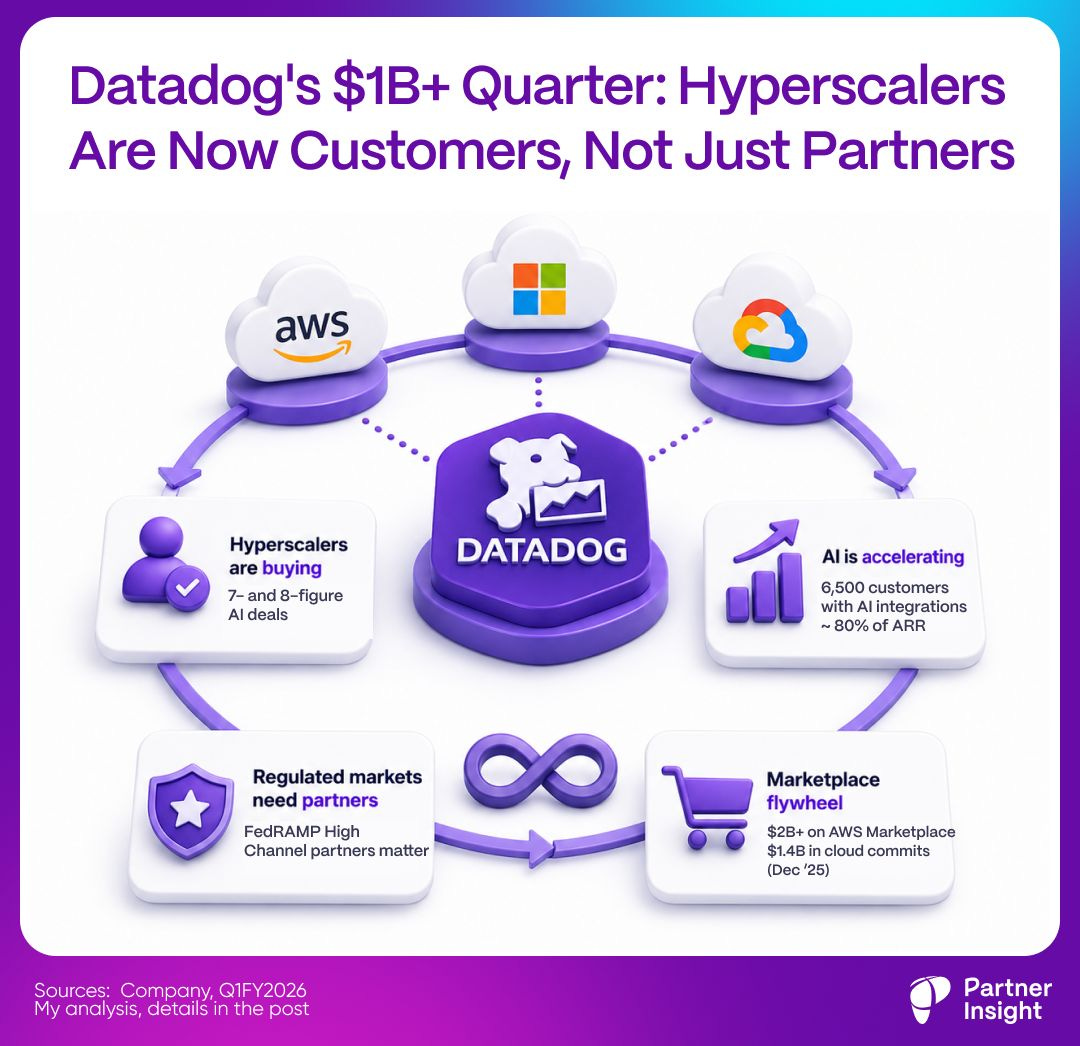
New logo bookings 2X+ YoY - all-time record. Shares jumped >30% - its best single-day gain ever.
What’s driving Datadog’s growth?
Hyperscalers aren’t just co-selling and co-innovating. They are buying
Why?
These are companies with massive balance sheets and deep engineering teams. If anyone can build anything in-house, it is them.
CEO Olivier Pomel: “If there was ever a set of companies for whom it makes sense to do it themselves, it’s those companies. And yet, we see that they have the same issue.
When it comes to going as fast as they can, being as efficient as they can with their resources, they come to us to replace some of the things they were using before.”
This is co-opetition at its best. Clouds can build, but they still buy best-of-breed products when the problem is important/urgent.
It is also why they co-sell with leading ISVs. Customers don’t want only cloud infra. They need solutions, including best-in-class products, AI, security, etc.
AI + Cloud: two growth engines
Pomel was clear:
“There is no change to our overall view that digital transformation and cloud migration are long-term secular growth drivers for our business. But we now have an additional secular growth driver with AI...”
AI numbers were striking:
6,500 customers now use 1+ AI integrations
They represent only 20% of customers, but ~80% of ARR
MCP server calls grew 4X QoQ
LLM Observability surged ~3X QoQ
Pomel added an insightful point for everyone considering agent pricing:
“We don’t care whether most of the usage is humans or agents. Our business model lends itself to do pretty well — we are usage-based, it doesn’t matter where the load is coming from.”
Regulated sectors still need channel
Datadog received FedRAMP High certification for U.S. federal customers.
CFO David Obstler explained:
“On the FedRAMP, we’ve been working on both the different certifications, but at the same time, we’ve been investing in the go-to-market function,both in terms of reps and channel partners for a number of years…
the channel partner relationships are a very important part of this.”
Public sector GTM requires partners to unlock the market.
Cloud GTM flywheel runs both ways
AWS highlighted in Dec that Datadog crossed $2B in total sales on AWS Marketplace.
They also signed an expanded Strategic Collaboration Agreement covering “solution development, AWS Marketplace availability, and go-to-market programs.”
Datadog itself disclosed ~$1.4B in cloud commits they have for the next 5 years.
Which brings us to the bigger lesson
Datadog is:
major cloud customer
strategic hyperscaler partner
top marketplace seller
and now a vendor to hyperscaler AI teams
That is the new Cloud GTM playbook - strongest hyperscaler relationships are no longer one-dimensional.
$1.2T+ Cloud Commits: 5 Playbooks AI-Natives Use to Build Marketplace Revenue
Cloud commits just crossed $1.2T — up from $900B in a single quarter.
AWS commits alone hit $364B, up $120B QoQ. AWS revenue grew 28% — its fastest pace in 15 quarters. Bedrock revenue is up 170% QoQ.
Translation for alliance leaders: marketplace is becoming the AI buying path. Enterprise customers have pre-allocated cloud funds they need to spend, and AI is now the fastest line item moving through it.

The question is no longer whether AI-native (or AI-adjacent) companies should be on cloud marketplaces. It is how they turn marketplace into pipeline, co-sell momentum, and closed revenue.
That is the focus of our next online workshop.
Join us May 27 (9–10 AM PT) for a tactical 60-minute session where we’ll break down what’s working for top AI-native companies scaling on AWS Marketplace — and hand you the playbooks to do the same.
We’ll cover:
Latest market data: why cloud commits crossed $1T+ and what it means for AI GTM and marketplace acceleration
Operator tactics: how AI-native teams qualify buyers, activate co-sell, and scale revenue through Marketplaces
5 marketplace playbooks: including Better Together framing for AI, co-sell outreach, seller enablement and more
Scaling the motion: how smart operations and workflows remove friction and drive marketplace revenue
Learn from operators who’ve built the motion
Karan Singh, Partnerships Lead at LangChain
Rob Weidner, Director of Global Cloud Alliances at Grafana Labs
Nate Stecz, Senior Partner Development Manager for AI at AWS
Trunal Bhanse, CEO of Clazar
You’ll walk away with 5 Marketplace Playbooks.
If you’re leading alliances, marketplaces, sales enablement, or RevOps for an AI or AI-adjacent ISV — this is the session that turns the $1T+ commits milestone into your pipeline and closed revenue.
ServiceNow Hit $1B on AWS in Just ~2 Years
ServiceNow just crossed $1B in AWS Marketplace. It is one of the fastest ramps to $1B on AWS in just ~2 years.
This milestone matters even more because of what ServiceNow is now selling through AWS marketplace.
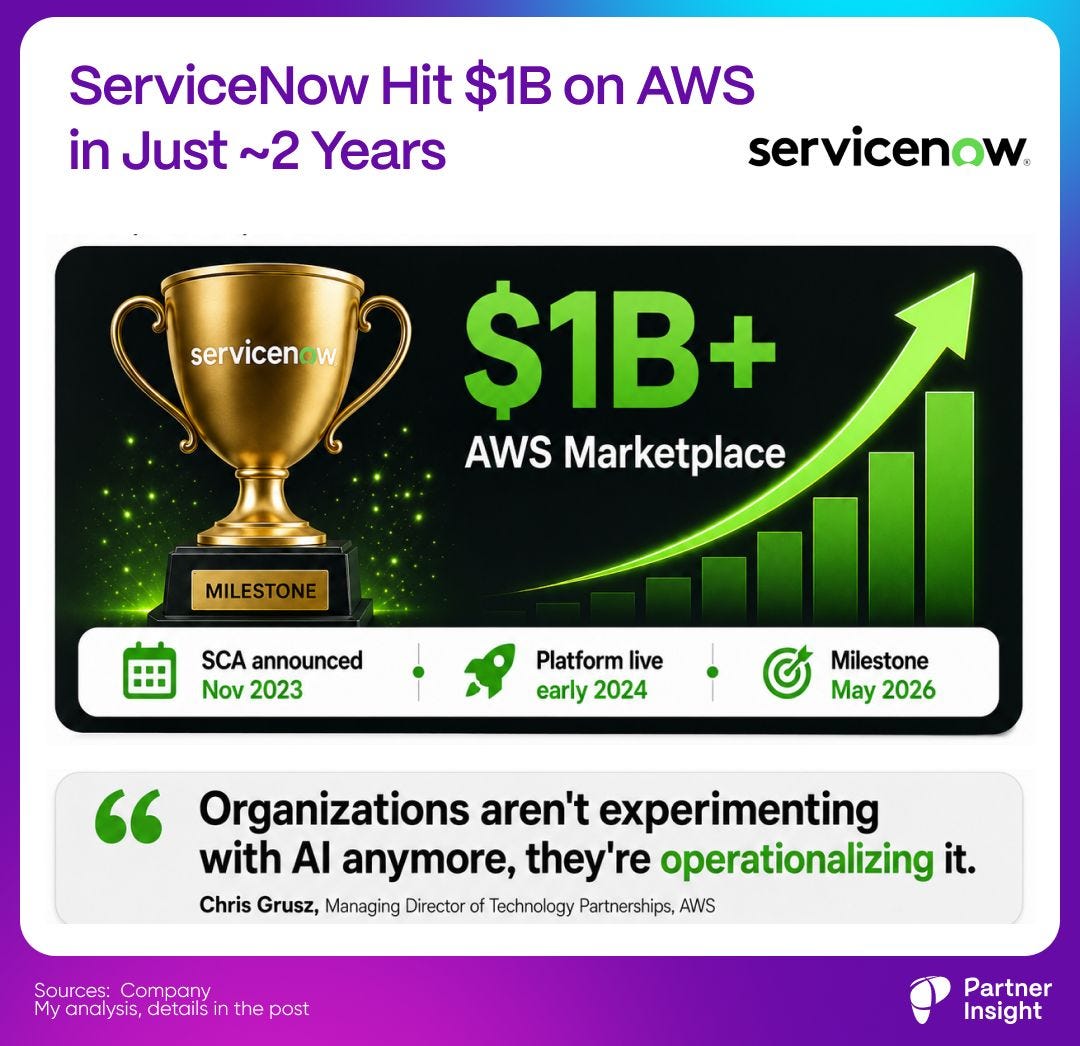
Not a point product. A full enterprise AI architecture: governance, AI agents, AWS cloud and model infrastructure, ServiceNow workflows, developer tooling, and services partners to move it into production.
Back in Nov 2023, ServiceNow and AWS announced a Strategic Collaboration Agreement:
ServiceNow Platform and full suite available as SaaS on AWS
Co-developed AI-powered industry applications in AWS Marketplace
New ways for joint customers to purchase and use ServiceNow
Marketplace worked because it was inside a strategic partnership and co-engineering, not beside them.
Now the next chapter is AI and marketplace execution
At Knowledge 2026, ServiceNow announced AI Control Tower with Amazon Bedrock AgentCore — available in AWS Marketplace.
The goal: one governance architecture for agents built on AWS infrastructure and connected into ServiceNow workflows.
Chris Grusz, Managing Director of Technology Partnerships at AWS, framed the moment well: “Organizations aren’t experimenting with AI anymore, they’re operationalizing it.”
Enterprises are deploying agents across clouds, models, teams, and systems. But they still need governance, auditability, permissions, security, workflow context, and human approval.
ServiceNow is positioning itself as the control layer for that complexity.
AWS provides cloud and model infrastructure
ServiceNow provides orchestration and governance
Marketplace becomes the commercial route
Workflows turn AI into outcomes
ServiceNow and AWS highlighted agent workflows across security, IT operations, and telecom — from vulnerability remediation to AIOps and customer care.
That is where enterprise AI becomes valuable: governed actions inside workflows where decisions happen.
This connects directly to ServiceNow’s bigger growth story
The company laid out a path to $30B+ in subscription revenue by 2030, with AI expected to represent more than 30% of ACV.
The AWS Marketplace milestone is part of the growth model.
One more signal worth watching: Action Fabric
ServiceNow is opening its full system of action to any AI agent via MCP — including agents built on Claude, Copilot, or custom stacks.
That makes the platform more than a system of record. It becomes the governed execution layer for the broader agent ecosystem.
For alliance leaders:
Marketplace strategy is becoming growth strategy
The strongest cloud partnerships package product, cloud, agents, workflows and services into something enterprises can actually buy and run
ServiceNow’s $1B milestone is impressive. For a workflow platform, not a security vendor, the speed is remarkable.
It shows that cloud marketplaces are becoming the commercial layer for enterprise AI transformation.
Private Equity Just Became AI’s Newest Channel
$11.5B committed in a single day to distribute AI through private equity portfolios.
OpenAI and Anthropic just made PE firms their newest “channel partners”.
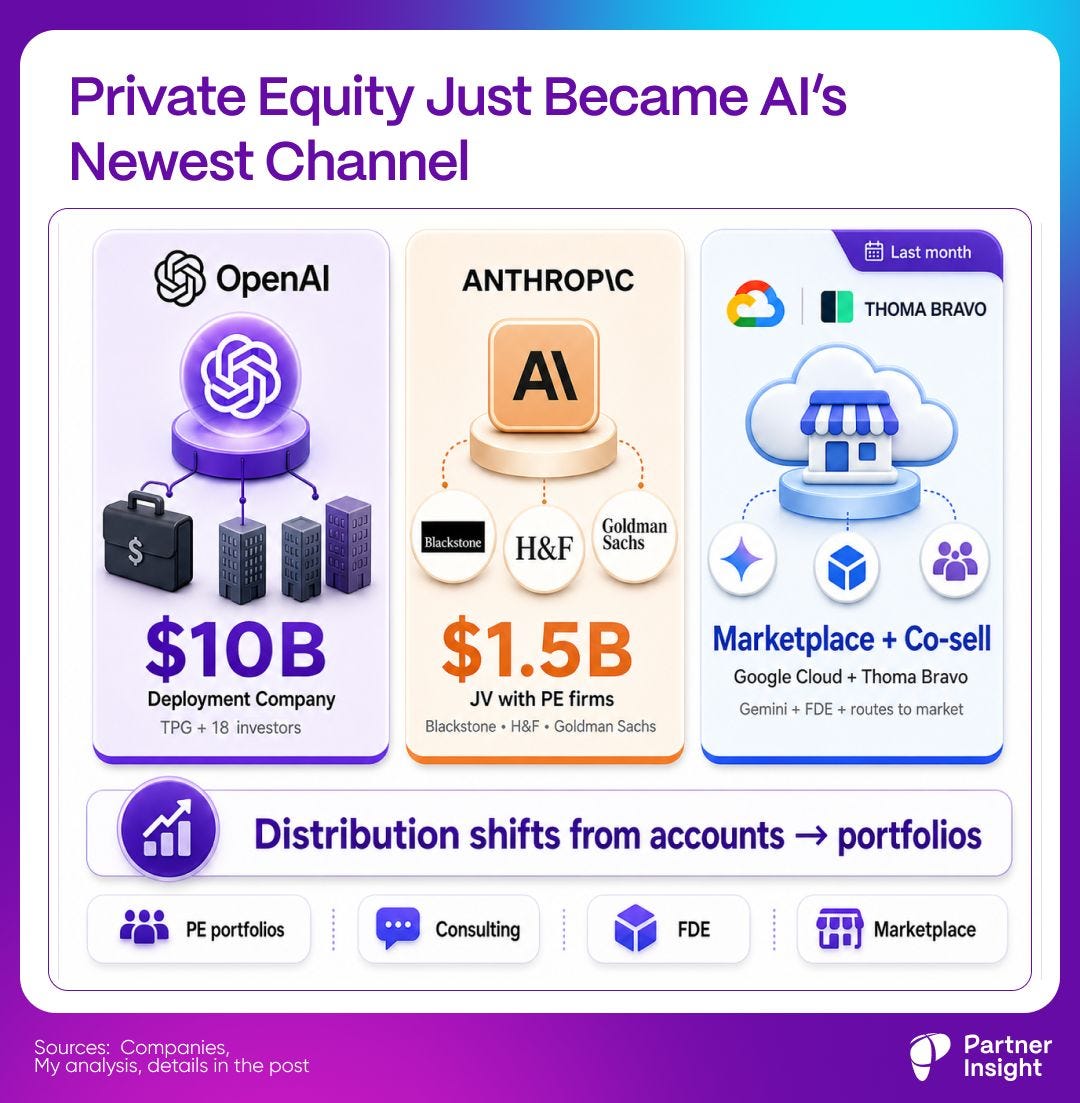
Two massive deals announced last week
OpenAI finalized “The Deployment Company” — a $10B vehicle anchored by TPG, with Brookfield, Advent, Bain Capital and 15 other investors.
PE firms open their portfolios as a captive customer base. In exchange, OpenAI commits up to $1.5B of its own capital and guarantees backers 17.5% annual return over five years.
Anthropic announced a $1.5B joint venture with Blackstone, Hellman & Friedman — each investing ~$300M — plus Goldman Sachs, Apollo, GIC, Sequoia and others. The entity will deploy Claude across PE-backed businesses and mid-sized companies.
Different structures. Same strategic direction.
AI labs are not waiting for enterprise adoption to happen company by company. They are building distribution through portfolios.
PE firms are a powerful channel. They have operating teams. They can standardize AI playbooks across dozens of companies at once.
That makes PE less like a traditional reseller and more like a portfolio-level adoption engine.
Last month, Google Cloud launched a partnership with Thoma Bravo — the world’s largest software-focused PE firm ($183B in assets).
The deal includes Gemini access, forward-deployed Google engineers, and routes to market through Google Cloud Marketplace and co-sell.
This is where it gets interesting for Cloud GTM leaders.
Many PE-backed software companies will not only use AI internally. They will embed AI into their products and look for faster enterprise distribution. Cloud marketplaces become one of the commercial rails for that shift.
Both AI labs are also locking in consulting capacity
OpenAI launched Frontier Alliances JV with BCG, McKinsey, Accenture and Capgemini. Anthropic highlights partnerships with Accenture, Deloitte and PwC.
Across all of these moves, a pattern repeats:
AI companies are combining models with PE portfolio access, consulting delivery, forward-deployed engineering, hyperscaler field teams and marketplace distribution.
In enterprise AI, partnerships are becoming the operating infrastructure for adoption itself. LLM vendors bring technology. PEs bring portfolio influence. Consultancies bring transformation. Clouds bring field alignment, orchestration and procurement.
Takeaways for alliance leaders:
AI distribution is expanding from accounts to portfolios. PE owners are becoming decision-makers for AI adoption.
Winning AI GTM motion is now co-sell + co-build + implementation. Model access alone is not enough.
If your cloud partner is embedding engineers inside PE portfolios, can you make your products part of it?
How is AI distribution changing your partnership strategy?
Why Enterprise AI Doesn’t Sell Itself
There is a popular myth right now: AI products are so powerful that customers just find them, try them, swipe a credit card, and revenue explodes.
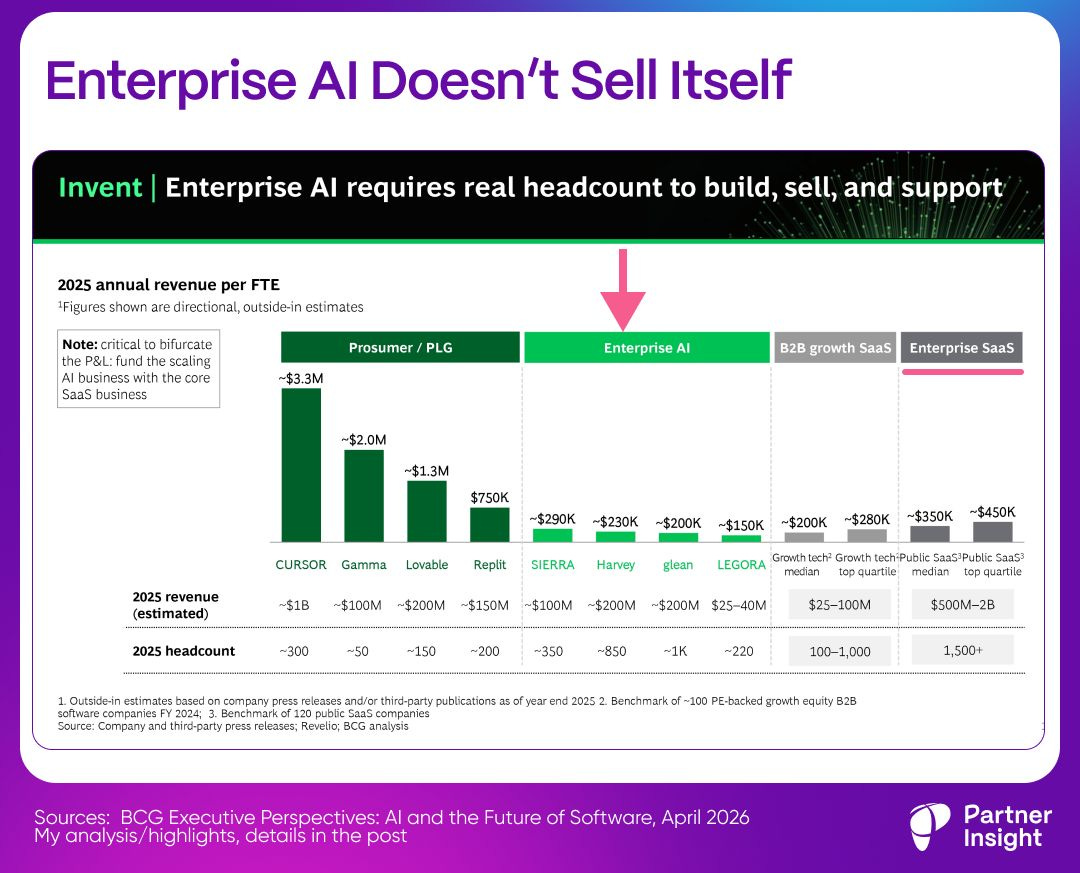
Sometimes, yes.
Cursor is reportedly generating $3.3M in revenue per employee. Gamma is at $2M. Lovable at $1.3M.
That is the magic of prosumer / PLG AI when it works.
But BCG’s latest AI software report shows a very different picture for enterprise AI.
Enterprise AI companies look much less like Cursor and much more like traditional B2B companies:
Sierra: $290K revenue/FTE
Harvey: $230K revenue/FTE
Glean: $200K
Legora: $150K
BCG’s conclusion: “Enterprise AI requires real headcount to build, sell, and support.”
That line kills one of the biggest myths in AI GTM.
Yes, there are extreme exceptions.
Anthropic’s growth is almost impossible to benchmark. It said its run-rate revenue surpassed $30B, up from $9B at the end of 2025 and $14B when it announced its Series G in February.
But most enterprise AI companies are not Anthropic.
They still need:
Sales teams
Implementation support
Security reviews
Procurement navigation
Partner ecosystems
Executive alignment
Usage expansion
The playbook is changing. But the fundamentals stay the same.
In fact, enterprise AI may require a more sophisticated GTM motion than SaaS did.
Because AI value is often realized after the sale.
BCG underscores that for AI applications, usage is the core driver of value, pilots are common, revenue is less stable, and gross margins vary widely.
Enterprise AI sales are not just: Sell seats → expand seats → renew ARR.
It is becoming: Prove workflow value → drive usage → expand consumption → route procurement through the customer’s preferred cloud relationship.
That is exactly why cloud partnerships and marketplaces are becoming central to AI GTM.
OpenAI started with Microsoft, but expanded with AWS too 2 weeks ago - and Amazon Web Services (AWS) explicitly says customers can apply OpenAI usage toward existing AWS cloud commitments.
Anthropic is available across Amazon Bedrock, Google Cloud Vertex AI, and Microsoft Foundry.
Replit and LangChain were just named Google Cloud Marketplace Partners of the Year in AI-related categories.
Best-in-class AI companies are not just building better products.
They are building better distribution around the clouds.
The key lesson for Cloud GTM leaders:
Enterprise AI is turning sales into a cloud-aligned, partner-led, usage-driven motion.
The companies that win will combine:
PLG where possible
Enterprise sales and partners to accelerate sales
Marketplace procurement to reach budgets already allocated
Co-sell where hyperscalers and partners already own the customer relationship
Customer success and ecosystems to drive usage, stickiness and full lifecycle
AI changed the GTM playbook.
But it did not remove the need for GTM.
If anything, the best enterprise AI companies are proving the opposite.
Turn Marketplace Into a Real Revenue Driver: 5-week course for Alliance & Cloud GTM Leaders
If Marketplace only shows up at the end of the deal, it is not a GTM motion.
It is firefighting.

And that is where many Cloud GTM teams get stuck.
A rep pulls alliances in late
A private offer becomes urgent
The cloud rep gets a vague ask
Procurement shows up in the final week
The “win” depends on one person who knows the maze.
It may save the deal.
But it does not compound.
That is the pattern I keep seeing across SaaS and AI companies trying to scale on AWS, Microsoft, and Google Cloud.
They are “doing marketplace.”
But they are not building a repeatable Cloud GTM growth system.
The teams pulling ahead do a few things differently:
they identify marketplace as a buying path earlier, not at the end
they train sales to use it, instead of treating it as an alliances side project
they make co-sell structured: real context, clear asks, better timing
they connect channel, marketplace, and cloud field into one motion
they build internal support across finance, ops, product, and leadership
That is what turns marketplace from extra work into leverage.
And it matters more now than it did even a year ago.
Cloud commitments across Amazon Web Services (AWS), Microsoft, and Google Cloud have crossed $1.2T.
Customers are more open to buying software digitally.
But they are also more selective.
Co-sell is getting more competitive.
And AI is reshaping how software gets discovered, packaged, and sold through hyperscaler ecosystems.
So the gap is widening: between teams that are listed and teams that turned marketplace into a repeatable revenue driver.
David Mauer — who helped drive $100M+ in marketplace revenue at GitLab and is now rebuilding the motion at LucidLink — put it well in our recent webinar:
”You never want a customer to tell you how they want to buy and have to say no.”
Over the past 2.5 years, 300+ alliance and Cloud GTM leaders have gone through our Cloud GTM Leader course to build that capability.
Some launched from zero marketplace motion to $200K revenue + $7M pipeline in 8 weeks.
Others closed their first $1M+ marketplace deal and turned it into a repeatable motion.
Some scaled marketplace revenue 4X YoY from an already high base.
That is not because they found one trick.
It is because they built the growth system.
Our next cohort starts on June 2
If you want to turn marketplace into a real growth driver — not just push isolated deals through it — this is what we work on for 5 weeks.
P.S. Thanks for reading! If this issue sparked an idea, please forward it to your alliance lead or cloud counterpart — it’s how this community shares what works.
The Datadog-hyperscaler dynamic is a procurement signal worth tracking closely. When a vendor’s biggest customer base shifts from direct buyers to cloud marketplace bundles, your negotiation leverage changes. Mid-market IT teams evaluating Datadog should be asking whether to buy direct, through AWS Marketplace, or via a reseller — the price floor and renewal terms differ materially across all three paths right now.