
Google's 25% AI Compute Lead Changes Cloud Partner Math
Plus: $750M for GCP partners to drive agentic AI. Agent Marketplace inside workflows. What 100 alliance leaders discussed at Next.

Hi, it’s Roman Kirsanov from Partner Insight newsletter, where I deconstruct winning Cloud GTM strategies and the latest trends in cloud marketplaces.
This week is all Google Cloud — and for good reason. Between Cloud Next announcements, a $750M partner commitment, and what we heard from ~100 alliance leaders at our breakfast at Next, the signals are too significant to split across editions.
Here’s what’s inside:
Google now controls 25% of global AI compute — and its full-stack strategy across TPUs, Gemini, agents, and Marketplace is changing the partner math.
$750M committed to agentic AI partner capacity — with forward-deployed engineering teams, Gemini Enterprise practices, and a new Agent Marketplace that moves distribution inside enterprise workflows
~100 Cloud GTM leaders joined our GCP Marketplace Breakfast at Next — five signals on agent distribution, marketplace trust, co-sell, and AI GTM.
But before we dive in, our next cohort of Cloud GTM Leader Course starts June 2nd — five weeks to turn marketplace from an end-of-deal scramble into a real growth system. Scroll below for details.
Google’s 25% AI Compute Lead Changes Cloud Partner Math
Google now controls 25% of all AI computing power - by building its own chips.
Their full-stack model is starting to reshape cloud economics and partnerships.
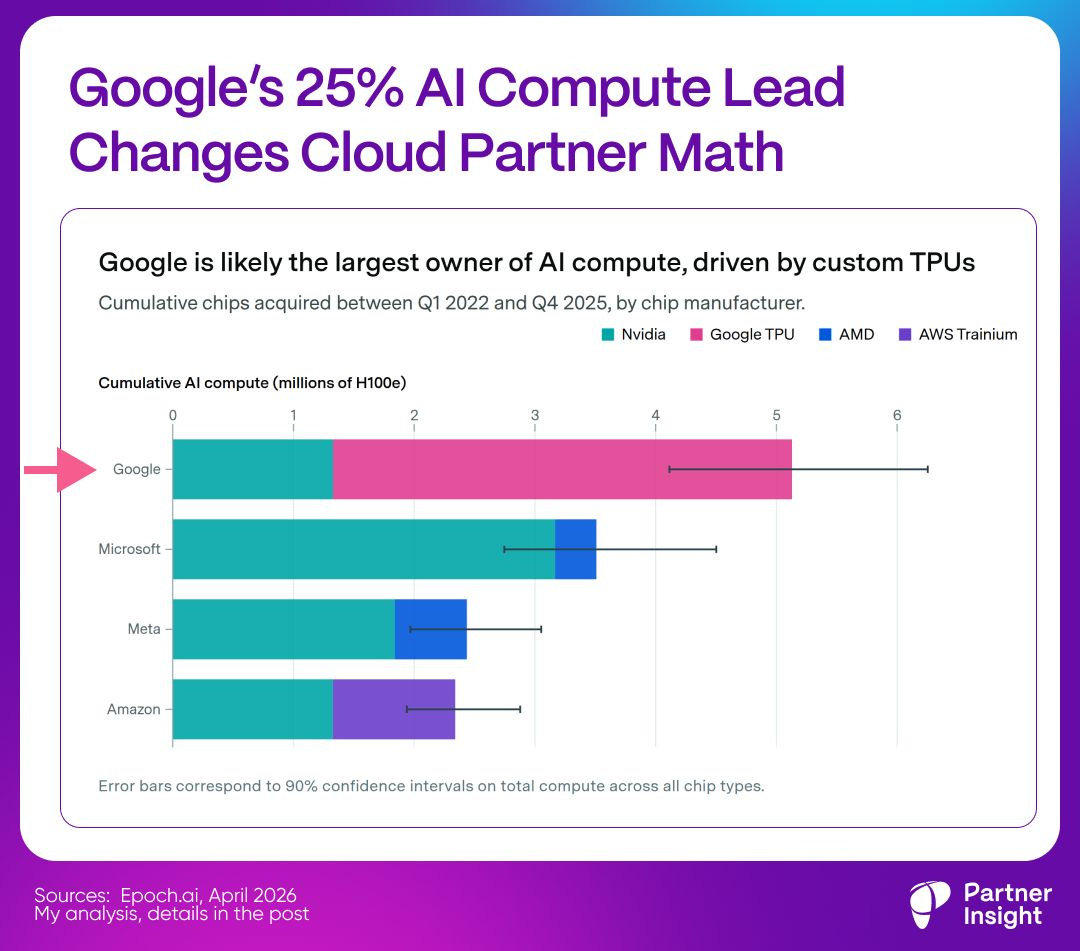
Epoch AI recently estimated Google holding ~1/4 of global cumulative capacity as of Q4 2025. Google has the equivalent of 5+ million H100 GPUs in compute capacity. Nearly 4 million of that comes from custom TPU chips. Microsoft is second with the equivalent of 3.5 million H100.
When others depend heavily on Nvidia for AI infrastructure, Google built and scaled an alternative.
Thomas Kurian, Google Cloud CEO, explained:
“We’re not just a hyperscaler reselling other people’s technology. Our differentiation comes down to the fact that we own the IP - the model and the chips are ours….
For every dollar of revenue, we’re not shipping 80% of it to either a model or chip provider, which allows us to invest more.” (FT)
The full stack matters even more as the industry shifts to compute-hungry agentic AI.
At Cloud Next last week, Google unveiled two 8th-generation TPUs - one for training, the other for inference and agentic workloads. Those chips power Gemini models. Gemini powers the new Agent Platform. The Agent Platform connects to a new Agent Marketplace.
Compute → models → data layer → agent platform → marketplace. Each layer owned internally, including distribution.
Google is playing a platform-company model
It competes with Anthropic on models - while powering Anthropic’s training on TPUs. Google just agreed to additionally invest up to $40B in Anthropic and provide it with more computing capacity.
It competes with Apple via Android - while supplying Gemini to power the next generation of Siri.
Kurian: “Google’s a platform company. Different parts of your business compete with different players in the market.”
Whether Google wins on models or infrastructure, it generates demand across the stack.
Partnerships sit at the center of how Google plans to scale this
At Next, Google announced a $750M partner fund for agentic AI development. Google wants partners building on Gemini, extending Gemini Enterprise, and helping customers to move agentic AI from pilots into production.
The commercial results already back up the thesis.
Google Cloud is at a $70B+ annual run rate, growing 48% year over year, with $240B backlog. FT puts its market share at 14%, up from 7% when Kurian joined.
For alliance leaders:
Google may still trail other hyperscalers overall, but AI creates a new decision layer.
The early data - growth, backlog, partner commitments - says the market is responding.
The Agent Marketplace is a new distribution category now with multiple surfaces. If your marketplace strategy only expects to include traditional listings, it may need a refresh.
What’s your current read on Google Cloud’s momentum?
Source: graph
Google’s $750M Push Turns Agentic AI Into a Partner Motion
Google Cloud Next last week had many AI announcements, but the biggest partner signal was clear: Google is turning agentic AI into an ecosystem motion.
In his Next keynote, Thomas Kurian said ~75% of GCP customers now use Google AI products.
He also said Google has thousands of agents and services across industries, reaching billions of people through the global scale of the Partner Network.
Google is describing AI adoption as a partner-scaled transformation.
Yesterday’s partner announcement made this clear. GCP committed $750M to accelerate agentic AI development across its 120,000-member partner ecosystem.
What the $750M actually funds:
New tools and resources
Forward-deployed engineering teams
Dedicated Gemini Enterprise practices
Enterprise-ready agents
This is partner capacity building, not just marketing. Google is trying to help partners move customers from AI interest to AI production to scale.
Numbers back this up
Google says its system integrator partners already have 330K experts trained on implementing Google AI for customers.
It also said more than 80% of the top 100 SaaS companies use Gemini models.
That tells you where the ecosystem is going. AI adoption is becoming both a services motion and an ISV modernization motion.
For services partners, the opportunity is to help customers redesign workflows, organize data, govern agents, modernize systems, and drive adoption.
For ISVs, the opportunity is to use Gemini Enterprise Agent Platform to build agents into existing products and workflows.
Gemini Enterprise Agent Marketplace: distribution is moving inside the workflow
In the keynote, Google showed partner-built agents from its ecosystem discoverable directly inside Gemini Enterprise.
Partner-built agents from Atlassian, Lovable, Salesforce, ServiceNow, etc., are now discoverable and deployable where enterprise employees work.
Marketplace is moving closer to the workflow.
Customers discover agents where employees already work, deploy them inside Gemini Enterprise and connect them into business processes.
That could create a new distribution layer for ISVs and a new packaging layer for services partners.
This is the evolution of the Cloud GTM playbook.
Combined with native MCP integration, GCP is also making cloud services more accessible to agents. ISVs can connect agents to MCP servers and extend workflows across systems more easily.
Three implications for alliance leaders:
Partner capacity is now bottleneck & unlock
AI demand is high, but customers need trained teams that can implement, govern, and drive adoption. $750M fund has specific buckets, so map your org to the right one.
Agent packaging becomes a new GTM skill
Services partners and ISVs need to turn expertise into repeatable agents.
Distribution is moving inside enterprise workflows
Gemini Enterprise is a new surface for discovering and deploying partner solutions.
How are you positioning your partner strategy for the GCP agentic push?
Sources: Opening keynote, GCP $750M annoucement
Five Signals from Our GCP Marketplace Breakfast at Next
~100 alliance leaders joined us at 7:30 AM in Vegas for the conversation Cloud GTM leaders at Next needed to have. Last week we hosted our largest GCP Marketplace Strategic Breakfast at Google Cloud Next.

The room was senior: alliance and marketplace leaders from Grafana Labs, Replit, Alteryx, Red Hat, and dozens more brought sharp questions and practical insight. All chose to join us over an extra hour of sleep.
Dai Vu, Managing Director of Google Cloud Marketplace, joined for a candid discussion.
A panel brought a direct operator perspective. David Mauer (LucidLink) moderated. Subhash Jawahrani (GCP Marketplace), John Jahnke (Tackle.io), and Rolf Heimes (Incorta) shared what’s actually working - and what’s changing - in co-sell, AI GTM, channel, and marketplace execution on GCP.
A few themes stood out:
Marketplace is becoming an AI trust layer, not just a distribution channel
As agentic AI scales the number of publishers, customers increasingly rely on Google Cloud to signal which vendors to choose. For publishers, discoverability will reward real performance - not just listing presence.
GCP’s $750M agentic AI investment is designed to help partners and their customers get to production faster
New GCP resources include agentic AI prototyping support, forward-deployed engineering teams, and usage incentives - structured to accelerate real adoption, not just experimentation.
The scale of these incentives shows how serious Google Cloud is about pushing forward with its partner ecosystem. For partners, the time to lean in is now.
Gemini Enterprise and Workspace are becoming agent distribution surfaces
The vision is more contextual discovery: agents recommended to users based on what they are working on, not only through search. A significant new distribution path for ISVs.
The user experience is shifting to the agent control plane
For many SaaS products, customers will increasingly experience the product through an agent - not the ISV’s own UI. A2A, MCP, and API-first architecture become strategically critical.
Alliance and product teams need to be more in the same room today.
Marketplace commerce is getting more ecosystem-native
Google is working toward integrating more partners into Marketplace transactions. Both GCP and ISVs with strong ecosystems recognize the value channel partners bring to customers and to scaling adoption.
Thank you to our fantastic speakers and attendees. The quality of the insight reflected the quality of the people in the room and the depth of their questions.
This was our largest in-person breakfast yet. We’ll be back.
Big thank you to our partners:
Tackle.io, our Presenting Partner, and LucidLink and Incorta for making this possible.
Turn Marketplace Into a Real Revenue Driver: 5-week course for Alliance & Cloud GTM Leaders
If Marketplace only shows up at the end of the deal, it is not a GTM motion.
It is firefighting.

And that is where many Cloud GTM teams get stuck.
A rep pulls alliances in late
A private offer becomes urgent
The cloud rep gets a vague ask
Procurement shows up in the final week
The “win” depends on one person who knows the maze.
It may save the deal.
But it does not compound.
That is the pattern I keep seeing across SaaS and AI companies trying to scale on AWS, Microsoft, and Google Cloud.
They are “doing marketplace.”
But they are not building a repeatable Cloud GTM growth system.
The teams pulling ahead do a few things differently:
they identify marketplace as a buying path earlier, not at the end
they train sales to use it, instead of treating it as an alliances side project
they make co-sell structured: real context, clear asks, better timing
they connect channel, marketplace, and cloud field into one motion
they build internal support across finance, ops, product, and leadership
That is what turns marketplace from extra work into leverage.
And it matters more now than it did even a year ago.
Cloud commitments across Amazon Web Services (AWS), Microsoft, and Google Cloud have crossed $900B.
Customers are more open to buying software digitally.
But they are also more selective.
Co-sell is getting more competitive.
And AI is reshaping how software gets discovered, packaged, and sold through hyperscaler ecosystems.
So the gap is widening: between teams that are listed and teams that turned marketplace into a repeatable revenue driver.
David Mauer — who helped drive $100M+ in marketplace revenue at GitLab and is now rebuilding the motion at LucidLink — put it well in our recent webinar:
”You never want a customer to tell you how they want to buy and have to say no.”
Over the past 2.5 years, 300+ alliance and Cloud GTM leaders have gone through our Cloud GTM Leader course to build that capability.
Some launched from zero marketplace motion to $200K revenue + $7M pipeline in 8 weeks.
Others closed their first $1M+ marketplace deal and turned it into a repeatable motion.
Some scaled marketplace revenue 4X YoY from an already high base.
That is not because they found one trick.
It is because they built the growth system.
Our next cohort starts on June 2
If you want to turn marketplace into a real growth driver — not just push isolated deals through it — this is what we work on for 5 weeks.
P.S. Thanks for reading! If this issue sparked an idea, please forward it to your alliance lead or cloud counterpart — it’s how this community shares what works.