
Marketplace Spend Just Entered IT’s Top 5 Focus Areas
Plus: Rubrik’s cloud ARR hit $1.39B, with 68% of revenue flowing through 3 distributors. How cloud + channel compound together. And 41% of CEOs rank partnerships as a top-3 growth bet.

Hi, it’s Roman Kirsanov from Partner Insight newsletter, where I deconstruct winning Cloud GTM strategies and the latest trends in marketplaces and partnerships.
In today’s edition:
55% of companies are increasing focus on marketplace spend, pushing it into IT’s top 5 budget priorities alongside AI and software.
Rubrik’s cloud ARR hit $1.39B, while 68% of revenue flows through 3 distributors. How cloud + channel compound together.
41% of CEOs now rank acquisitions and partnerships as a top-3 growth priority
90% of B2B buyers choose from vendors they knew on Day 1, according to recent Bain research. Marketplace has to show up before the shortlist is set.
Before we dive in: if this free newsletter helps to sharpen your thinking on cloud marketplaces, forward it to one alliance or GTM leader on your team who should be reading it.
Marketplace Spend Just Entered IT’s Top 5 Focus Areas
55% of companies are increasing their focus on the cloud marketplace spend.
That puts marketplaces among the top 5 priorities reshaping IT budgets - climbing right alongside AI and software spend.
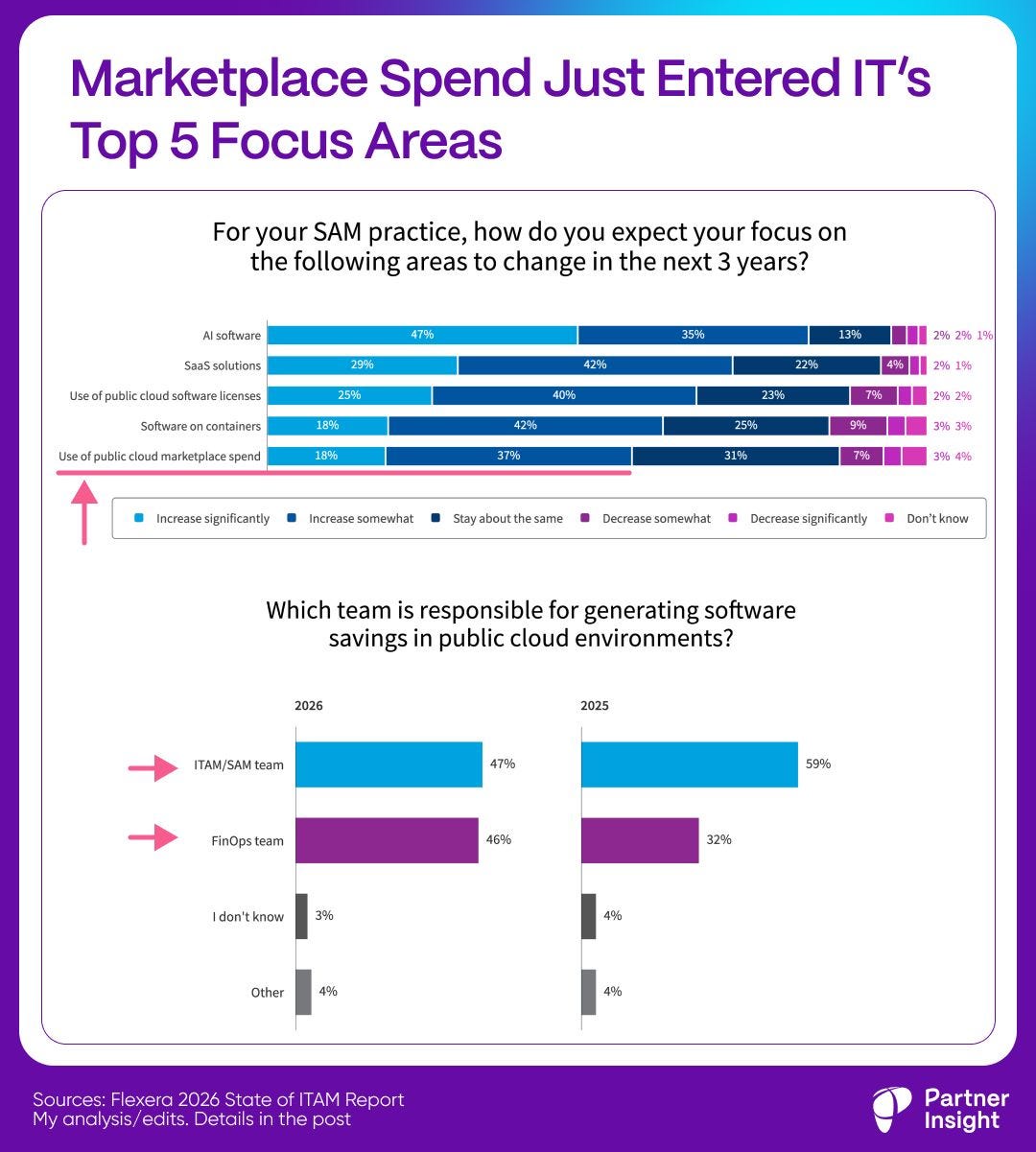
Flexera surveyed 512 professionals responsible for IT asset management (ITAM) for its 2026 State of ITAM report.
The throughline: software spend is under a microscope, and the buying center is moving. The AI stack is rising, and marketplaces are now part of that conversation.
78% of organizations now have a dedicated FinOps team
But in public cloud, accountability for software savings is split almost evenly - ITAM and SAM teams own it at 47%, FinOps at 46%.
A year ago that gap was 59% to 32%.
The report calls this “both opportunity and friction” as the two functions share control. For anyone co-selling through cloud commitments and marketplaces, that’s two budget owners to track, not one.
The wallet behind this is large
51% of companies spend $5M+ a year just on pay-as-you-go and bring-your-own-license software running in the cloud; 29% spend more than $15M.
But buyers are tightening
Flexera says wasted spend declined or held steady across most areas, yet what remains is still meaningful - SaaS and public cloud software waste sit around 18-20%, IaaS and PaaS around 15-20%, depending on maturity.
So procurement is getting sharper: 47% now negotiate contract terms directly with vendors, up 14 points in a year; 59% track usage and rightsize SaaS contracts; 42% hunt for shadow SaaS. Deals now meet a buyer who can see and challenge the bill.
AI is the variable everyone is watching
47% expect their focus on AI software to rise significantly, while 59% say AI waste already grew last year. Yet only 31% have real visibility into their AI software spend, even as half of ITAM teams pick up responsibility for AI spend.
Companies estimate just 10% of AI software is wasted - the lowest of any category. My read: that says as much about limited visibility as it does about efficiency.
Tracking or adopting new AI applications is now the top challenge overall, cited by 84% of respondents.
Rising spend, no clear view - that gap is where the next wave of cloud commitments and marketplace purchases will likely land.
Lessons for alliance and marketplace leaders:
Map budget owners - and get closer to whoever controls the commits - because no single department fully owns the cloud spend
Lead with measurable ROI and usage data; buyers are negotiating and rightsizing harder than last year
Position AI and SaaS offers against cloud commits, as marketplace focus is climbing
Source: Flexera 2026 State of ITAM
Cloud-first Rubrik routes 68% of revenue via 3 distributors
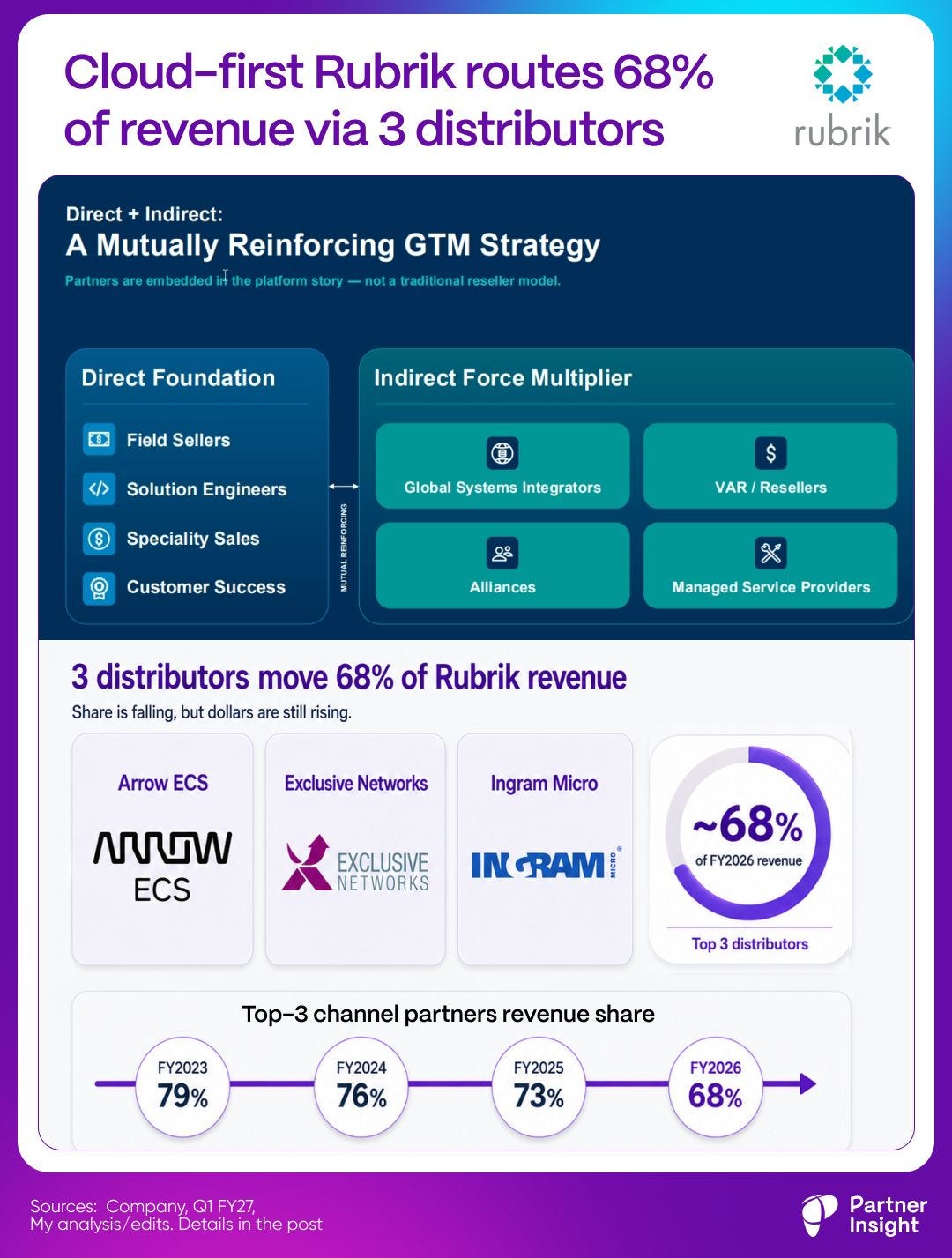
Rubrik’s cloud ARR grew an impressive 43% last quarter to $1.39B. 68% of it flows through 3 distributors with channel amplifying Cloud and direct GTM.
Two GTM engines running at once. Here is how they fit together.
Rubrik posted a record Q1: subscription ARR of $1.57B, up 32%, with $103M of net new subscription ARR — its largest first-quarter add ever.
Cloud is now 89% of subscription ARR, up from 82% a year ago.
Cloud GTM engine
Mature cloud motion
Rubrik sells its data security platform across AWS, Azure, and Google Cloud, won two 2025 Google Cloud Partner of the Year awards, and signed a Strategic Collaboration Agreement with AWS last November.
CEO Bipul Sinha: “our customers are buying Rubrik solution on AWS, Azure, GCP.” Each cloud is a separate place to land and expand, so coverage across all three compounds revenue.
Cloud engine + AI product
Agentic AI is still early (for everyone), which makes Rubrik’s traction notable.
Rubrik Agent Cloud launched in February, and a US financial services customer already moved “from AI experimentation to full production deployment across AWS Bedrock and Microsoft Copilot” last quarter.
AI integrations with clouds are key, but co-selling of agents is still forming:
The CEO responded to a question asking if Rubrik would “create partnerships with some of the larger players in this market to accelerate enterprise take-up” of Agentic AI:
“what we are doing is to discovering all the agents that exist in the enterprise environment. And for that, we actually integrate with platforms such as Bedrock, Microsoft Copilot, Copilot Studio, Google and other platforms.
So definitely, we believe that there’s an opportunity for a deeper partnership and go to market together across all of that. And we really want to build an ecosystem because we have a platform play.”
The channel engine
Rubrik reports that “a vast majority of sales flow through our Channel Partners with the support of our sales force.”
Three distributors: Arrow ECS, Exclusive Networks, and Ingram Micro — moved ~68% of Rubrik’s revenue in FY2026.
However, the share of top 3 partners has fallen every year since 2023, with the last year dropping 5%: 79% to 76% to 73% to 68%
But because the revenue base is growing rapidly the dollars through those three rose ~38%.
The base widens while the anchors keep growing: healthy deconcentration or channel substitution?
What’s clear is that with this much running through partners, the agentic product is almost certainly reaching customers the same way.
3 takeaways for alliance leaders:
Cloud and channel are not either/or. Rubrik scales both at once, and they reinforce each other
A mature cloud motion is the launchpad for the next product. Agent Cloud rides the partner muscle the core product already built
Read concentration both as a ratio and a dollar figure. Falling share with rising dollars could signal a maturing partner base
Which GTM compounds faster for you — cloud or channel?
41% of CEOs Rank Partnerships & M&A as Top-3 Growth Priority
In the CEO playbook for growth, partnerships just moved into the top 3.
Oliver Wyman and the New York Stock Exchange asked 415 CEOs, running companies worth ~10% of global market cap, how they plan to raise shareholder value over the next 2 years. It’s the largest survey of its kind, now in its third year.
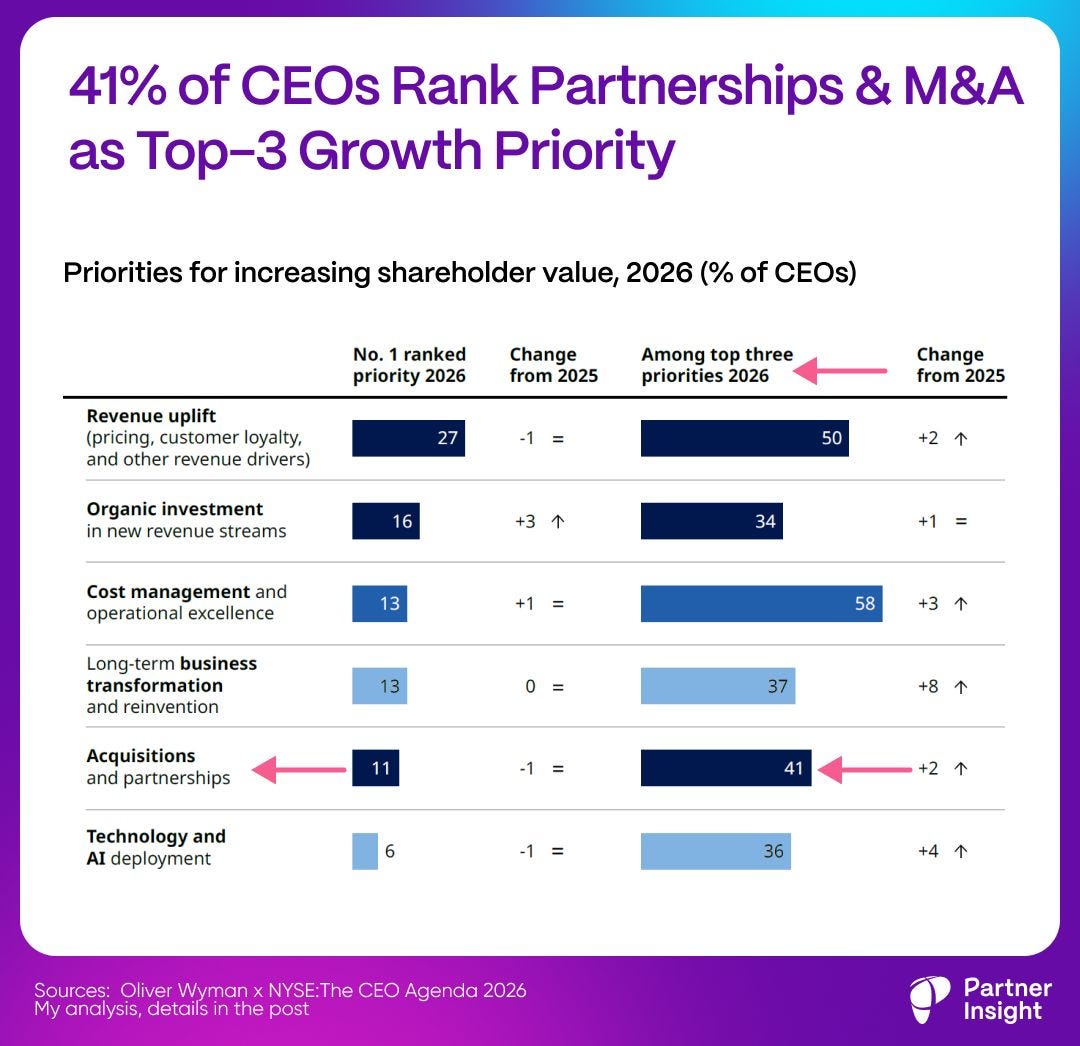
“Acquisitions and partnerships” came in as a top-three priority for 41% of them - behind only cost management (58%) and revenue uplift (50%), and ahead of both AI deployment and business transformation.
Here’s what stood out to me, and what I think it means for those of us building alliances.
CEOs treat buying and partnering as two routes to the same destination: capability they don’t have time to build
Here is why.
42% of CEOs pursuing M&A want capabilities and intellectual capital — rising to 54% at the largest firms and above 55% in the fastest-moving sectors.
In their words:
“Buying is faster than building, and is sometimes more effective, setting companies up to leapfrog the competition.”
Partnerships are the non-binding version of that same move.
Same speed, same access to technology, data, and markets — with less capital at risk and less to integrate. When an acquisition is too costly or too slow, a co-sell or marketplace motion gets a CEO most of the way there.
Two forces make this urgent.
First, 65% of CEOs rank competitive disruption as a top-three opportunity — higher than any other opportunity in the survey.
They’re playing offense, and offense needs capability fast.
Second, AI is pulling deployment leaders away from the pack.
Two-thirds of companies are still stuck in pilots, but those scaling AI across two or more use cases are 3x more likely to report returns that meet or beat expectations (49% versus 15%).
Moving from pilot to production is exactly where cloud and implementation partners prove their worth.
Three things I’d take from this for alliance leaders:
Lead every partnership case with the growth number — revenue, customer access, time-to-value — not just relationship strength
Frame partnerships as the lower-risk path to the capability CEOs are otherwise trying to buy
Position your ecosystem as the shortest route from AI pilot to deployed outcome
Partnerships have earned a seat at the growth table. The question is whether you show up speaking the CEO’s language.
Source: The CEO Agenda 2026
Bain: 90% of B2B Buyers Choose Early. Marketplace Often Arrives Too Late.
Most enterprise buyers choose from the vendors they already had in mind on Day 1 - before the buying process even starts.
Yet in many deals sellers introduce Marketplace later, after that shortlist is set.
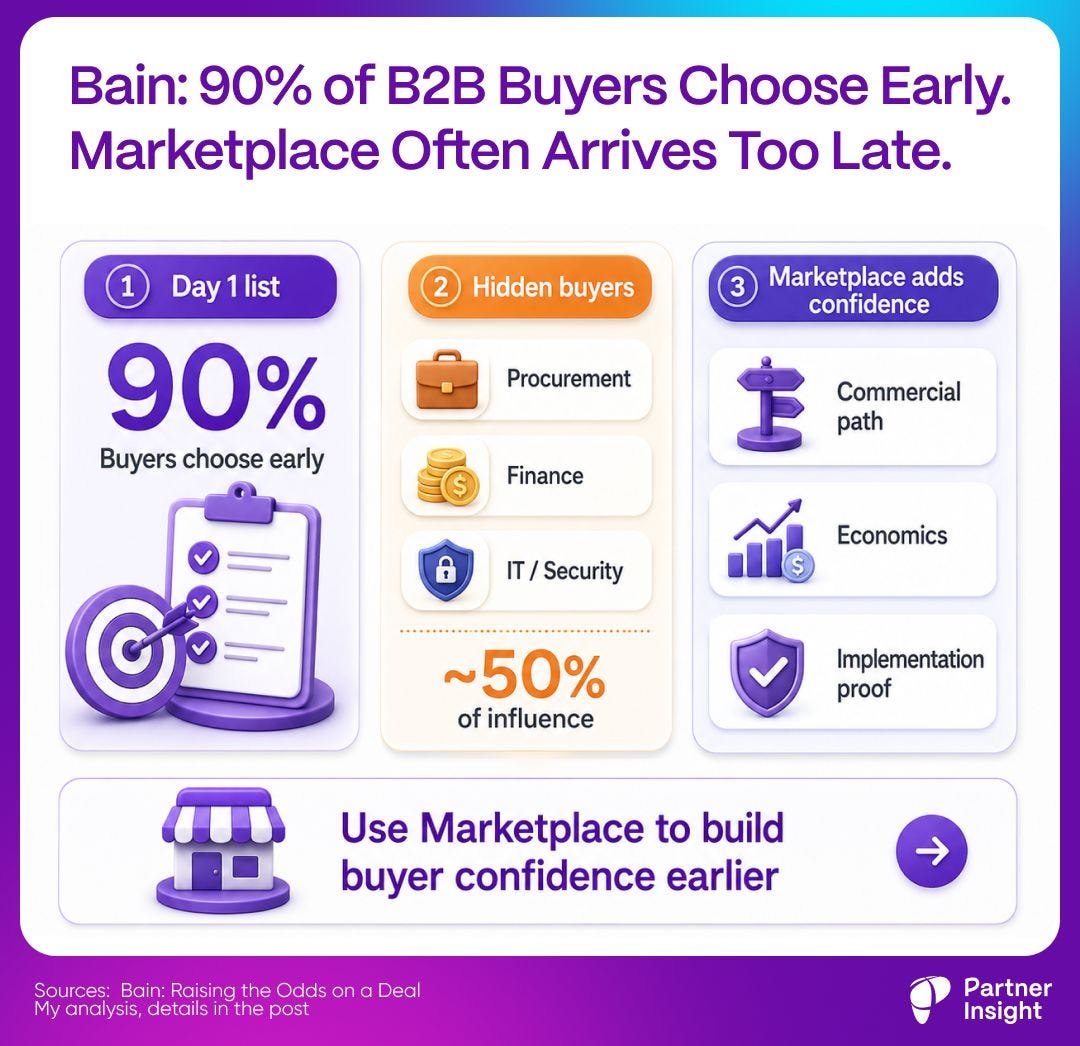
Some of those late deals still close: they give procurement a workable path, let finance use committed cloud spend, and take friction out of the paperwork. But they could do far more.
Bain & Company and LinkedIn surveyed 750 buyers of B2B software like cloud data platforms.
Their finding: winning has two jobs.
Get onto the Day 1 list first.
Then build confidence on the five things buyers actually weigh:
meeting current and future needs,
value against total cost,
whether the choice is safe to defend internally,
confidence it will be implemented,
and ease of working with you.
The buyers Marketplace teams overlook usually decide the deal
Users and business leaders judge the product.
But procurement, finance, and IT hold roughly 50% of the influence, and their call leans as much on defensibility as on features — they want the safe choice they can justify later.
Each asks a different question, and a Marketplace transaction answers it:
Procurement: is there a manageable commercial path?
A familiar buying route, standard workflows, less vendor admin.
Finance: can we defend the economics?
Align the purchase to committed cloud spend, consolidate billing, clarify total cost.
IT and security: can we deploy this with controlled risk?
Cloud alignment, a named implementation partner, proof from comparable deployments.
Executive sponsor: can I stand behind this?
Hyperscaler advocacy, SI support, relevant customer references.
One caveat: A listing alone moves very little in large enterprise deals.
In many cases it’s only the transaction layer. On its own it creates no preference.
It earns its weight as part of a package: a clear customer and cloud outcome, defensible economics, implementation proof, partner validation, and a ready commercial path.
That is what turns Marketplace into part of the reason a buyer chooses you, well before they reach the transaction.
Three lessons for alliance leaders:
Put Marketplace into account planning and discovery for priority accounts, before procurement becomes the trigger
Stop measuring Marketplace only by how fast it closes. Measure it by whether it lifts confidence across the whole committee — especially the hidden buyers your sellers rarely brief
Get your proof early. References, SI partners, and cloud-seller advocacy are what put you on the Day 1 list in the first place. Marketplace then turns that into a yes the committee can defend internally.
When does Marketplace enter your deals — before the shortlist is set, or only when you need a transaction path?
Source: Bain B2B decision framework
Turn Marketplace Into a Real Revenue Driver: 5-week course for Alliance & Cloud GTM Leaders
If Marketplace only shows up at the end of the deal, it is not a GTM motion. It is firefighting.

And that is where many Cloud GTM teams get stuck.
A rep pulls alliances in late
A private offer becomes urgent
The cloud rep gets a vague ask
Procurement shows up in the final week
The “win” depends on one person who knows the maze.
It may save the deal.
But it does not compound.
That is the pattern I keep seeing across SaaS and AI companies trying to scale on AWS, Microsoft, and Google Cloud.
They are “doing marketplace.”
But they are not building a repeatable Cloud GTM growth system.
The teams pulling ahead do a few things differently:
they identify marketplace as a buying path earlier, not at the end
they train sales to use it, instead of treating it as an alliances side project
they make co-sell structured: real context, clear asks, better timing
they connect channel, marketplace, and cloud field into one motion
they build internal support across finance, ops, product, and leadership
That is what turns marketplace from extra work into leverage.
And it matters more now than it did even a year ago.
Cloud commitments across Amazon Web Services (AWS), Microsoft, and Google Cloud have crossed $1.2T.
Customers are more open to buying software digitally.
But they are also more selective.
Co-sell is getting more competitive.
And AI is reshaping how software gets discovered, packaged, and sold through hyperscaler ecosystems.
So the gap is widening: between teams that are listed and teams that turned marketplace into a repeatable revenue driver.
David Mauer — who helped drive $100M+ in marketplace revenue at GitLab and is now rebuilding the motion at LucidLink — put it well in our recent webinar:
“You never want a customer to tell you how they want to buy and have to say no.”
Over the past 3 years, 300+ alliance and Cloud GTM leaders have gone through our Cloud GTM Leader course to build that capability.
Some launched from zero marketplace motion to $200K revenue + $7M pipeline in 8 weeks.
Others closed their first $1M+ marketplace deal and turned it into a repeatable motion.
Some scaled marketplace revenue 4X YoY from an already high base.
That is not because they found one trick.
It is because they built the growth system.
Our next cohort starts in September
If you want to turn marketplace into a real growth driver — not just push isolated deals through it — this is what we work on for 5 weeks.
P.S. Thanks for reading! If this issue sparked an idea, please forward it to your alliance lead or cloud counterpart — it’s how this community shares what works.