

Hi, it’s Roman Kirsanov from Partner Insight newsletter, where I deconstruct winning Cloud GTM strategies and the latest trends in cloud marketplaces.
This week, two $1B+ software companies show where partner leverage is really driving growth — and why cloud marketplace execution is becoming a core GTM advantage.
DocuSign’s 30%+ partner growth reveals how AI can reshape Cloud GTM — with IAM hitting $350M+ ARR, Microsoft actively co-selling a 3-year marketplace deal, and partners becoming essential to enterprise expansion.
Two partners now drive 30% of SentinelOne’s $1B revenue — while its top 10 MSSP partners grew ACV 75%, showing how elite partner concentration can scale revenue without scaling headcount.
Enrollment is now open for our June 2 Cloud GTM Leader cohort — helping leaders build repeatable marketplace growth: from first $1M+ deals to 4X YoY growth from an already high base.
Before we dive in: if this newsletter helps you stay sharp on cloud marketplaces, forward it to one alliance or GTM leader on your team who should be reading it.
Microsoft “really leaned in.” DocuSign 30% partner growth
DocuSign just showed what happens when an AI product forces a real partner and marketplace transformation.
In one quarter, partner-contributed bookings grew 30%+ YoY, and a 3-year deal was closed via Microsoft Marketplace where Microsoft “really leaned in” and was “a big part of the sale.”
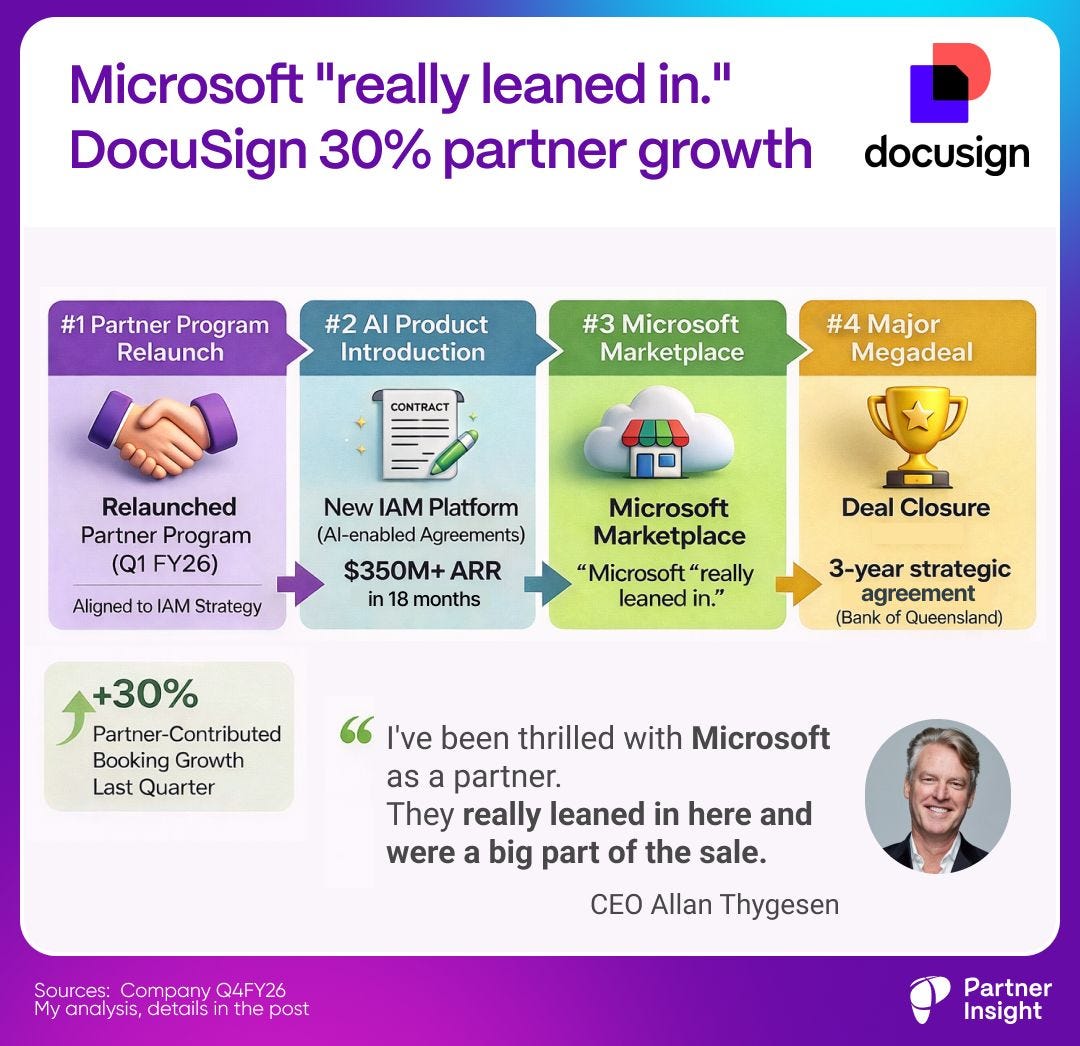
Their formula is what caught my attention:
New partner program + New AI product motion + Marketplace transaction +
Active hyperscaler co-sell
Here’s what stands out.
The partner push followed the product shift
At the start of FY26, DocuSign relaunched its partner program around IAM.
IAM is not lightweight e-signature, it is an end-to-end agreement platform spanning sales, procurement, HR, legal, analytics, workflow, identity, and now agentic use cases.
When a product becomes more cross-functional and enterprise-wide, partner involvement usually rises with it.
Fast forward 12 months >> DocuSign partner-contributed bookings grew 30%+ YoY in Q4.
Azure Marketplace signal is even more telling
DocuSign signed the Bank of Queensland deal — a three-year strategic agreement — closed through Microsoft Azure Marketplace. Microsoft didn’t just process the transaction. They actively co-sold it.
CEO Allan Thygesen: “I’ve been thrilled with Microsoft as a partner. They really leaned in here and were a big part of the sale. In fact, a Microsoft leader presented that case at our conference last week to the entire partner community.”
This is cloud GTM at its best:
customer buys via marketplace
cloud commits help the economics
hyperscaler field gets involved
partner champions the deal internally
That is a very different story from “we listed on marketplace.” It is marketplace as part of enterprise co-sell.
IAM is already big enough to change how the company sells
After only 18 months, IAM reached $350M+ ARR and 10.8% of total ARR, up from 2.3% a year earlier.
Complex AI products rarely stay direct-only for long.
They pull in SIs, cloud sellers, workflow partners, and specialist services because the real work is not the demo. It is deployment, process redesign, trust, and adoption.
DocuSign is trying to become infrastructure for the agentic layer
The company said IAM now connects via MCP to ChatGPT, Claude, Gemini, GitHub Copilot, Copilot Studio, and Agentforce.
Instead of betting on one AI vendor, they are making agreement data and workflows available wherever enterprise users will work.
Their CEO said EVERY major model provider is interested because agreements are one of the key data elements customers want to expose and act on.
It is a play to become the agreement layer inside enterprise AI workflows.
The broader GTM model is becoming more diversified
DocuSign disclosed that digital sales were 15% of total revenue growing faster than overall revenue.
So the shape of the machine is becoming clearer:
Digital lands
Direct expands
Partners scale delivery and co-sell
Marketplace helps transact enterprise demand
That is much more durable than relying on one route to market.
3 lessons for alliance leaders:
When product complexity rises, partner contribution can rise much faster than most teams expect.
Marketplace becomes strategic when the hyperscaler field is actively helping win the deal, not just process it.
The strongest AI partnerships are often built by controlling a critical workflow and making it available across the ecosystem.
Two Partners Drive 30% of SentinelOne’s $1B Revenue
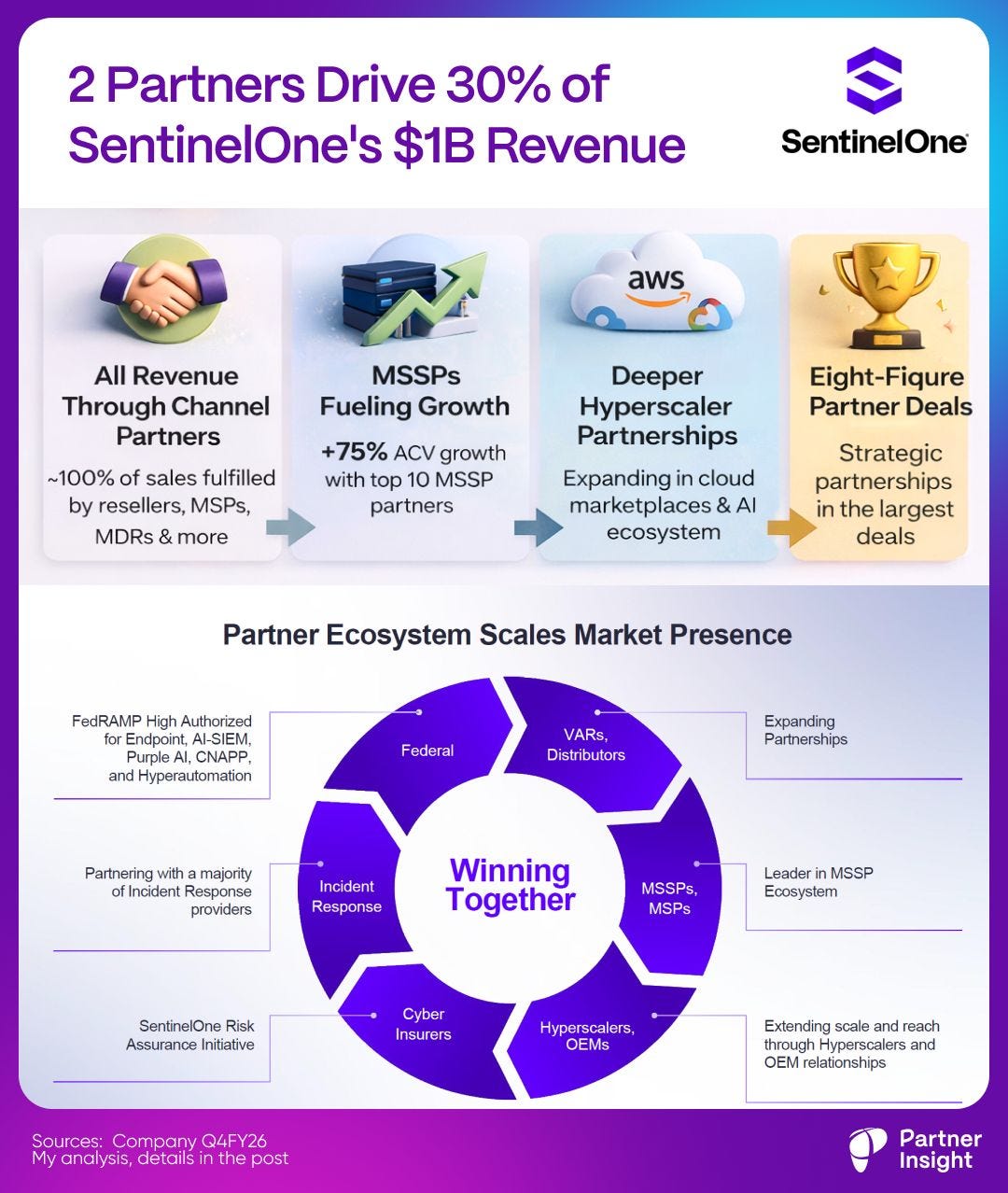
SentinelOne just crossed $1B in revenue, growing 22% YoY — and nearly a third of that flows through just 2 channel partners.
That’s not a “side channel”. That’s the business.
In FY 2026, SentinelOne surpassed $1B in revenue. In Q4, it added a record $64M in net new ARR.
But the more interesting story for alliance, marketplace, and partner leaders is this:
SentinelOne is running a partner-dependent growth model.
A few signals stood out:
Substantially all sales flow through channel partners
At $1B scale, that is worth pausing on. SentinelOne says in its reporting:
“Substantially all of our sales are fulfilled through our channel partners, including resellers, distributors, MSPs, MSSPs, MDRs, OEMs, and IR firms, and we expect that we will continue to generate a significant portion of our revenue from channel partners for the foreseeable future.”
Two channel partners alone drove 30% of total revenue
One represented 18% of revenue, another 12%. That shows the upside of deep channel alignment at scale — and the level of concentration the model can create when it works.
MSSPs are a major growth engine
CEO Tomer Weingarten said the company achieved over 60% ACV growth with its top 20 MSSP partners, and over 75% with its top 10.
That matters even more because these partners are not just reselling endpoint anymore. Management said they are adopting AI, data, cloud, and broader platform solutions and standardizing on SentinelOne.
In some segments partners run the full sales cycle
SentinelOne says that in specific market segments, channel partners independently manage the complete sales cycle.
That is not partner-assisted selling. That is outsourced scale.
Hyperscaler partnerships are deepening on two fronts
First, SentinelOne is integrating across cloud marketplaces and AI services — positioning as both a marketplace seller and an AI services integration partner.
Second, they signed a multi-year infrastructure partnership with a global hyperscaler where their threat intelligence data now pairs with the hyperscaler’s native threat intelligence services.
That’s co-build, not just co-sell. And their platform runs primarily on Amazon Web Services (AWS) across multiple regions, with Google Cloud as secondary — making SentinelOne a significant cloud customer itself.
Partners are also the leverage story
When asked about growth, Weingarten said:
“I do not think you are going to see us grow headcount in a significant way, and it will imply that sales productivity, which is reflected in the margin guide, is going to get better. And we are clear on our continued upmarket trajectory. We are clear on the need and the desire to do more with our partner base. We are clear about the potential in our partner base.”
When a $1B company says “no headcount growth” and “do more with partners” in the same breath, it tells you where the operating leverage lives. Partners are the margin story now.
Three lessons for alliance leaders:
Partner-led growth gets more powerful when partners own real parts of the sales process
The best hyperscaler partnerships combine marketplace distribution, co-sell, and co-building.
In the AI era, partners are not just routes to market. They are part of the product and scale model
Turn Marketplace Into a Real Revenue Driver: 5-week course for Alliance & Cloud GTM Leaders
If Marketplace only shows up at the end of the deal, it is not a GTM motion.
It is firefighting.

And that is where many Cloud GTM teams get stuck.
A rep pulls alliances in late
A private offer becomes urgent
The cloud rep gets a vague ask
Procurement shows up in the final week
The “win” depends on one person who knows the maze.
It may save the deal.
But it does not compound.
That is the pattern I keep seeing across SaaS and AI companies trying to scale on AWS, Microsoft, and Google Cloud.
They are “doing marketplace.”
But they are not building a repeatable Cloud GTM growth system.
The teams pulling ahead do a few things differently:
they identify marketplace as a buying path earlier, not at the end
they train sales to use it, instead of treating it as an alliances side project
they make co-sell structured: real context, clear asks, better timing
they connect channel, marketplace, and cloud field into one motion
they build internal support across finance, ops, product, and leadership
That is what turns marketplace from extra work into leverage.
And it matters more now than it did even a year ago.
Cloud commitments across Amazon Web Services (AWS), Microsoft, and Google Cloud have crossed $900B.
Customers are more open to buying software digitally.
But they are also more selective.
Co-sell is getting more competitive.
And AI is reshaping how software gets discovered, packaged, and sold through hyperscaler ecosystems.
So the gap is widening: between teams that are listed and teams that turned marketplace into a repeatable revenue driver.
David Mauer — who helped drive $100M+ in marketplace revenue at GitLab and is now rebuilding the motion at LucidLink — put it well in our Q1 recap last week:
”You never want a customer to tell you how they want to buy and have to say no.”
Over the past 2.5 years, 300+ alliance and Cloud GTM leaders have gone through our Cloud GTM Leader course to build that capability.
Some launched from zero marketplace motion to $200K revenue + $7M pipeline in 8 weeks.
Others closed their first $1M+ marketplace deal and turned it into a repeatable motion.
Some scaled marketplace revenue 4X YoY from an already high base.
That is not because they found one trick.
It is because they built the growth system.
Our next cohort starts on June 2
If you want to turn marketplace into a real growth driver — not just push isolated deals through it — this is what we work on for 5 weeks.
P.S. Thanks for reading! If this issue sparked an idea, please forward it to your alliance lead or cloud counterpart — it’s how this community shares what works.