
Okta hit $750M/year on AWS, CrowdStrike hit $1.5B (+ Claude Marketplace)

Hi, it’s Roman Kirsanov from the Partner Insight newsletter, where I deconstruct winning Cloud GTM strategies and the latest trends in cloud marketplaces.
In this week’s edition:
Okta hit ~$750M in TCV on AWS Marketplace in a single year — with Cloud GTM growing ~4X faster than total revenue. Partners were in 18 of its top 20 deals. The playbook behind it.
CrowdStrike crossed ~$1.5B on AWS Marketplace last year, still growing ~50% YoY. Then Satya Nadella joined George Kurtz to address CrowdStrike’s GTM team as it opened up on Microsoft marketplace. Co-opetition at its most explicit.
Anthropic just launched Claude Marketplace — turning AI commits into a software distribution channel. The same mechanic hyperscalers used to reshape SaaS buying, now one layer higher in the stack.
But before we dive in:
📅 March 24: Google Cloud Marketplace — Your Growth Engine for 2026
$240B in Google Cloud commits. Triple-digit GCP marketplace growth YoY.
In 2 weeks, Jay McBain (Chief Analyst, Omdia) and Dai Vu (Managing Director, Google Cloud Marketplace) are keynoting our biggest GCP online event of the year — alongside leaders from Palo Alto Networks, MongoDB, Optiv and more.
Now, let’s dive in.
Okta Hit $750M on AWS Marketplace/ year. Partners in 18/20 Top Deals
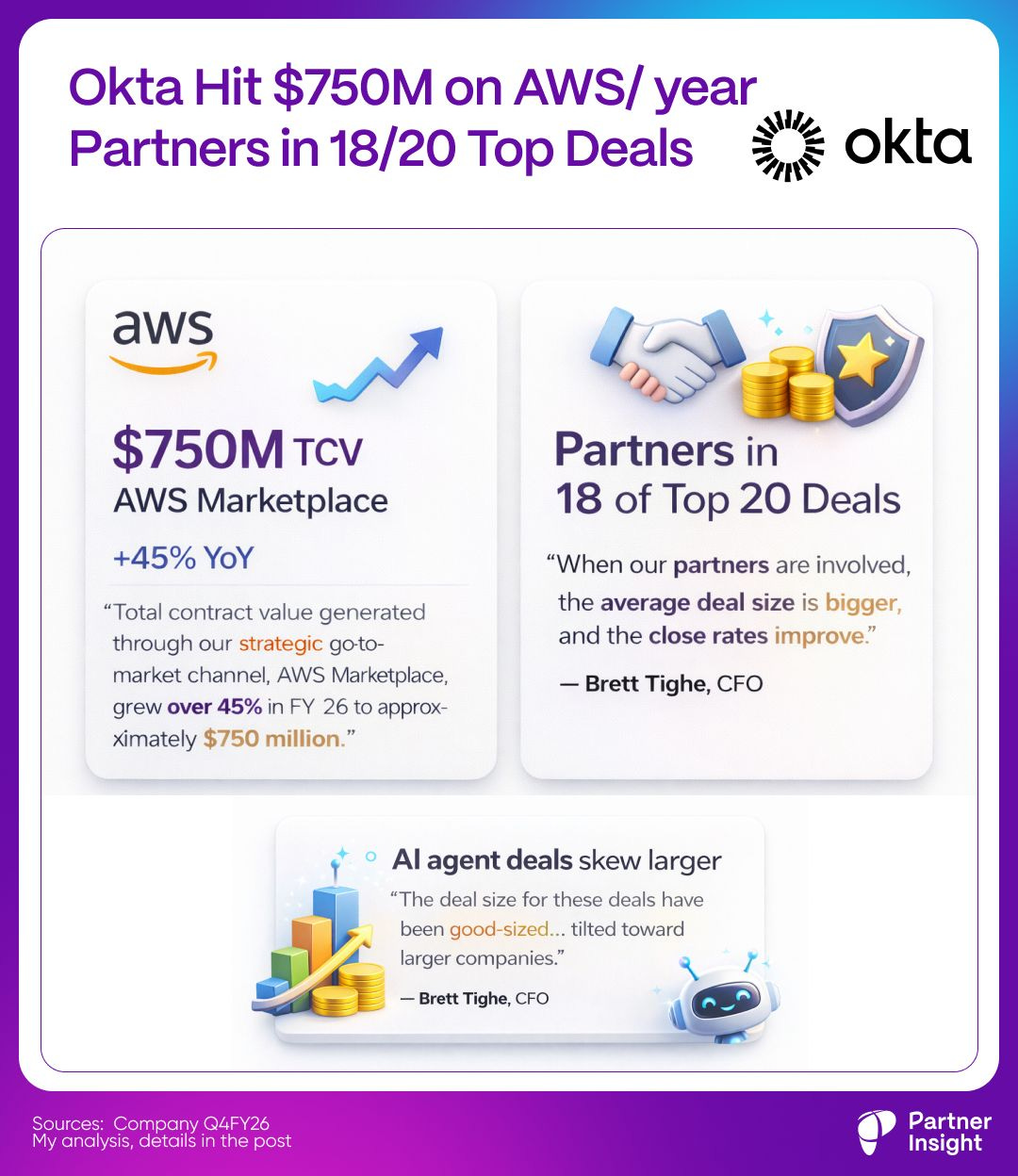
Okta closed ~$750M in TCV on AWS Marketplace last year growing 45%+ YoY.
Their total revenue grew 12%. Marketplace grew ~4X faster. That gap tells you a lot about where enterprise software distribution is heading.
Okta’s results just beat Wall Street expectations
Record $1.3B in total contract value (TCV) in Q4. New products ~30% of Q4 bookings. $3B+ in annual contract value. The growth engine is clearly firing.
But the real story is how they’re growing.
AWS Marketplace as a strategic GTM channel
Okta’s CFO called AWS Marketplace a “strategic go-to-market channel” as the company shared a ~$750M annual TCV milestone on AWS.
The context makes this even more striking.
Okta crossed $1B cumulative in AWS Marketplace sales in Jan 2025. Now they’re doing $750M in TCV in a single year.
That kind of acceleration at scale shows what’s possible when marketplace becomes embedded in how a company sells.
Partners in 18 of top 20 deals
Channel partners were involved in 18 of Okta’s top 20 Q4 deals.
And as Brett Tighe put it: “When our partners are involved, the average deal size is bigger, and the close rates improve.”
But here’s what’s interesting:
Okta is deliberately shifting more professional services work to global system integrators — a move that management said creates about a 1% impact on FY27 revenue guidance.
Why give up revenue?
Because customers need GSIs more than ever for change management around agentic AI, and Okta is betting that deeper GSI relationships will drive larger enterprise subscription growth over time.
It’s a classic long-term partner trade-off: sacrifice short-term PS dollars to build an ecosystem that can scale the platform.
Agentic is landing as enterprise deals
Okta’s new AI agent products had their first real bookings quarter.
Todd McKinnon, CEO, said Q4 “translated into real dollars and real bookings,” even if it is still small relative to the overall business.
Brett Tighe added that the deals “have been larger” because they are “more tilted toward larger companies.”
The company also said agentic identity should be accretive to growth in FY28 and FY29 — not a one-quarter story. For anyone evaluating AI-related investments, that helps clarify the timeline: plant seeds now, harvest in 12–24 months.
One more point worth noting
Despite all the industry talk about AI replacing people, Okta said it has been adding quota-carrying sales capacity starting in Q2, and continued through Q4 and into the current Q1.
When GTM is working — including partners and marketplace — you often need more people to capture the demand, not fewer.
3 lessons for alliance leaders:
Treat marketplace as a strategic GTM system
Pull SIs closer when the product requires real transformation and change management
Build for agentic now, even if the revenue curve is still ahead
How are you seeing the marketplace and partner dynamics shift in your own organization?
$240B in Google Cloud commits. Dai Vu and Jay McBain on what’s next for GCP Marketplace
$240B in Google Cloud commits. Triple-digit Google Cloud Marketplace growth YoY, billions in transaction value annually.
Managing Director leading GCP Marketplace is sharing what’s next. Joined by the top analyst who tracks where the market is going.
On March 24, Jay McBain (Chief Analyst at Omdia) and Dai Vu (Managing Director of Google Cloud Marketplace) are keynoting in our deep-dive online event “Google Cloud Marketplace: Your Growth Engine for 2026”.

Jay McBain has been the most accurate analyst of marketplace growth.
His forecast has nearly doubled 3 times in under 3 years: $45B → $85B → $163B. Each time, the industry is catching up to where he already was.
Five signals from Jay I keep coming back to:
Marketplaces projected to reach $163B by 2030
By 2027, 5 out of 10 marketplace deals will be partner-led
For GCP partners: up to $7 of partner revenue for every $1 of GCP consumption
Partner opportunity around AI is on track to $267B by 2030
AI is shifting toward micro-consumption and outcome-based selling — and marketplaces are the distribution layer that makes it work
Dai Vu leads the global teams behind Google Cloud Marketplace — business development and P&L, partner and platform strategy, co-sell and field GTM models, partner engineering and enablement.
If you sell software through or alongside Google Cloud, Dai Vu is shaping how that entire market works.
Under his leadership, GCP Marketplace has been growing triple-digits YoY for multiple years, driving billions in transaction value annually.
Google Cloud momentum is hard to ignore
Revenue grew an incredible 48% YoY last quarter
Annual run rate crossed $70B
Cloud commitments jumped to $240B — customer spend that can be used on its marketplace to buy ISV partner products
Revenue from AI solutions built by partners grew ~300% YoY
Commitments from Google’s top 15 software partners increased 16X+ YoY
His keynote on March 24 is the closest you’ll get to Google’s Marketplace strategy before Next season.
The all-star lineup (10+ speakers in 2.5h):
Keynotes from Dai Vu and Jay McBain
Leaders from Palo Alto Networks ($1.5B+ in GCP Marketplace sales), MongoDB (3X GCP Partner of the Year), Google Cloud, Optiv and more
Two panels on co-sell strategy + channel ecosystem growth, plus a deep dive on marketplace ops & automation to scale revenue
📅 March 24, 9–11:30 AM PT
This event is 4 weeks before Google Next — your chance to hear from the leaders shaping GCP Marketplace distribution, and lock in where to focus for 2026 before Next starts.
Thanks to our partner Tackle for supporting this event

Tackle (now part of AppDirect) is the Cloud GTM platform built to help software companies win in the cloud. As the category creator and leader in Cloud GTM, Tackle enables ISVs to list, transact, and scale through the hyperscalers.
Tackle streamlines every stage of the cloud marketplace journey with deep co-sell automations, private offer management, and real-time marketplace analytics.
Together with AppDirect’s global subscription commerce platform, Tackle is building the first truly unified solution for software companies to reach buyers across every route to market: cloud marketplaces, direct sales, and the channel.
Anthropic turns AI commits into software distribution
Anthropic just turned its committed AI spend into a new distribution channel for software. Meet Claude Marketplace — same idea as cloud marketplaces, different spelling.
But does Anthropic already have enough commits to make this work?
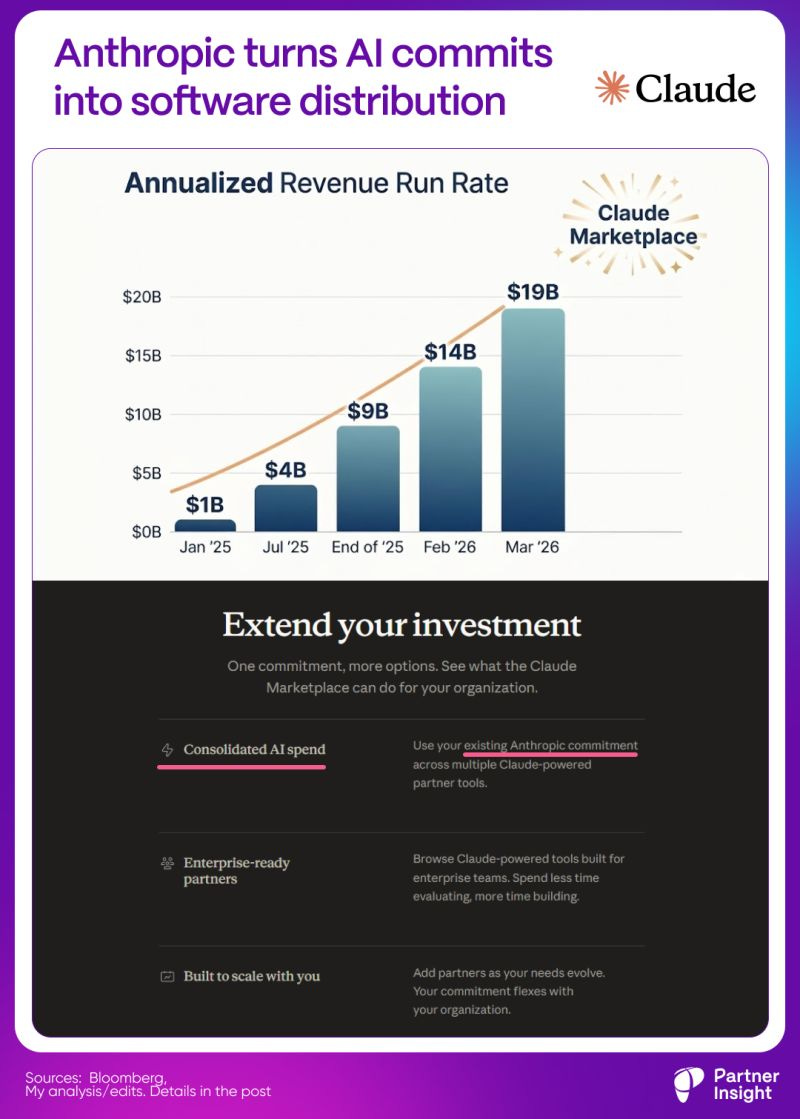
Anthropic just copied one of the most effective cloud GTM mechanics of the last decade
Claude Marketplace lets enterprises buy partner software against a share of their existing Anthropic commitments, with Anthropic handling all invoicing.
GitLab, Lovable, Replit, and Snowflake are already listed.
The implications are significant.
For 5+ years, AWS, Microsoft, and Google have taught the market that pre-committed budget can become a growth engine for third-party software.
They used commits to remove vendor friction, speed up procurement, and make SaaS easier to buy — while accelerating their own cloud consumption.
Anthropic is now applying that same mechanic one layer higher in the stack.
Claude as a mini-ecosystem
This potentially changes Anthropic’s role. It’s becoming an orchestrator around Claude — for budgets and 3rd-party software distribution.
This move also says something important:
The best application layer still matters. Anthropic’s own pitch is essentially: Claude is the intelligence layer, but Harvey, GitLab and others add the domain workflows, governance, and context enterprises need. A strong signal that frontier model vendors don’t think raw models alone will capture all enterprise value.
Anthropic also distributes Claude through Amazon Bedrock, Google Vertex AI, and Microsoft Foundry. Now it’s also running its own marketplace.
How much in Anthropic commits are we talking about?
Anthropic doesn’t disclose its backlog, but a few data points help estimate it:
$19B annual revenue run-rate as of March ‘26 (Bloomberg)
500+ customers spending over $1M annually
Business subscriptions to Claude Code up 4x since the start of 2026
So Anthropic’s commitment pool is likely already in the hundreds of millions to low single-digit billions.
Not hyperscaler-sized yet — AWS alone has $244B in backlog — but those commitments will grow fast if Anthropic continues on its recent trajectory.
The marketplace is one way to accelerate that growth and make the platform stickier. Plus, Anthropic is waiving transaction fees at launch to attract partners.
However, a big part of successful Cloud GTM with hyperscalers is co-sell — tapping into thousands of cloud sellers to bundle your product into large enterprise deals.
What this means for Cloud Alliance leaders:
Multi-listing will matter more — across cloud and AI platforms
AI commitments are becoming a new budget path. Route-to-budget is now as important as route-to-market
If Anthropic adds real co-sell, or if agentic AI changes buyer behavior, this can get big fast
First, clouds turned commits into SaaS distribution. Now frontier AI vendors are doing the same.
Are you integrating marketplaces in your GTM strategy?
CrowdStrike: $1.5B AWS Marketplace/ year, +50% YoY
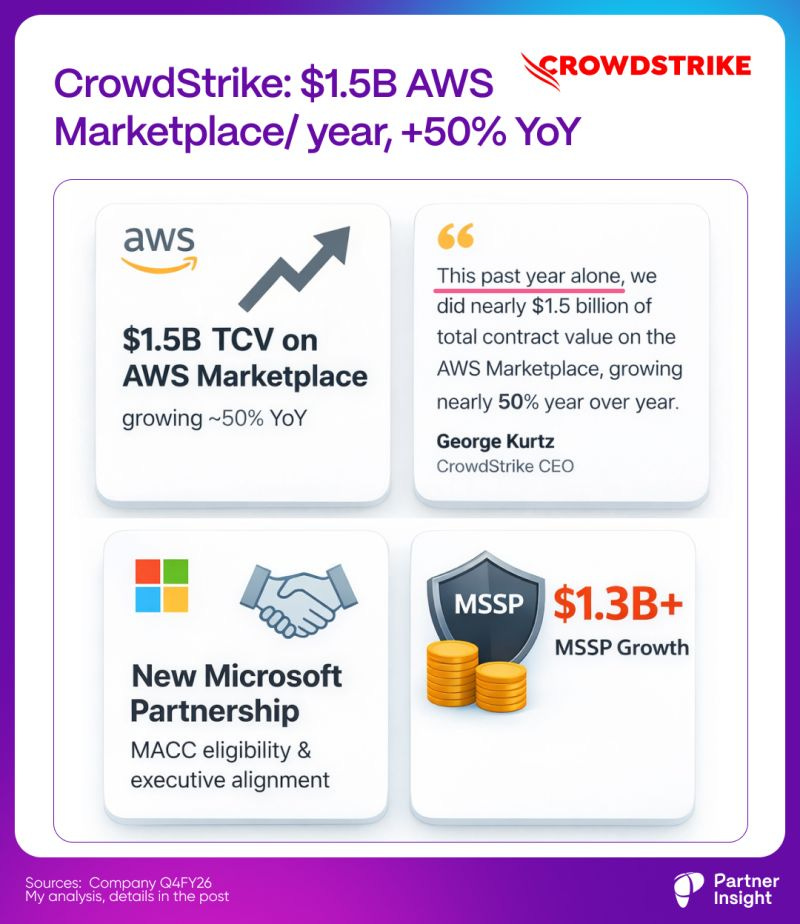
CrowdStrike hit ~$1.5B in TCV on AWS Marketplace last year, growing ~50% YoY.
Even at scale, marketplace revenue isn’t slowing down. It’s compounding.
The company just reported a stellar year: $5.25B ARR (+24% YoY) and record net new ARR of ~$331M (+47% YoY).
But the marketplace + partnerships story was the real highlight.
1️⃣ AWS Marketplace is still accelerating at $1B+ scale
“This past year alone, we did nearly $1.5 billion of total contract value on the AWS Marketplace, growing nearly 50% year over year.” - George Kurtz, CEO
Cloud marketplaces can stay a high-growth route to market… even at >$1B/year scale.
This milestone makes CrowdStrike one of two ISVs that reached this scale (Snowflake crossed $2B/year on AWS MP).
2️⃣ Microsoft Marketplace + MACC eligibility = a real distribution unlock
“Satya Nadella and I spoke to CrowdStrike’s go-to-market team together.
We are now open for business on the Microsoft marketplace, and customers can use their Microsoft Azure consumption commitment dollars on Falcon.
This is a watershed moment…”
3 takeaways:
Executive alignment is explicit (Satya + George with the GTM team).
Marketplace is positioned as the default path to burn committed cloud spend.
For a company that used to directly compete with Microsoft in security, this is a striking co-opetition move
Context: After mastering AWS Marketplace, CrowdStrike went from 0→$150M on Google Cloud Marketplace in its first year (FY25). Now they’re bringing that playbook to Azure to capture MACCs.
3️⃣ MSSPs are becoming the second growth engine alongside marketplaces
“In just over three years, we have gone from a sub-$100 million MSSP business to more than $1.3 billion…”
Marketplaces + services partners reinforce each other:
Commits drive faster buys. MSSPs drive faster outcomes.
That growth spans partners like Kroll, Pax8, and NinjaOne — and shows how quickly a services-led route to market can scale.
4️⃣ The best answer to “AI and hyperscalers will compete with you”
“Over the years, as cloud was maturing… I heard a lot about the hyperscalers actually providing all the security services.
Well, that did not happen… we transact billions through these platforms, and they are a great partner… So we see the same thing happening with what I call AI hyperscalers.”
The CEO framing is unambiguous:
“In summary, we did not just have a great partner year, we built an ecosystem to win the next decade.”
Lessons for Cloud GTM leaders:
Marketplace compounds even at scale. $1.5B and still ~50% YoY. Plan for it as a key channel, not a side bet.
Co-opetition is the new normal. CrowdStrike competes with Microsoft in security and sells through their marketplace.
Pair marketplace motion with partners who can deliver outcomes fast.
Multi-cloud marketplace expertise transfers: master one hyperscaler, then replicate fast on others.
How is your Cloud GTM strategy changing your sales conversations?
P.S. If you found these insights valuable, please forward this newsletter to your alliance lead or cloud/GTM counterpart - it’s how this community shares what works.