
OpenAI vs Anthropic: The $250M Partner Race
Co-sell, certifications and partner-led deployments are moving from clouds to AI labs. Plus: token consumption is forecast to rise 24X — AI cost control is becoming a CFO problem.

Hi, it’s Roman Kirsanov from Partner Insight newsletter, where I deconstruct winning Cloud GTM strategies and the latest trends in marketplaces and partnerships.
In today’s edition:
OpenAI just put $150M behind its new partner program (Anthropic moved first with $100M) — tiers, co-sell, certifications: AI labs are speed-running the hyperscaler partner playbook
AI token use is set to jump 24X by 2030, yet only 26% of companies can see their AI spend. Your next buyer is the CFO, and spend may be consolidating onto marketplaces.
Gartner’s counterintuitive call: AI creates more new ecosystem roles, not fewer — 40% of supply chains add them by 2029.
But first — last chance to join us in New York this week.
This Wednesday morning, we’re hosting our AWS Marketplace Strategic Breakfast before AWS Summit NYC opens — June 17, 7:30–9:30 AM ET, near the Javits Center. 8 speakers, 4 senior AWS Marketplace leaders, plus the leaders behind ServiceNow’s $1B+ AWS Marketplace milestone and Clazar’s $2B+ in marketplace transactions. A few seats remain.
OpenAI’s $150M Answer to Anthropic’s Partner Head Start
OpenAI just launched its partner program - $150M behind it, with a heavier co-sell emphasis. Anthropic moved first in March with $100M, and already 10K consultants have Claude certification.
AI labs are now building partner ecosystems that look a lot like AWS, Azure, and Google Cloud.
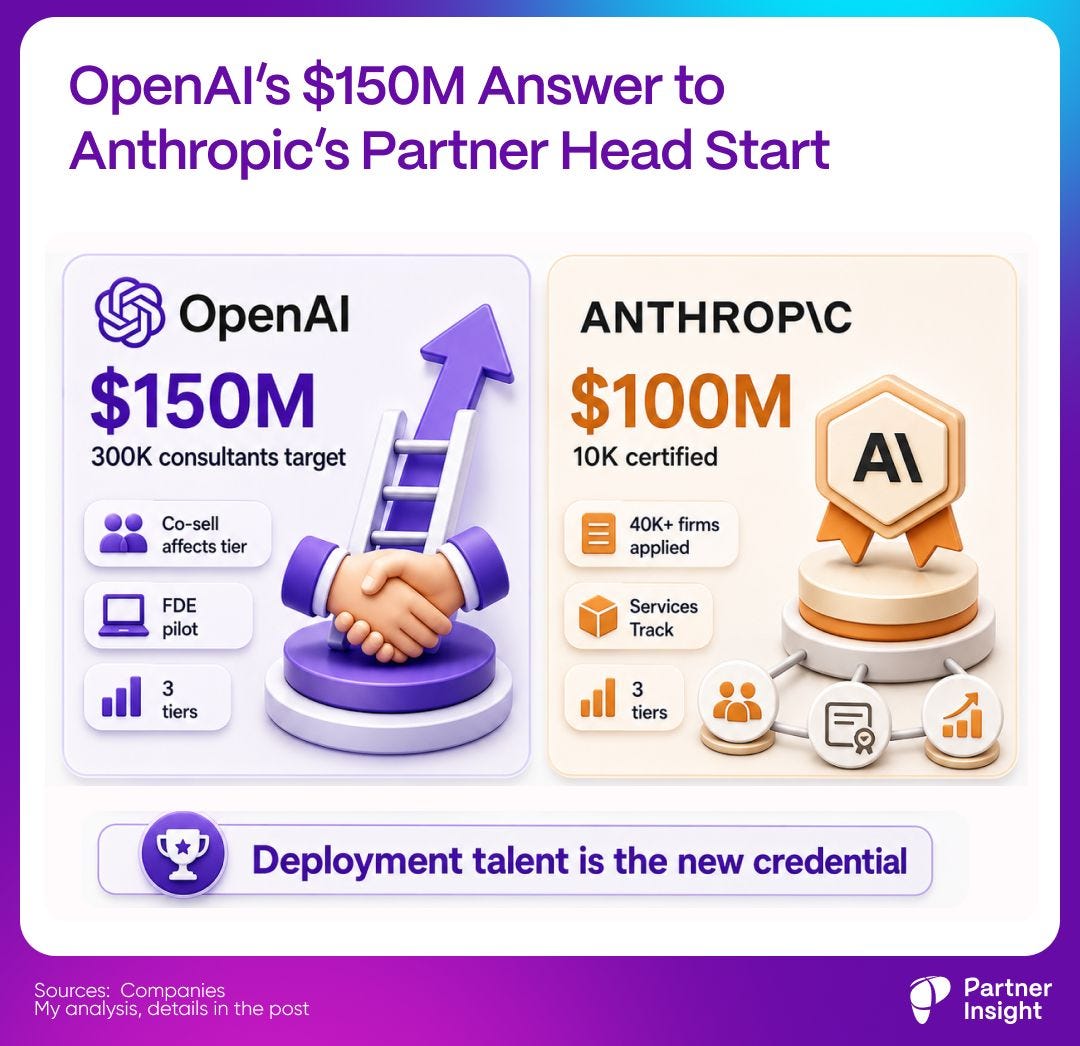
OpenAI Partner Network (June 14)
$150M, three tiers - Select, Advanced, Elite - and specializations in Codex, cybersecurity, and agents. The goal: certify 300K consultants by the end of 2026.
The fund covers enablement, offsets delivery costs, and adds MDF, when it opens in July.
Tier advancement depends on technical depth, deployment experience, and co-sell engagement.
“This ecosystem-led approach is central to how we believe AI will create value. No single company can deliver every solution, in every market, for every customer” - OpenAI
Claude Partner Network (since March)
$100M for training, technical support, and shared marketing.
As of June: 40K+ firms applied, 10K+ consultants certified.
Its Services Track, launched this month, also runs three tiers - Select, Preferred, Global Premier - measured on certified people, production deployments, and public customer stories.
Toolkits match, but here is where they split.
One design choice separates them
OpenAI ties co-sell to how partners climb the ladder. Selling with OpenAI moves you up a tier - though its partner leader frames “co-sell” less as selling, more as “how are you strategizing with us and with customers.”
Anthropic is less explicit about co-sell, though it launched Claude Partner Hub with MCP.
You can ask Claude where your firm stands against the next tier, the status of a registered deal, or how many of your consultants hold an active certification.
The scarcest resource is becoming a credential
Deployment talent is the constraint for both labs.
OpenAI’s answer is a Forward Deployed Experts pilot that pairs top partner practitioners with its own engineers. The deployment work that was internal-only is now something partners can earn.
Anthropic makes the same point differently: certification belongs to individuals, and active certification requires recent Claude use.
OpenAI partner leaders behind this signal where it goes:
Colleen Kapase led channels and partner programs at Google Cloud before joining OpenAI.
Brian Landsman ran Salesforce’s partner ecosystem for 14 years.
Tiers, co-sell, specializations, and MDF feel familiar because the people who built them at hyperscalers now work here.
Lessons for alliance leaders:
Treat AI labs as emerging hyperscaler ecosystems. You already know these mechanics - certification, tiers, co-sell, deployment requirements
Build proof around production deployments, certified people and customer stories
The same SIs you rely on for cloud co-sell and enterprise implementation are now building AI-lab practices. They can bring your product into the AI transformation story - or bring the AI lab around you
Last Chance to Join: AWS Marketplace Strategic Breakfast at AWS Summit NYC
This Wednesday, before AWS Summit NYC opens, 100+ alliance and cloud GTM leaders are gathering for breakfast.
8 speakers. 4 senior AWS Marketplace leaders. A curated room of operators building and scaling on Marketplace. Last chance to join us in New York on June 17.

We’ll focus on one essential question:
What does it take to build repeatable revenue on AWS Marketplace - a key route to market for AI and enterprise software?
AWS Marketplace leaders will cover the full picture — buyer behavior, AI-driven growth, scaling, and global expansion.
This depth of insights in this room is rare:
George Maroulakos — WW Leader, Amazon Web Services (AWS) Marketplace CoE, Buyer Experience
Few people track how customers discover, evaluate, buy, and renew across 3M+ active subscriptions as closely as George does.
Michael Levy — Senior Manager, AWS Marketplace
Michael leads feature launch and adoption, and GTM strategy for AI agents and tools in Marketplace. He works directly with top ISVs and knows what gets field support, what gets prioritized, and what gains marketplace traction.
Arif Razvi — WW Leader, AWS Marketplace Business Development
Arif leads International Expansion & New Business, helping drive AWS Marketplace’s global growth strategy as it scales past 6,000+ sellers and 25,000+ solutions globally.
Reagan Koryozo — WW Scale Adoption Specialist, AWS Marketplace
Reagan leads the Third-Party Integrator category, helping ISVs and partners operationalize Marketplace through the ecosystem and reduce the manual work that slows execution.
Whitney Bragg-Sabins — Senior Global Relationship Manager, AWS at ServiceNow
ServiceNow hit $1B in AWS Marketplace in less than two years.
Whitney will walk through the strategy behind that scale: co-sell execution, SI ecosystem activation, joint innovation, and what it takes to build toward $2B.
Trunal Bhanse — CEO, Clazar
Clazar has facilitated $2B+ in cloud marketplace transactions, and is trusted by companies like Cursor, Perplexity, Replit, and Zapier. Trunal will break down how leading teams turn marketplace GTM into a repeatable system that scales with limited resources.
David Mauer — VP of Channel & Alliances, LucidLink
David built $100M+ in marketplace revenue at GitLab with partners. At LucidLink, he just rebuilt their entire partner GTM so 39% of revenue now runs through channel — with AWS Marketplace at the center.
Roman Kirsanov — CEO, Partner Insight
I’ll break down market context: AWS commits have reached $364B — spend that increasingly flows through Marketplace to ISVs.
Marketplace is becoming a core GTM operating layer for AI and enterprise software. This is the room where operators compare notes on what that means in practice.
June 17, 7:30–9:30 AM ET, near Javits Center, NYC
Last chance to join
Thank you to our event partners:

Clazar, our Presenting Partner, is the leading Cloud Sales Acceleration Platform for GTM teams scaling revenue through AWS, Azure, and Google Cloud marketplaces.
From listing to co-selling to revenue reconciliation and recognition, Clazar helps companies streamline and automate their entire cloud sales journey from a single, unified platform—with zero operational overhead. Top AI companies like Cursor, Perplexity, Replit trust Clazar to power their success on cloud marketplaces.

ServiceNow is a proud sponsor of the AWS Marketplace Strategic Breakfast at AWS Summit NYC.
As one of AWS Marketplace’s most significant partners — crossing $1.5B in Marketplace TCV in record time — ServiceNow is focused on what comes next: bringing 12 joint innovations to life for enterprise customers, activating a world-class SI ecosystem, and going deep in the industries where AWS and ServiceNow create outcomes neither could deliver alone.
AI Spend Is Scaling Faster Than CFOs Can Track It
Anthropic shipped its most capable model last week, and while it’s been temporarily suspended, it was priced 2X Opus 4.8 on a per-token basis.
CFOs are now asking a different question: what will this Agentic AI shift cost us — and how do we control the spend?
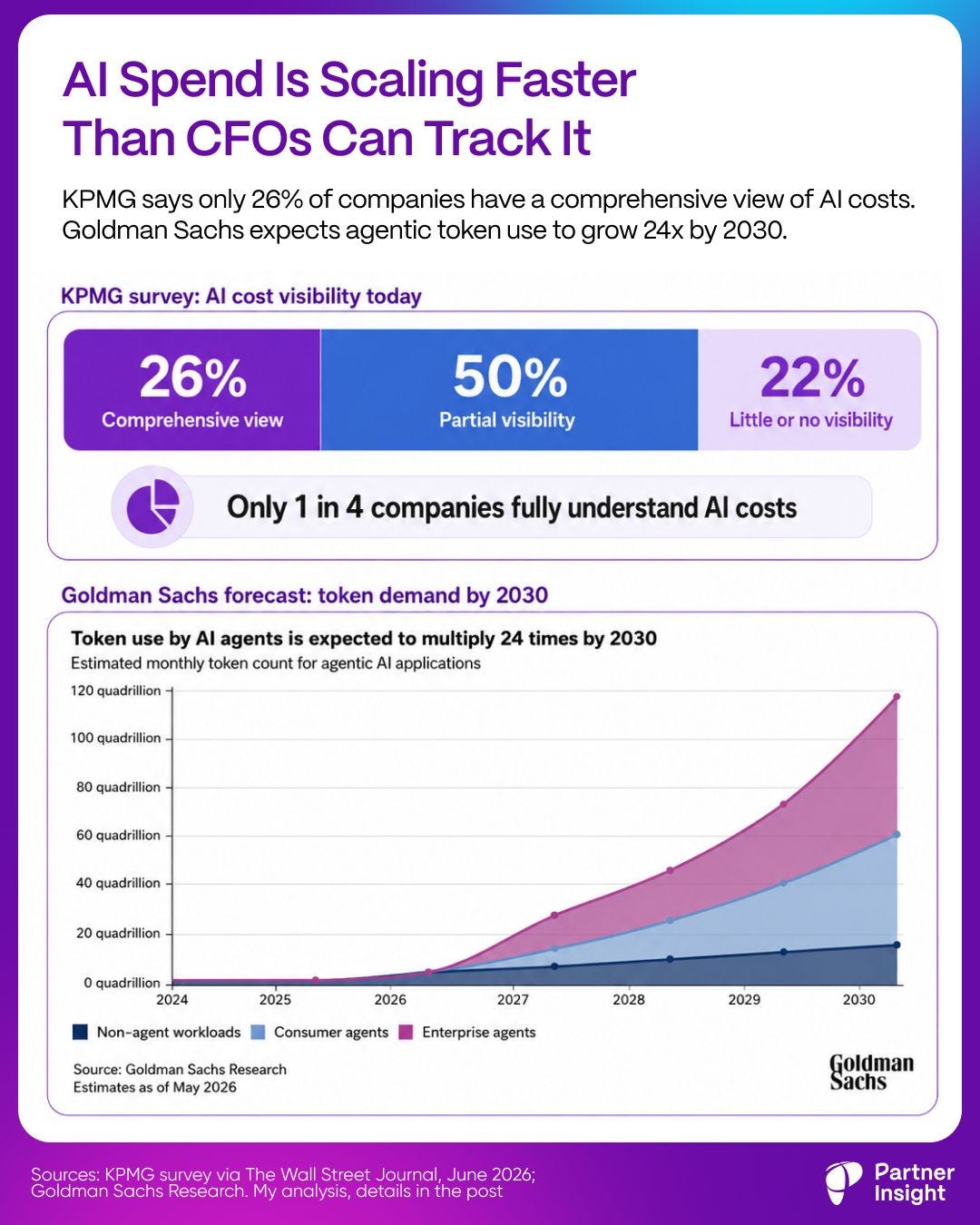
AI demand side is staggering
Goldman Sachs forecasts AI token consumption will multiply 24x by 2030, to 120 quadrillion tokens per month.
The mechanics explain why: an agent doesn’t answer one query, it runs a sequence of them — blowing up a simple chatbot request 10x, 20x, 50x in compute.
And even though we’re now talking quadrillions, the assumptions underneath are conservative. Goldman models just 12% of knowledge workers using agentic AI by 2030, rising to 37% by 2040.
Bill is already arriving
Per a new KPMG survey (via WSJ), only 26% of companies have a comprehensive view of their AI costs.
50% have partial visibility
22% have none - they only see it after billing
The challenge follows: Uber burned through its entire 2026 AI coding budget by April.
One KPMG client watched token usage grow 6X. Jellyfish says per-developer token consumption rose ~19X in nine months.
And one company reportedly ran up a $500M Claude bill after skipping usage limits.
KPMG’s Steve Chase in WSJ on AI token cost:
“It’s a new resource that needs to be managed that didn’t exist quite that way.”
AI is no longer just a CTO/platform conversation about model capability.
It is becoming a CFO, procurement and FinOps conversation about variable spend, auditability, routing, budgets, commits and governance.
Response is forming:
The Linux Foundation is standing up the Tokenomics Foundation to bring token spend into the same kind of discipline FinOps brought to cloud. Model routers, AI gateways and observability vendors are racing into the gap.
Meanwhile, spend is consolidating where governance already exists
Increasingly, that means cloud marketplaces: one bill, drawdown against existing cloud commits, procurement controls built in.
Marketplace teams tell us Anthropic is becoming one of their top revenue performers - and recent Ramp data shows it just passed OpenAI in business adoption (34.4% vs. 32.3%) for the first time in April.
Marketplaces won’t be the only control plane for AI spend. But they are the ones that already operate at scale.
Lessons for alliance and tech leaders:
Your buyer now includes the CFO. AI deals (and others) will run through finance, so cost visibility and commit drawdown belong in your pitch — not just capability.
ISVs that make spend predictable and controllable — private offers against commits, usage transparency, sensible defaults — will win deals and renewals that capability alone won’t.
Is AI cost control becoming the next big marketplace use case — or will FinOps tooling get there first?
Gartner: AI Will Create More Ecosystem Roles in Supply Chain, Not Fewer
40% of supply chains will create new ecosystem relationship roles by 2029 as AI changes how supply chains work.
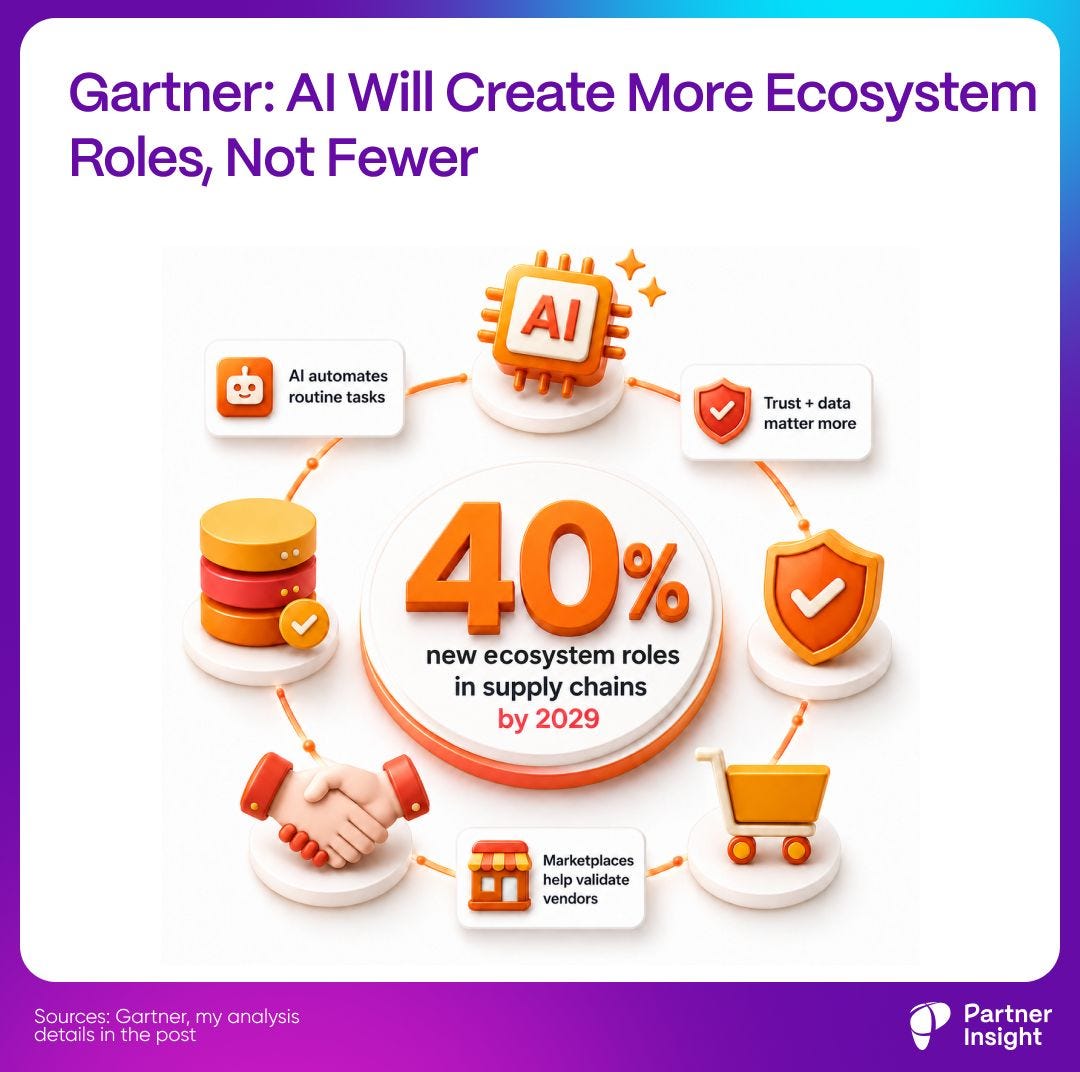
This recent Gartner prediction raises a question: Why would AI create more ecosystem roles?
Shouldn’t automation reduce the need for people managing supplier and partner relationships?
I think the answer is in what AI can automate first.
AI is automating routine procurement work
Routine procurement interactions are becoming easier to hand over to agents: supplier checks, risk monitoring, compliance reviews, guided buying, renewals, onboarding and market scanning.
Gartner’s message at its Supply Chain Symposium in May was much more grounded.
Procurement leaders should be careful with agentic AI hype. AI agents can handle bounded tasks. Broader agentic AI, where systems coordinate across workflows, is still early.
They also pointed to a gap between what people think agentic AI can do, what it can reliably do, and what vendor demos show.
So the near-term opportunity is practical: targeted sourcing and procurement use cases.
Procurement starts depending more on trusted inputs
That is where the ecosystem angle becomes interesting.
The more procurement becomes AI-assisted, the more it depends on trusted inputs.
AI can compare vendors faster.
It can screen risk faster.
It can surface contract or compliance issues faster.
But it still needs clean supplier data, reliable partner records, clear ownership, governed workflows and human accountability.
This is why ecosystem roles do not disappear. They move closer to trust, data quality and orchestration.
There is also a readiness gap
Gartner found only 17% of surveyed supply chain leaders are pursuing immediate transformational redesign. 83% are moving incrementally.
The blockers are familiar: low data quality, fragmented vendor landscapes, inconsistent partner data, immature workflows and continued need for human expertise.
That explains why new ecosystem roles are emerging.
AI reduces manual coordination, but increases the need for trusted digital coordination.
What about marketplaces?
If an AI-assisted workflow is evaluating (software) vendors, it needs more than a polished website or a broad value proposition.
It needs structured proof:
Marketplace availability
Integrations
Security posture
Compliance status
Pricing and renewal paths
References
Support coverage
Partner certifications
That makes marketplace listings more important. A listing is no longer only a storefront. It becomes part of vendor validation.
For a human buyer, missing information creates friction.
For an AI-assisted procurement workflow, missing information can mean being filtered out before a conversation starts.
AI will automate more procurement tasks, but enterprise buying will still depend on credible partners, governed workflows and trusted ecosystems.
P.S. Thanks for reading! If this issue sparked an idea, please forward it to your alliance lead or cloud counterpart — it’s how this community shares what works.