
Snowflake’s AWS Marketplace Math: $2B Year, $7B Total
Plus: Elastic tells investors hyperscaler partnerships are why they win, Zscaler hits a $100M/month marketplace run-rate, and 5 patterns still stall Cloud GTM teams.

Hi, it’s Roman Kirsanov from Partner Insight newsletter, where I deconstruct winning Cloud GTM strategies and the latest trends in cloud marketplaces.
In today’s edition:
Elastic tells Wall Street that hyperscaler partnerships are one of four competitive pillars — while its cloud revenue hit $837M, 48% of total
Snowflake crossed $2B+ on AWS Marketplace in 2025 and $7B+ lifetime — while signing a new $6B AWS deal and raising growth guidance.
$1.2T in cloud commits is creating a huge opportunity — but 5 repeatable patterns still keep Cloud GTM teams stuck.
Zscaler doubled marketplace sales to $900M in 9 months — a $100M/month run-rate inside an already partner-led GTM model.
Before we dive in:
Cloud GTM Leader Cohort 15 starts tomorrow — June 2.
Five weeks to build the system that turns marketplace into repeatable revenue: co-sell, internal alignment, sales enablement, KPIs, scaling frameworks and partner-led growth.
300+ alumni rated it 9/10. If marketplace and co-sell are H2 priorities, this is the cohort to join.
Snowflake’s AWS Math: $2B+ Year, $7B Total
~45% of Snowflake’s revenue now runs through AWS Marketplace: $2B+ in 2025 alone, $7B+ total.
They just committed $6B more to AWS and raised their full-year growth outlook.
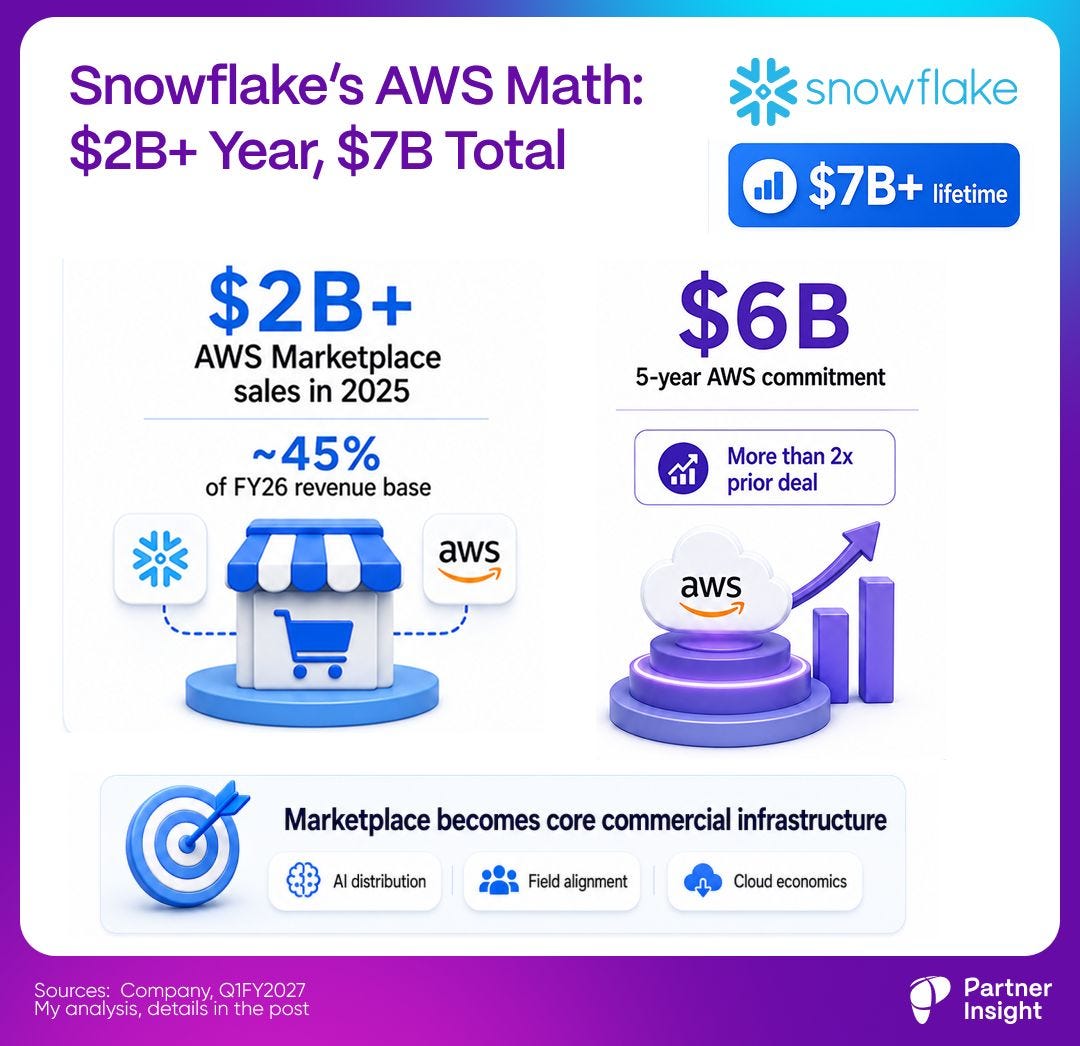
Snowflake reported Q1 FY2027 earnings last week
Product revenue hit $1.334B, growth accelerated to 34% YoY. The company raised its full-year outlook from 27% to 31%.
The same day, Snowflake signed a five-year, $6B infrastructure deal with AWS - more than 2X its prior contract from three years ago.
Interestingly, Snowflake exceeded $2B in AWS Marketplace sales in calendar 2025, also 2X+ YoY. Lifetime sales crossed $7B.
Against FY2026 total revenue of $4.68B, marketplace now accounts for ~45% of Snowflake’s revenue.
A few years ago, that share would have sparked debate over whether relying on one partner was wise. Today it shows the scale and the central place that cloud marketplaces have reached in enterprise software distribution.
Cloud partnership GTM is now priced into guidance raise
CFO Brian Robins confirmed the AWS deal is fully factored into Snowflake’s raised FY2027 outlook. AWS committed to “expanded go-to-market investment and collaboration” — co-sell, joint customer programs, and workload migration support.
Robins also noted the contract helps offset lower gross margins on AI products like Cortex Code by reducing infrastructure costs. That’s how Snowflake holds 75% product gross margin guidance despite surging AI revenue. The AWS deal fuels growth and protects margins at the same time.
Discovery, not just procurement
Snowflake calls AWS Marketplace “the fastest path to procure and deploy” its AI and data capabilities. The expanded agreement is designed to help customers ‘discover, procure, and deploy AI and data solutions through AWS Marketplace’ and includes joint investments in customer success, workload migrations, and strategic industry solutions.
AWS field teams actively help Snowflake win enterprise accounts. Customers buying and deploying AI products — Cortex AI, Snowflake Intelligence, Cortex Code — are doing it through marketplace, against cloud commits.
CEO Sridhar Ramaswamy:
“With AWS, we are making it easier for enterprises to bring AI directly to governed data.”
New benchmark — with a challenger
Snowflake’s $7B lifetime and $2B+ annual pace sets the bar for data and AI companies. But Salesforce — a line-of-business software company — is already at ~$3B annually and crossed $5B+ total on AWS.
The race at the top keeps accelerating. Stay tuned as we track the $1B+ Marketplace Club.
3 lessons for alliance leaders:
When ~45% of a $5B+ company’s revenue flows through one marketplace, it becomes core commercial infrastructure
Partners pricing co-sell into growth guidance is the clearest signal cloud GTM is now an operating model
$2B annual is the new marketplace benchmark for top ISVs
How much of your revenue runs through cloud marketplaces?
5 patterns stalling Cloud GTM teams
Cloud commits crossed $1.2T. Yet, too many GTM teams still run marketplace as a side project.
That disconnect is the single biggest theme after training hundreds of alliance, marketplace, and partnership leaders across 14 cohorts of Cloud GTM Leader.

The market has never been better for Cloud GTM
Enterprise buyers increasingly start procurement with “we have cloud commits to use.” Hyperscaler CapEx is expected to reach $550B+ across the Big 3 clouds this year. AI is accelerating cloud consumption and creating new buying paths.
But many teams still struggle to turn marketplace presence into repeatable revenue.
Five patterns that keep holding teams back:
1. They list, but don’t build a system
Getting listed on AWS, Azure or Google Cloud Marketplace is (still!) treated as the finish line. It is only the starting point.
The teams that scale build the full operating system around it: sales process, cloud alignment, marketplace operations, enablement, and channel integration. Listing without GTM infrastructure is like launching a product with no distribution.
2. They chase cloud sellers without a clear ask
Most teams want co-sell support from hyperscalers. Few make it easy for cloud sellers to understand why the deal matters — to the customer and to the cloud provider’s own priorities.
Co-sell works when the ask is specific, structured, and tied to real customer and cloud outcomes. Not “any help is appreciated.”
3. Sales stays on the sideline
Marketplace is still treated as a partnerships initiative in too many companies. That caps growth.
The companies scaling fastest embed marketplace into the sales motion. Sellers know when to introduce it, how to qualify cloud budget, and how to use marketplace to cut procurement friction. Without sales buy-in, marketplace stays a side project.
4. No shared KPIs or internal business case
Cloud GTM touches partnerships, sales, finance, product, legal, and leadership. When each team defines it differently, execution stalls.
The strongest teams align around clear KPIs, realistic expectations, and shared ownership of the revenue role marketplace should play. That alignment starts with one internal business case — not five.
5. Marketplace, co-sell, and channel stay fragmented
Marketplace is not just procurement. Co-sell is not just partner management. Channel is not a separate workstream.
The teams that scale connect these motions into one system — where cloud providers, sellers, internal teams, and partners reinforce each other deal by deal.
These are exactly the gaps we work through in Cloud GTM Leader
Cloud GTM Leader is our 5-week cohort course for alliance and Cloud GTM leaders building repeatable growth across AWS, Microsoft, and Google Cloud.
Inside the course: marketplace strategy across maturity stages, co-sell motions that work, internal buy-in with CEO/CRO/CFO, sales enablement, KPIs, business case frameworks, and partner-led growth.
Our summer cohort starts tomorrow - June 2
If you want to turn marketplace into a real growth driver — not just push isolated deals through it — this is what we work on for 5 weeks.
Is your team building a Cloud GTM system - or still running marketplace as a project?
Elastic: Hyperscaler Partnerships Are Why We Win
Elastic just told investors that hyperscaler partnerships are part of why they win.
It posted an excellent quarter. Cloud revenue reached $837M for the year - 48% of total.
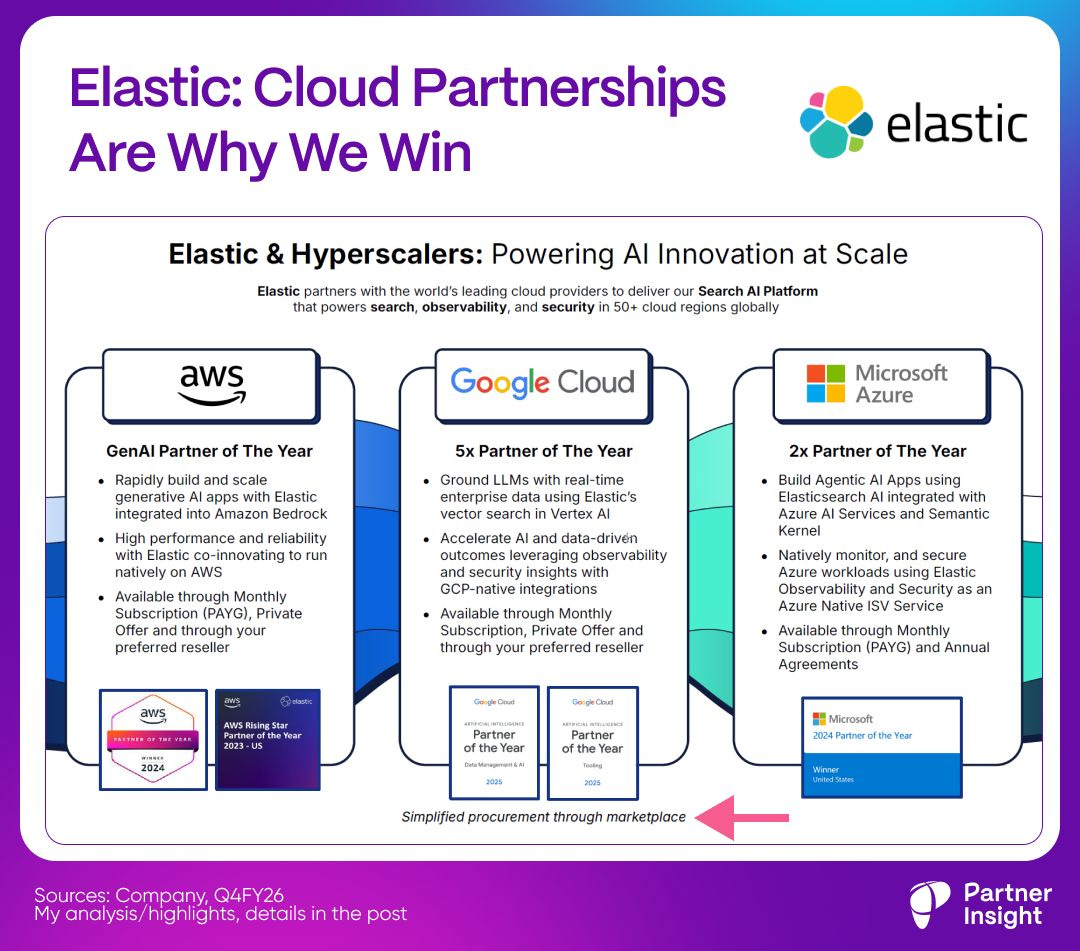
Elastic reported Q4 FY26 results that changed analyst sentiment
Revenue $1.74B for the year, up 17%. RPO grew 28% to $1.98B, much faster than revenue.
This mirrors what we see across the ecosystem: committed spend is accelerating. Customers are locking in for the platforms they trust and rely upon.
But the partnership and cloud signals are what stood out.
Power of Partnerships is one of 4 strategic pillars Elastic presents to Wall Street
It includes:
Strategic partnerships with hyperscalers, including co-investments
Technology integrations
Preferential access and relationships
Joint sales pursuits
In addition to alliances as a competitive advantage, they highlight to investors “simplified procurement through marketplace.”
Award-winning GTM across all three major cloud marketplaces
Google Cloud: 5X Partner of the Year. Won 2026 Google Cloud Marketplace Partner of the Year for Data Management & AI.
Integrated with Vertex AI. Available through Monthly Subscription, Private Offer, and reseller.
Amazon Web Services (AWS): integrated into Amazon Bedrock, GenAI Partner of the Year.
Available through PAYG, Private Offer, and resellers. FedRAMP High on AWS GovCloud.
Microsoft Azure: 2x Partner of the Year. Integrated with Azure AI Services and Semantic Kernel. Azure Native ISV Service for observability and security.
Available through PAYG and Annual Agreements.
That is the modern cloud GTM stack:
technical integration
cloud-native deployment
marketplace procurement
reseller optionality
field alignment
regulated-sector access
AI is a growth driver
600+ Elastic Cloud customers with ACV above $100K are using Elastic for AI. That is more than one-third of the enterprise cohort.
Elastic is building across the full multi-cloud AI stack. Vertex AI. Amazon Bedrock. Azure AI Services. Gemini Agent Platform. MCP Apps for security and observability that embed workflows into Claude, VS Code, and GitHub Copilot.
CEO on MCP:
“I think it’s going to be a durable advantage, especially because we are able to not just provide access to data, but smart access to data.”
3 takeaways for alliance leaders:
When cloud partnerships and marketplaces appear in investor materials as a competitive pillar, it tells you the scale of impact they are driving
AI integration across cloud platforms is becoming a strong co-sell lever. Connect your AI use cases to hyperscaler consumption
Marketplace is most powerful when paired with native cloud services, private offers, reseller paths, and field-level joint pursuits - not just a listing
How does your company leverage cloud partnerships?
Zscaler’s Marketplace Sales Doubled to $900M in 9 Months
Zscaler transacted $900M through cloud marketplaces in 9 months. That’s $100M/month.
Marketplace TCV more than 2X (doubled) YoY, making it the fastest growing GTM channel.
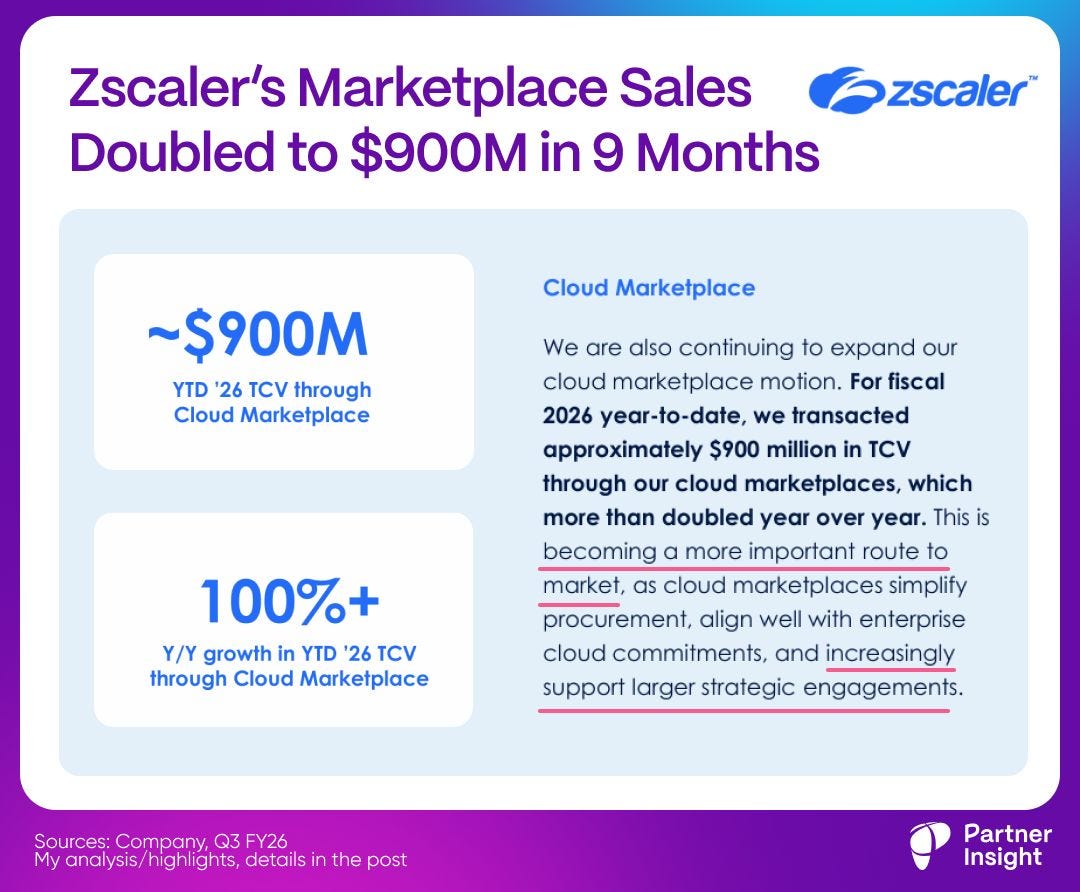
Zscaler reported Q3 FY2026 earnings, ARR hit $3.5B, growing 25%
But marketplace TCV grew much faster than overall revenue, >100% YoY.
For context, Zscaler crossed $1B in total Amazon Web Services (AWS) Marketplace sales last November.
Now they’re doing $900M across all cloud marketplaces in 9 months of the current fiscal year.
CEO Jay Chaudhry:
“This is becoming a more important route to market, as cloud marketplaces simplify procurement, align well with enterprise cloud commitments, and increasingly support larger strategic engagements.”
84% of Zscaler’s revenue already runs through partners
Zscaler disclosed that channel partners generated $2.07B in revenue over the first nine months — 84% of total.
Zscaler is deeply partner-led historically. And cloud marketplaces are the fastest-growing layer inside that partner mix.
New logo growth is the priority — and partners are the answer
Zscaler is focusing on growing new logo acquisition.
Chaudhry explained how they plan to do it: the company has more limited coverage in the lower end of enterprise, roughly 2,000 to 10,000 users
“The channel, especially the VAR channel, plays an important role in the low end of the market. So we are creating specific programs and incentives for new logo in that area.”
For large enterprises, the partner motion is global system integrators.
CEO highlighted “strong growth in bookings through our GSI partners.”
AI Protect crossed $100M in bookings within a year of launch
AI Protect is Zscaler’s suite for securing enterprise AI usage. Bookings crossed $100M in the trailing twelve months since its launch.
The partner play:
Zscaler launched Project AI-Guardian with GSI partners to extend Zero Trust to AI agents. GSIs will build specialized AI discovery and risk mitigation services on the AI Protect portfolio.
Zscaler also partners with Anthropic on Project Glasswing, and with OpenAI as part of its Daybreak program.
Takeaways for alliance leaders:
When marketplace TCV grows much faster than overall revenue, the channel mix is shifting. Cybersecurity is leading the marketplace adoption, but data, observability, and line-of-business software are fast following.
Study the partner segmentation: VARs for coverage, GSIs for major transformation, marketplaces for procurement. Each has a defined role in the growth plan
AI security is creating a new services attach opportunity for GSIs — implementation revenue around AI discovery and agent risk, not just resale.
Is cloud marketplace part of your GTM?
P.S. Thanks for reading! If this issue sparked an idea, please forward it to your alliance lead or cloud counterpart — it’s how this community shares what works.