
Zoom's Partner Math: 10/10 Top CCaaS Deals Channel-Led, $1B+ Anthropic Bet
Plus: For AI GTM, partnerships are “an incredibly efficient strategic lever,” — new research. NVIDIA’s $75B data center revenue split reveals how fast AI is scaling.
Hi, it’s Roman Kirsanov from Partner Insight newsletter, where I deconstruct winning Cloud GTM strategies and the latest trends in cloud marketplaces.
In today’s edition:
Zoom’s partner math is hard to ignore. 10 out of 10 top contact center deals were channel-driven — 8 of them competitive rip-and-replaces. Plus: a quiet $1.27B Anthropic bet and what its multi-model AI architecture means for partnerships.
Only 3% of AI companies use partnerships as their primary GTM motion — yet the research calls it “an incredibly efficient strategic lever for scalable growth.” What this gap means, and why building partner infrastructure before $25M ARR compounds.
NVIDIA just split its $75B data center business in two — and the non-hyperscaler half grew 2.5x faster last quarter. AI is scaling into neoclouds, enterprises, and factory floors. The partnership surface area is expanding with it.
The next Cloud GTM Leader cohort starts next week, on June 2. Join us for a 5-week deep dive on turning cloud marketplaces from end-of-deal firefighting into a repeatable revenue system.
Before we dive in:
Cloud commits crossed $1.2T+. AWS alone is at $364B, up $120B in one quarter. Tomorrow (May 27, 9–10 AM PT), we're hosting a free tactical workshop with AWS, LangChain, Grafana Labs and Clazar — breaking down 5 marketplace playbooks AI and SaaS teams are using to scale revenue. Last chance to join us.
Zoom's Partner Math: 10/10 Top CCaaS Deals, $1B+ Anthropic Bet
Zoom is one of the few software stocks that is up 22% YTD. Just raised full-year guidance. On track to cross $5B ARR.
The standout growth segment? Contact center. And 10 out of 10 top deals were channel-driven.
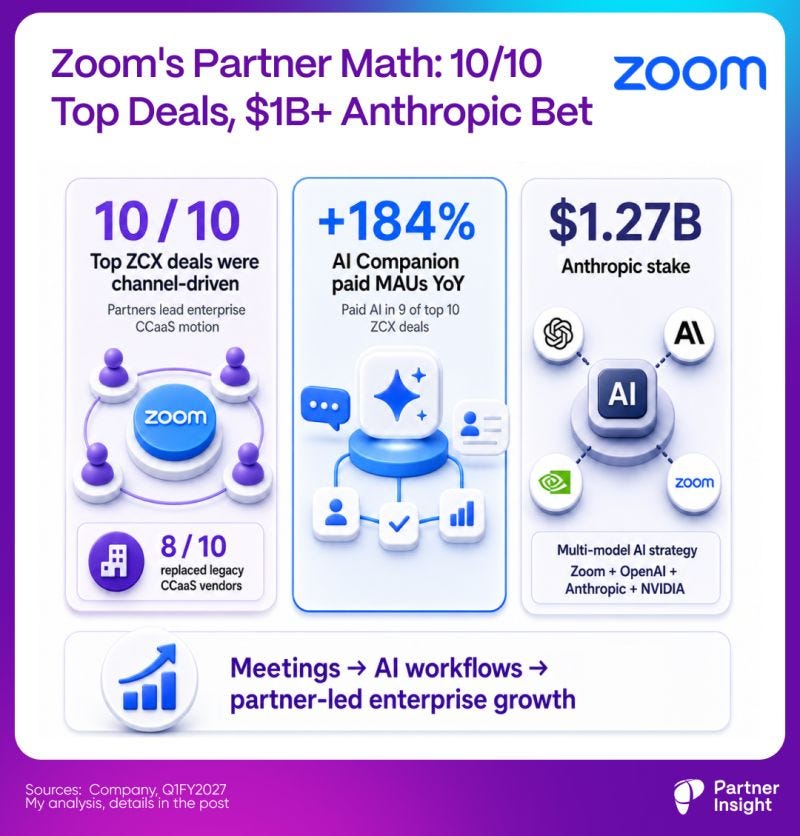
Zoom’s Q1 earnings tell a partner-led growth story
Eric S. Yuan, CEO:
“…a lot of new customers, they want to deploy CCaaS. They would like to leverage channel partners.
You look at our top 10 deals, 10 out of 10 are channel driven. Our channel partners, they know how to pitch our story. How to sell to our enterprise customers.”
These aren’t greenfield wins. In 8 of those 10 top contact center deals, Zoom displaced a legacy CCaaS vendor. Partners are running competitive rip-and-replace at scale.
Million-dollar-plus deals hit one of the strongest levels Zoom has ever recorded — in a Q1.
AI is now embedded in the enterprise deal structure
Zoom’s AI Companion paid monthly active users grew 184% YoY. And 9 of the top 10 contact center deals included paid AI.
The pattern keeps showing up across SaaS earnings this quarter: AI features drive larger contracts and more partner involvement, because deployment complexity rises with them.
Zoom is responding by deploying forward-deployed engineers inside enterprise accounts to accelerate AI adoption — the same approach used by Google Cloud, Open AI, Anthropic and others. When your AI product needs that level of hands-on support, the door opens wider for SIs and advisory partners.
Zoom’s biggest external AI bet: $1.27B in Anthropic
Zoom has been quietly investing in Anthropic since 2023. During Q1, Zoom added another $46M to its Anthropic preferred stock, bringing total carrying value to $1.27B.
On top of that, $99.7M went into other private AI companies in the quarter.
Zoom is building AI capabilities and ecosystem through investments, not only internal R&D or vendor relationships.
Zoom itself isn’t locking into a single model.
Their federated architecture dynamically routes across OpenAI, Anthropic, NVIDIA, and Zoom’s own models. For tech partnership leaders, that’s a playbook on how top companies avoid vendor dependency.
One more signal: Zoom just hired Russell Dicker as its new CPO — a familiar hyperscaler story:
“Russell brings more than 25 years of product leadership experience across Microsoft, Google, and Amazon, including leading Microsoft Teams’ product and data science teams.”
3 lessons for alliance leaders:
When one of the fastest-growing product lines is 100% partner-led at the top end of the market, it shows what can scale through partners.
AI is making enterprise deals larger and more complex, which pulls partners deeper into both the sale and the deployment
Multi-model AI architectures create more partnership surface area and reduce single-vendor risk for everyone in the ecosystem
Is your partner motion keeping pace with your fastest-growing product line?
Tomorrow: LangChain, AWS, Grafana & Clazar on Playbooks they Use to Scale Marketplace Revenue
Cloud commits crossed $1.2T+. AWS alone is at $364B, up $120B in a single quarter.
That creates a massive pool of pre-committed enterprise technology budget — and a growing share can be routed to software purchases through cloud marketplaces.
But for most AI and SaaS teams, the playbook for turning marketplace listings into revenue growth is still being written in real time.
Tomorrow’s workshop (May 27, 9–10 AM PT) brings together operators and leaders who have built Cloud GTM from 0→1 and scaled marketplace revenue to $100M+. Last week we introduced Nate Stecz from AWS and Rob Weidner from Grafana Labs. This week, meet two more leaders joining us tomorrow.
Karan Singh — Head of Partnerships, LangChain
From a standing start to launch partner for AWS Marketplace’s AI Agents & Tools category — and 2026 Google Cloud Marketplace Partner of the Year.
That’s the LangChain marketplace story and Karan Singh is the operator building it.

Karan is LangChain’s founding partnerships hire, building the 0→1 motion across cloud/hyperscalers, technology ISVs and SIs.
LangChain is at the center of AI application development: $1B+ valuation, 150M+ monthly downloads across LangChain + LangGraph, and teams like Replit, Harvey, Clay and Rippling building with it.
In a short window, Karan led LangChain’s move from early marketplace motion to real cloud marketplace traction and recognition:
2.7x increase in monthly co-sell deal registrations and 2x increase in inbound monthly referrals from cloud providers in 6 months
LangChain was a launch partner for AWS Marketplace’s AI Agents & Tools category with LangSmith + LangGraph Platform
It was named 2026 Google Cloud Partner of the Year in Marketplace: Agent Platform
Before LangChain, Karan was at AWS for 4 years, most recently leading Agentic AI Strategic Partnerships, building alliances with leading agent and AI infrastructure companies and shaping how AWS shows up for AI partners.
On the panel, Karan will break down parts that matter most in marketplace traction:
How to think about build → market → sell with AWS and what it looks like in an AI-first world
How to drive marketplace motions with sellers not familiar with cloud co-sell
How to reduce the perceived risk that slows early marketplace deals
How to think about building the foundational pieces in a startup to set up for cloud co-sell
How to align and influence marketing, product and engineering to think about cloud marketplaces as a distribution channel
Trunal Bhanse — CEO, Clazar
If Karan will cover the 0→1 journey, Trunal sees what happens at scale — where marketplace GTM breaks operationally, and what unlocks the next stage of growth.
Clazar has facilitated $2.5B+ in cloud marketplace transactions across AWS, Azure, and GCP. Top AI companies including Cursor, Perplexity, Replit, Zapier and n8n use Clazar to power their marketplace operations.

At that volume, Trunal has seen every bottleneck that slows ISVs down — and what the teams that break through actually do differently. Using Clazar, Vectra AI grew 2.5x YoY on AWS Marketplace; Honeycomb achieved a 100% opportunity approval rate from AWS.
Trunal will explain how to scale marketplace GTM operationally — and how to remove manual friction without adding headcount.
Join Us Tomorrow
Karan and Trunal join a panel alongside:
Nate Stecz, Senior Partner Development Manager — AI, AWS
Rob Weidner, Director, Global Cloud Alliances, Grafana Labs ($100M+ via AWS Marketplace in 6 months)
Roman Kirsanov, CEO, Partner Insight
In 60 minutes, we’ll cover:
Why $1.2T+ in cloud commits is changing the marketplace opportunity
How AI companies build marketplace revenue from 0→1 and how they scale it
What AWS looks for in AI partners
How top operators activate co-sell and field alignment to turn cloud marketplace into revenue
How to scale marketplace GTM operationally, and more
Join us tomorrow, May 27, 9–10 AM PT
For AI Companies, Partnerships are an “incredibly efficient strategic lever for scalable growth”
Partnerships are one of AI’s most efficient GTM levers for scalable growth, according to the just published State of AI report.
Yet only 3% of AI companies use channel / partnerships as their primary GTM motion. Why?
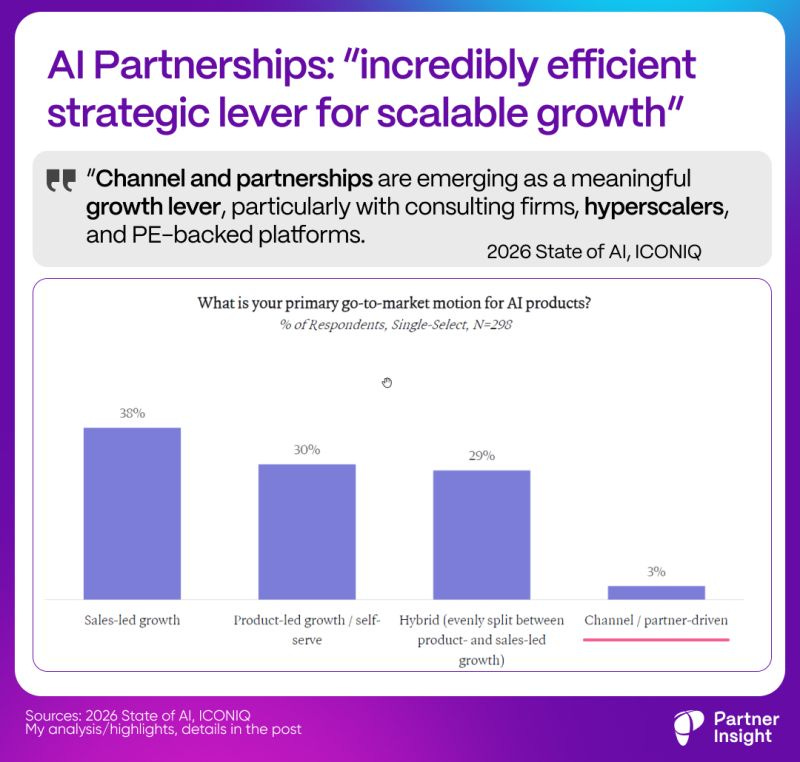
ICONIQ, one of the largest VC/PE funds, surveyed 300 software execs - CEOs, revenue chiefs, and product leaders — for their AI report.
It highlights that “AI builders increasingly formalizing partner ecosystems”, leaning on partners and hyperscalers to drive revenue.
My takeaways:
Channel, partnerships and hyperscalers are driving revenue for AI companies
“Channel and partnerships are emerging as a meaningful growth lever, particularly with consulting firms, hyperscalers, and PE-backed platforms, contributing directly to pipeline generation and post-sale implementation.”
Primary GTM motion is still sales-led at 38%
product-led/self-serve is 30%
hybrid is 29%
and channel/partner-driven is 3%
What it means: Partnerships are not yet the main route to market (they rarely are), but they are an important force multiplier across sourcing, credibility, implementation, and expansion.
Partnerships need to be built earlier than most companies think
Rob Bernshteyn, former CEO of Coupa highlights the importance of timing:
“Partnerships are an incredibly efficient strategic lever for scalable growth. The earlier companies lay the foundation (ideally well before $25M ARR) the more likely they are to see channel revenue become a meaningful contributor down the line.”
Companies that wait until scale to build partner ecosystems may miss the compounding effect of partner-led revenue.
AI is forcing a rethink of GTM
“Go-to-market strategies for AI products are becoming more complex and diversified” — highlights the report
“While sales-led motions remain the most common, nearly 60% of companies now employ hybrid or product-led elements, reflecting the need to combine enterprise selling with hands-on product experience.”
The self-serve-plus-sales motion is now the norm — it maps on how cloud marketplaces operate with free trials and PAYG layered onto an enterprise sales process.
AI stack is going multi-model, multi-cloud
Companies now use ~3.1 model providers on average, up from ~2.8 six months ago.
Orchestration is beating allegiance to a single vendor in AI — the same logic we see in multi-cloud.
Two insights for alliance leaders:
3% shows that partnerships doesn’t have to be your primary motion to become one of the largest revenue drivers.
Leaning on partnerships and cloud GTM is an early-stage decision. Partner infrastructure built before $25M ARR compounds. Bolted on at $100M, it is harder to catch up because GTM motion, and sales habits are already set.
Source: research.
NVIDIA Just Revealed AI’s Second Growth Engine
Half of NVIDIA’s $75B data center revenue now comes from outside the big clouds. The AI buildout just gained a second engine — and last quarter it grew faster than the first.
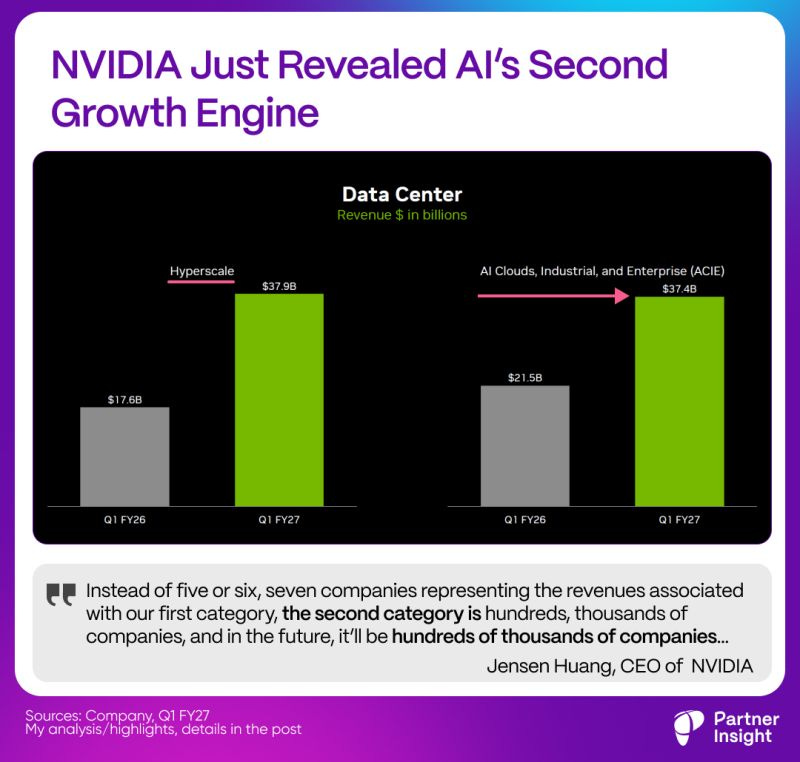
NVIDIA posted a record quarter: $81.6B in revenue, up 85% in a year, with $75B from the data center alone, up 92%. Demand, in Jensen Huang’s words, “has gone parabolic.”
But the more interesting number sits underneath.
NVIDIA changed how it reports. Data Center now splits into two sub-markets:
Hyperscale — the public clouds (AWS, Azure, Google, Oracle) and the largest consumer internet companies
ACIE — AI Clouds, Industrial and Enterprise
NVIDIA only began reporting the business this way this quarter, so treat it as a fresh signal, not a long trend. Still, the two halves are now almost the same size:
Hyperscale: ~$38B, up 12% quarter on quarter.
ACIE: ~$37B, up 31% quarter on quarter.
Half of the data center business now sits outside the hyperscalers — and this quarter, that half grew more than twice as fast.
To be clear, the clouds are not slowing
They remain the largest route to market for NVIDIA.
As Jensen put it, hyperscaler capex is “a trillion dollars this year,” and “I have every expectation it’s going to grow from here.”
CFO Colette Kress added context:
“Analysts now forecasting hyperscale CapEx to exceed $1 trillion in 2027… AI infrastructure spending is on track to reach $3 to $4 trillion annually by the end of this decade.”
What changed is the scale of everything growing alongside big clouds.
So what is ACIE? NVIDIA defines it broadly — AI factories “across industries and countries.”
It didn’t give a full breakdown, but from what Jensen described on the call, it appears to span:
AI-native clouds (the neoclouds)
Enterprise AI factories
Industrial AI on the factory floor
Sovereign and regional clouds
On-prem AI builds
His framing: hyperscalers are 5 or 6 companies — a simple GTM motion for NVIDIA. This second group is “hundreds, thousands of companies. And in the future, hundreds of thousands.”
Frontier AI is now multi-cloud by default
That same diversification strategy is showing up at the frontier.
NVIDIA named Anthropic a new strategic partner, with Jensen noting it has “partnered with them to secure computing capacity across Azure, AWS, CoreWeave” — coverage that was “largely zero until just recently.”
No single cloud now owns the frontier model layer, except maybe GCP.
The signal is simple: AI is no longer scaling only on the big clouds.
It’s scaling across industries — into neoclouds, enterprises and factory floors.
Of course, NVIDIA has reason to tell this story. A more diversified buyer base means less dependence on a handful of clouds, and that’s a good narrative for its own stock.
But the direction is hard to argue with: AI is spreading — and the partners who reach these new buyers scale with it.
Where are you placing your bets this year?
Turn Marketplace Into a Real Revenue Driver: 5-week course for Alliance & Cloud GTM Leaders
If Marketplace only shows up at the end of the deal, it is not a GTM motion. It is firefighting.
And that is where many Cloud GTM teams get stuck.
A rep pulls alliances in late
A private offer becomes urgent
The cloud rep gets a vague ask
Procurement shows up in the final week
It may save the deal. But it does not compound.
That is the pattern I keep seeing across SaaS and AI companies trying to scale on AWS, Microsoft, and Google Cloud.
They are “doing marketplace.” But they are not building a repeatable Cloud GTM growth system.

The teams pulling ahead do a few things differently:
they identify marketplace as a buying path earlier, not at the end
they train sales to use it, instead of treating it as an alliances side project
they make co-sell structured: real context, clear asks, better timing
they connect channel, marketplace, and cloud field into one motion
they build internal support across finance, ops, product, and leadership
That is what turns marketplace from extra work into leverage.
And it matters more now than it did even a year ago.
Cloud commitments across Amazon Web Services (AWS), Microsoft, and Google Cloud have crossed $1.2T.
Customers are more open to buying software digitally.
But they are also more selective.
Co-sell is getting more competitive.
And AI is reshaping how software gets discovered, packaged, and sold through hyperscaler ecosystems.
So the gap is widening: between teams that are listed and teams that turned marketplace into a repeatable revenue driver.
David Mauer — who helped drive $100M+ in marketplace revenue at GitLab and is now rebuilding the motion at LucidLink — put it well in our recent webinar:
”You never want a customer to tell you how they want to buy and have to say no.”
Over the past 2.5 years, 300+ alliance and Cloud GTM leaders have gone through our Cloud GTM Leader course to build that capability.
Some launched from zero marketplace motion to $200K revenue + $7M pipeline in 8 weeks.
Others closed their first $1M+ marketplace deal and turned it into a repeatable motion.
Some scaled marketplace revenue 4X YoY from an already high base.
That is not because they found one trick.
It is because they built the growth system.
Our next cohort starts next week — June 2
If you want to turn marketplace into a real growth driver — not just push isolated deals through it — this is what we work on for 5 weeks.
P.S. Thanks for reading! If this issue sparked an idea, please forward it to your alliance lead or cloud counterpart — it’s how this community shares what works.