
$531B → $900B in One Quarter: The Cloud Commit Jump (and the Marketplace Play)

Hi, it’s Roman Kirsanov from the Partner Insight newsletter, where I deconstruct winning Cloud GTM strategies and the latest trends in cloud marketplaces.
In today’s newsletter:
$531B → ~$900B in cloud commits — AI just pulled enterprise cloud budgets forward faster than anyone projected. What it means for your marketplace deals.
Google Cloud’s killer quarter — 48% revenue growth, $240B backlog, and partner AI revenue up nearly 300%.
AWS beat every estimate — 24% growth (fastest in 13 quarters), $244B in commits, and $44B in new backlog added in a single quarter.
Before we dive in:
Join us on February 24, 9-10 am PT for a tactical online workshop on turning these cloud commits into your marketplace revenue. You’ll walk away with frameworks for CEO buy-in, sales comp design, co-sell scripts, and more.
$531B → ~$900B in cloud commits AI just pulled cloud budgets forward
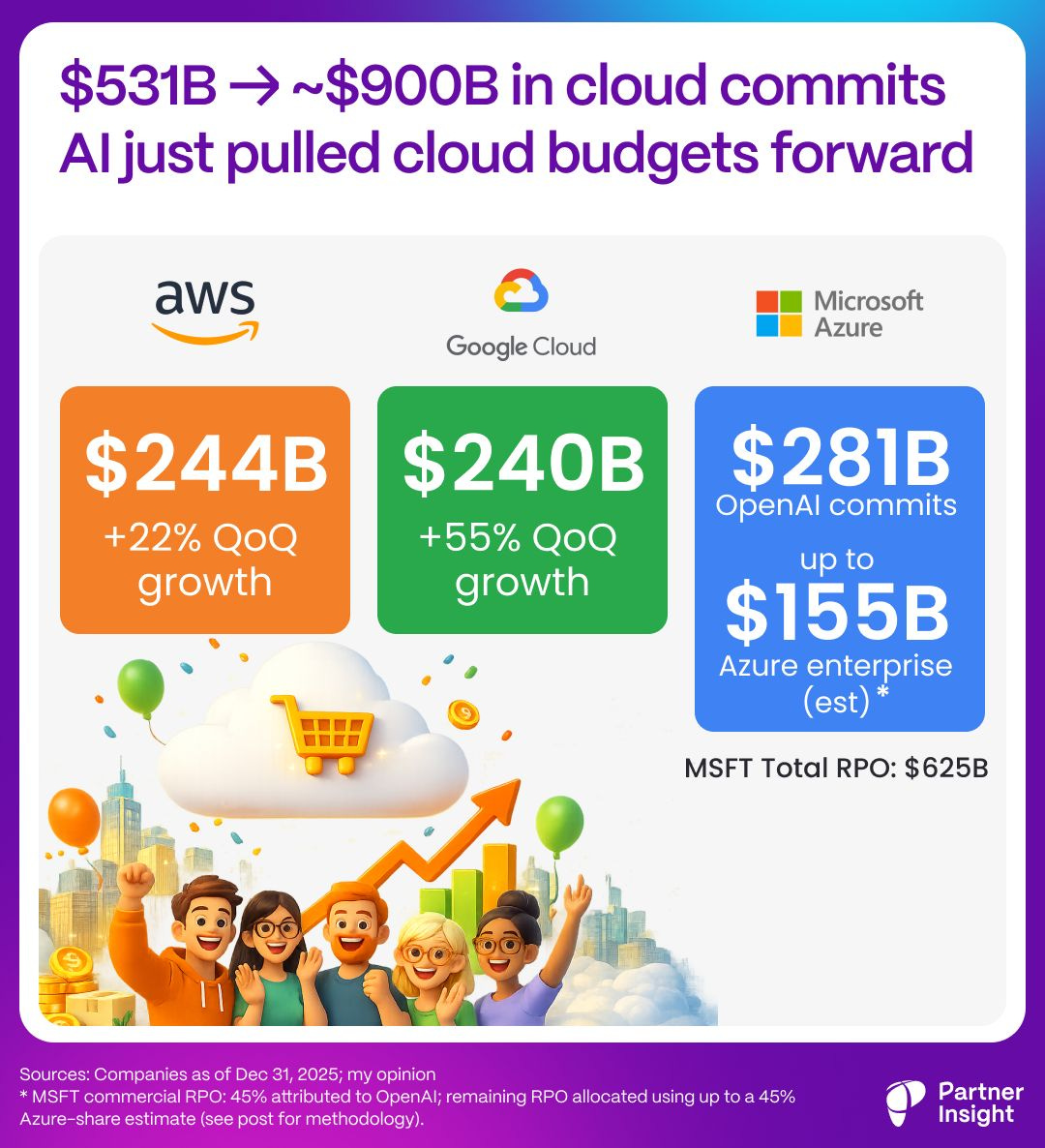
Cloud commits across AWS, Azure and GCP jumped to nearly $900B last quarter - up from $531B just one quarter prior.
AI demand is rewriting enterprise procurement faster than anyone projected.
Here’s what each hyperscaler reported for the last quarter (Q4 CY2025):
Amazon Web Services (AWS):
$244B cloud commits (+40% YoY, +22% QoQ)
Revenue reaccelerated to 24% on a $142B run rate — the fastest pace in 13 quarters.
CEO Andy Jassy described a “barbelled market” with AI labs consuming massive compute on one end and enterprises deploying cost-saving workloads on the other. Both sides are pulling forward commitments.
Google Cloud
$240B cloud commits (+100%+ YoY, +55% QoQ)
The standout mover this quarter.
Revenue grew 48% to a $70B+ run rate — the fastest growth among the big three.
Backlog more than doubled year-over-year, jumping $85B in 90 days. Sundar Pichai, CEO, noted: “The number of deals over a billion dollars in 2025 surpassed the previous three years combined.”
Existing customers are outpacing initial commitments by 30%+.
Microsoft
Reported $625B total commercial RPO (+110% YoY), that spans all Microsoft Cloud products, not just Azure.
But this quarter brought an interesting new data point: 45% of the $625B — roughly $281B — comes from OpenAI (that runs on Azure).
If we apply the 45% of Azure share we used previously to the remaining non-OpenAI backlog, we’ll additionally arrive at up to $155B in diversified enterprise Azure commits.
This would put the total Azure backlog at $436B total, inclusive of OpenAI share.
In a recent call, CFO Amy Hood highlighted that the non-OpenAI part of their total backlog is also growing quickly: “Roughly $350 billion is related to the breadth of our portfolio... larger and more diversified than most peers.”
That diversified base grew 28% YoY — the organic demand signal beneath the headline.
Why include large OpenAI deals in the combined total of ~$900B commits calculation?
AWS and Google Cloud backlogs likely also include undisclosed large AI lab commitments — Anthropic and others. Microsoft is simply the first to disclose the customer concentration.
What this means for your marketplace strategy:
All three clouds remain supply-constrained and locking in bigger, longer deals. These are pre-allocated budgets enterprises must consume — and cloud marketplaces remain the fastest path to capture that spend.
Map which of your target accounts hold cloud commits and with which provider
Align your offers and co-sell to where those commit dollars sit
Use commit drawdown timelines to create deal urgency with procurement
How are you factoring this rapid cloud commit growth into your marketplace deals?
Pro Tip:
Hyperscalers will prioritize partners who help customers turn committed spend into measurable AI ROI. If your offer accelerates AI adoption (and proves outcomes), your co-sell attention goes up fast.
Next, I’ll break down each hyperscaler’s growth drivers and what they signal for partners. But first — if you want the templates to turn commits into marketplace revenue:
$900B Cloud Commitments: 5 Templates to Convert Spend into Marketplace Revenue
Cloud commitments just reached ~$900B — a roughly 2X increase in 12 months. Translation for alliance leaders: customers have pre-allocated cloud funds they must spend. You can tap into these commits selling your software on cloud marketplaces.
But here’s the gap: most ISVs list on marketplaces, but stall between “listed” and actually “growing.” Their sellers don’t know when or how to route deals via marketplaces. Their leadership hasn’t fully bought in. Their ops can’t scale it.

We’re fixing that — with templates you can copy.
Join us February 24 (9–10 AM PT) for a tactical 60-minute session where we’ll break down what’s changed in 2026 and hand you the playbooks to capture the opportunity.
We’ll cover:
Market drivers: why the $900B milestone changes the math for every ISV on marketplace
How top teams set up and execute marketplace growth — from leadership buy-in to seller activation
5 ready-to-use frameworks and templates (CEO pitch, sales comp design, co-sell scripts, seller enablement checklist, automation playbook)
How to automate the motion and remove friction — so your team scales without adding headcount
Learn from operators who’ve built the motion
Drew Zurek, Senior Director, Global Cloud Marketplaces at Qlik, brings 20+ years across cloud, SaaS, and enterprise tech — including leadership roles at AWS and Salesforce.
He’ll be joined by Trunal Bhanse, CEO of Clazar, on the execution and automation layer
Plus additional speakers, including AWS to be announced shortly.
You’ll walk away with a Marketplace Template Pack.
If you’re leading alliances, marketplace activation, sales enablement, or RevOps — this is the session that turns the $900B commits milestone into your pipeline and closed revenue.
Google Cloud’s killer quarter: 48% growth + 240 backlog
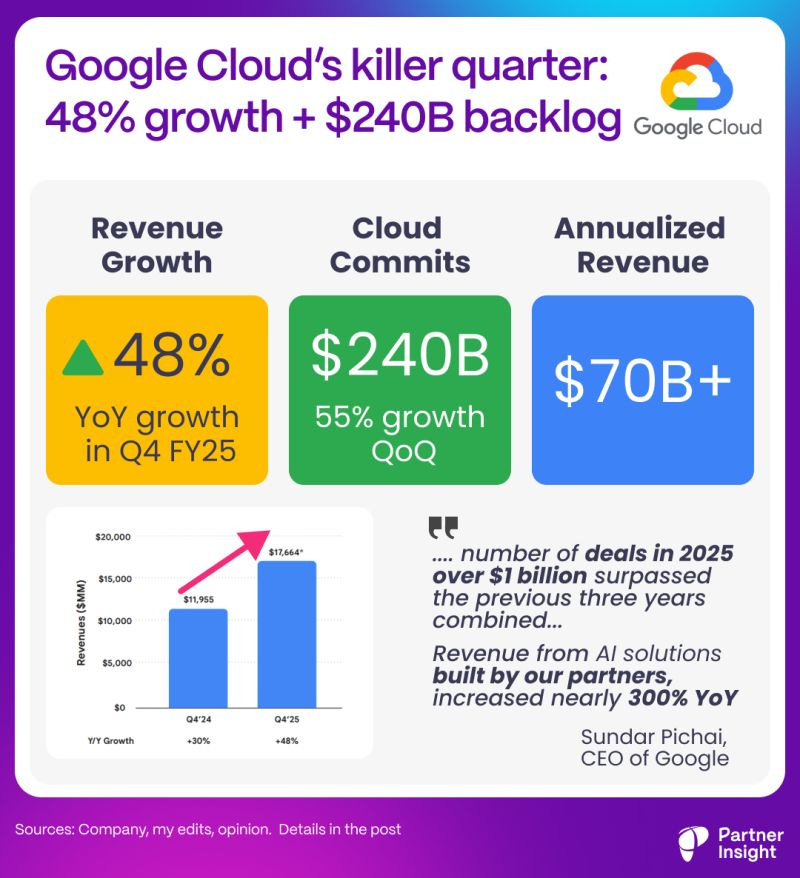
Google Cloud revenue up 48% YoY. Cloud’s backlog jumped from $155B to $240B in just 3 months.
But the partner signals are what deserve real attention.
Google reported Q4 last week. Here’s what matters for Cloud Alliance and tech leaders
Revenue hit $17.7 billion, up 48% year-over-year.
Annual run rate crossed $70 billion. Operating margin expanded to 30.1%, up from 17.5% last year.
The SaaS adoption is striking
95% of top 20 SaaS companies now use Gemini. Over 80% of the top 100. Salesforce. Shopify. More than 120,000 enterprises use Gemini, including AI unicorns like Lovable and OpenEvidence.
Sundar Pichai framed it directly: “Gemini is becoming the AI engine for the world’s most successful software companies.”
Partner revenue is accelerating fast
Revenue from AI solutions built by partners grew nearly 300% year-over-year.
Commitments from Google’s top 15 software partners increased more than 16X compared to last year.
That’s not incremental growth. That’s a strategic pivot toward ecosystem-led AI distribution.
The enterprise motion is working
New customer velocity doubled compared to Q1.
Deals over $1 billion in 2025 exceeded the previous three years combined.
Existing customers are outpacing their initial commitments by over 30%.
AI customers behave differently
“Nearly 75% of Google Cloud customers have used our vertically optimized AI – from chips, to models, to AI platforms, and enterprise AI agents”
They use 1.8X as many Google Cloud products as non-AI customers.
In December alone, 350 customers each processed over 100 billion tokens.
8 million paid Gemini Enterprise seats sold across 2,800+ companies.
This creates natural expansion paths for ISVs who integrate with AI workflows.
The infrastructure bet is massive.
Google announced $175-185 billion in CapEx for 2026.
Sundar acknowledged they remain “supply constrained” even at this scale.
Demand is outpacing capacity.
The $240 billion backlog represents committed customer spend
And an increasing share of customer wallets can flow through Google Cloud Marketplace — where customers can buy ISV partner products with their cloud commitment.
When partner revenue triples and billion-dollar deals multiply, the co-sell math changes.
Is Google Cloud Marketplace part of your 2026 growth plan?
AWS beat all expectations: 24% growth, $244 backlog
Wall Street underestimated AWS.
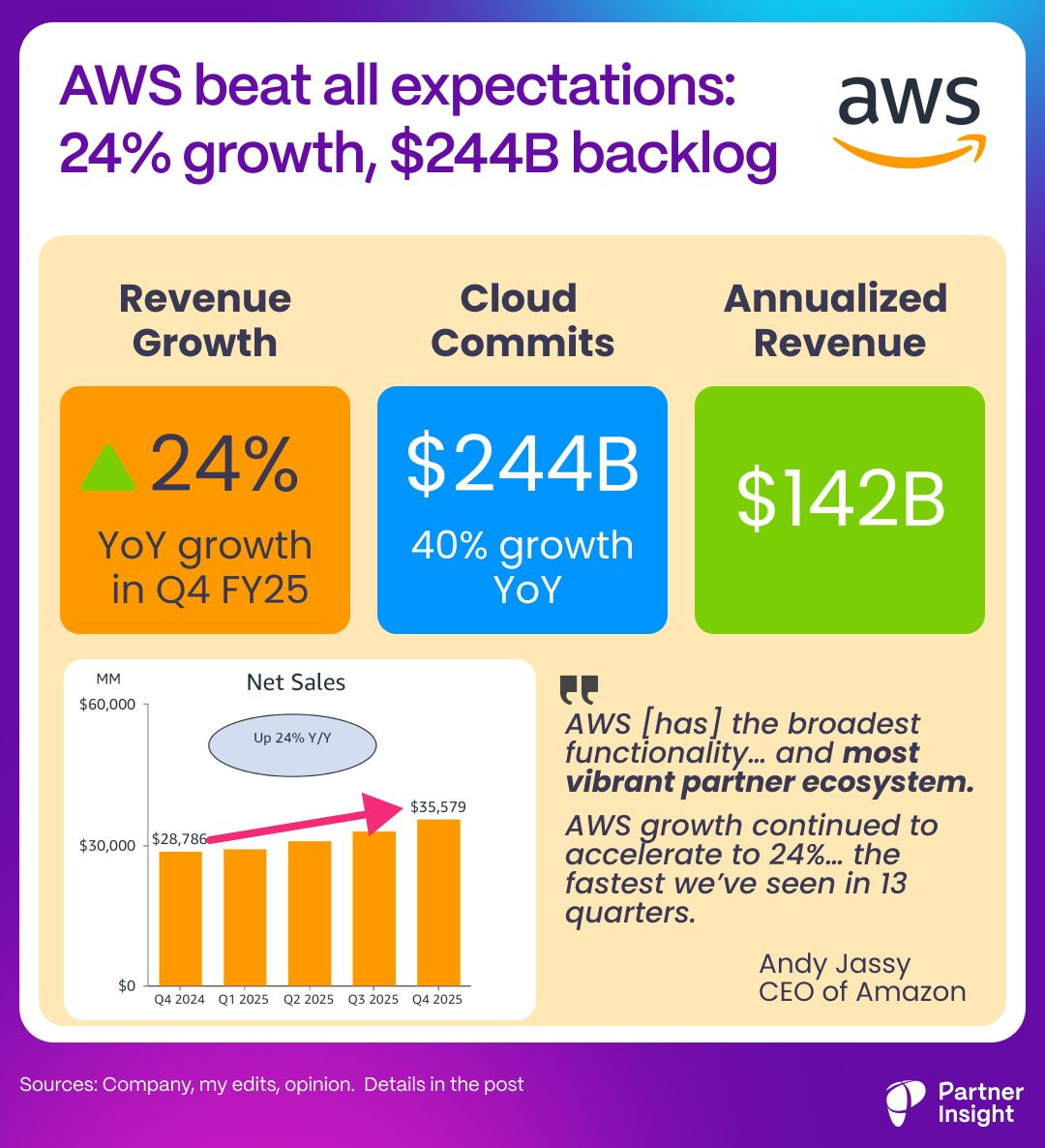
21.4% growth expected → 24% delivered + added $44B new cloud backlog in a single quarter.
If you run cloud alliances, this is your 2026 major demand signal from the world’s biggest cloud.
Here’s what the Q4 call just revealed:
Growth accelerated further on a massive base
“AWS growth continued to accelerate to 24%… the fastest we’ve seen in 13 quarters.” That’s “up $2.6 billion quarter over quarter… and nearly $7 billion year over year.”
AWS is now “a $142 billion annualized run rate business.”
“Our backlog is $244 billion… up 40% year over year… up 22% quarter over quarter.”
This isn’t only AI — core migrations are back
“We’re… seeing strong growth in core non-AI workloads as enterprises return to… moving infrastructure from on premises to the cloud.”
Finance was explicit: acceleration was “driven by both core and AI services.”
Partners were named as part of the edge
AWS highlighted its “most vibrant partner ecosystem,” then listed new agreements (OpenAI, Accenture, HSBC, CrowdStrike, Adobe, Salesforce, and more).
They also claimed “more of the top 500 US startups use AWS… than the next two providers combined.”
Bedrock is scaling because buyers want choice
“Most sophisticated AI applications leverage multiple models.” “Bedrock is now a multi-billion dollar annualized run rate business,” with customer spend up “60% quarter over quarter.”
And customers want AI “where the rest of their applications and data are.” AWS even pushed custom models earlier in the lifecycle (Nova Forge), calling it “a potential game changer.”
AI expands the rest of the footprint
“As customers run large AI workloads on AWS, they’re adding to their core AWS footprint as well.”
The next battleground is AI agents
Enterprises are “apprehensive about deploying to production” until agents can connect to “data, tools, memory, identity, policy, governance…” But Bedrock Agent Core is now “unlocking deployments.”
Demand is ahead of supply (still)
“We could actually grow faster if we had all the supply that we could take.” AWS added “3.9GW of power” in 12 months, “1.2GW” just in Q4, and expects to “double it again by the end of 27.”
CFO: AWS “added more data center capacity than any other company in the world.”
AWS plans “about $200B” in capex, “predominantly in AWS,” while “monetizing capacity as fast as we can install it.”
Silicon + economics are becoming GTM levers
AWS says chips (Graviton + Trainium) are “over $10B” run rate. Trainium2 has “over 1.4 million” chips landed; Trainium3 supply is expected to be “committed by mid 2026.”
And the principle is simple: “we have to make the costs of inference lower.”
$244B is customer cloud commits
If $244B is the committed demand pool... are your AWS partner + marketplace GTM positioned to capture it?
PS. I covered the full Microsoft earnings breakdown in last week’s issue.
PPS. Thanks for reading! If this issue sparked an idea, please forward it to your alliance lead or cloud counterpart — it’s how this community shares what works.