
7 Seller Coaching Tactics to Convert $531B Cloud Commits into Marketplace Revenue

Hi, it’s Roman Kirsanov from Partner Insight newsletter, where I deconstruct winning Cloud GTM strategies and the latest trends in cloud marketplaces.
This week we’ll break down:
$531B in cloud commits: 7 seller-coaching tactics from Contentsquare, AWS, KnowBe4 & Suger that actually turn cloud commits into marketplace revenue.
How to train sellers to qualify for marketplace early and why it unlocks co-sell, shortens cycles, and avoids last-minute procurement chaos.
BCG’s 21% software budget share: how exploding software + cloud infra costs make marketplaces your strongest lever with CFOs and procurement teams to cut “waste” and leverage cloud commits.
In SF for Microsoft Ignite this week?
On Thursday (Nov 20, 7:30–9:30am) I’m hosting a Microsoft Marketplace Strategic Breakfast with Microsoft marketplace leaders Will Kearl and Darren Sharpe plus cloud GTM heads from Datadog, NetApp, Contentsquare, and Suger. We’ll discuss how to translate key trends into concrete marketplace plays.
Last Call: Cloud GTM Leader Cohort 13 starts tomorrow
If you want a structured 5-week deep dive into AWS/Azure/GCP marketplace growth and co-sell strategy, Cohort 13 (the final cohort of 2025) kicks off tomorrow. 10+ live expert sessions, 250+ alumni from GitLab, Citrix, Wiz and others.
7 Seller Coaching Tactics to Convert $531B Cloud Commits into Marketplace Revenue
Cloud commits crossed $500B, reaching $531B. Milestones matter, but only if your sellers can turn commits into won deals on cloud marketplaces.
Last week, leaders from Contentsquare, AWS, KnowBe4, and Suger joined our online workshop to share how they coach sellers to convert commits into revenue and how to scale on marketplaces faster. Here are the seven tactics that separate scalers that grow on marketplaces from stragglers:
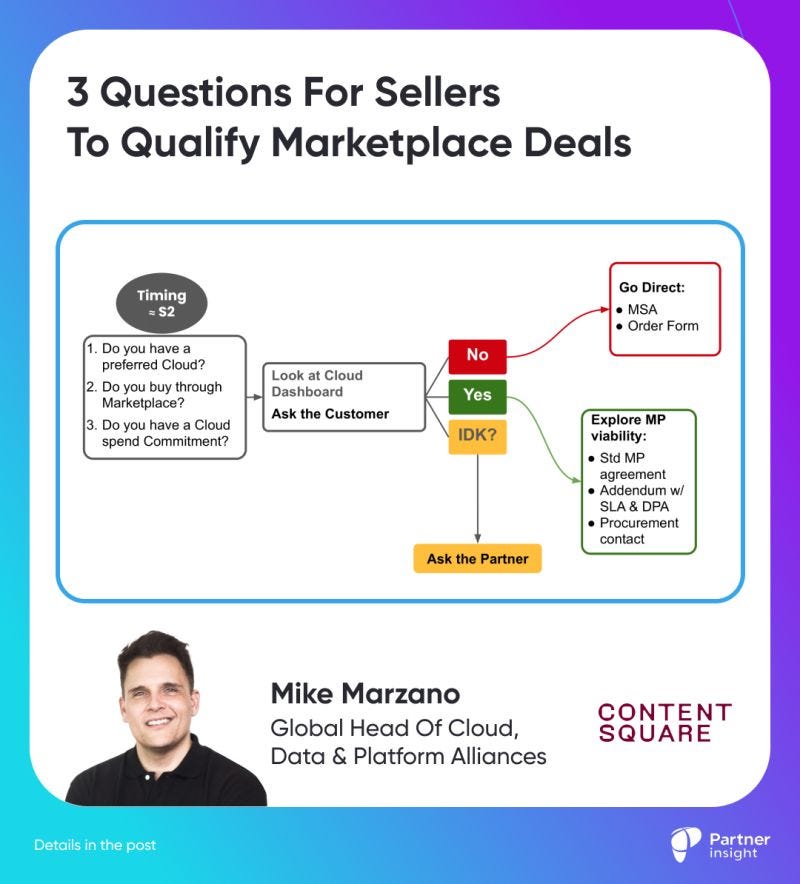
1) Install the 3-Question Framework at Stage 2
Mike Marzano drove $0 to $30M+ in marketplace revenue in 30 months with just 3 people supporting 400 sellers at Contentsquare by making qualification automatic.
His framework triggers when deals hit Stage 2 (validated opportunity, initial sizing complete):
Do you have a preferred cloud?
Do you buy through its marketplace?
Do you have a cloud spend commitment?
Then route based on answers:
Yes → Use marketplace, build private offer, engage cloud AE
I don’t know → Pull in cloud partner team to verify
No → Standard direct contract
Why this works: Asking early (Stage 2, not at contract) gives you time to build the three-way win with customer + cloud AE instead of scrambling at the 11th hour.
2) Comp Neutrality Isn’t Optional—It’s Table Stakes
Every speaker emphasized this: if reps don’t get the same comp for marketplace deals as direct, they’ll route around you.
What top performers do differently:
Neutrality baseline: Marketplace = direct comp (no penalty for 1.5-3% transaction fee)
Velocity kicker: Temporary SPIF (6-12 months) to drive adoption
Proof via data: Track deal size lift and cycle compression to show why marketplace earns the incentive
One ISV scaled to $100M ARR on marketplace by running a time-bound comp-positive program. Over that period, they saw deals close ~30% faster and 20–40% larger on Marketplace — and reps kept using it even after the SPIF ended.
3) Operations Before Heroics
Mike’s quote: “Good operations are worth their weight in gold.”
Contentsquare’s 3-person team scaled to $30M because they invested in:
Pipeline syncing (CRM ↔ ACE/Partner Center)
Propensity-to-buy and engagement scoring for marketplace eligibility
Standardized info bundles for ACE submissions (who we are, deal size, buyer, 3 key asks)
The trap: Alliance leaders try to manually quarterback every deal. That caps you at dozens deals per quarter.
The unlock: Build workflows that let sellers self-serve 80% of marketplace mechanics (eligibility check, private offer request, etc.).
4) Map Marketplace to MEDDPICC (or Your Sales Methodology)
AWS’s guidance: integrate marketplace into your existing sales qualification framework—don’t make it a separate track.
For MEDDPICC users:
Metrics – Tie Marketplace to quantifiable impact: revenue, efficiency, or risk reduction from doing the deal via Marketplace.
Economic Buyer – Identify who owns cloud commercial strategy and commit budget (EDP/PPA, discretionary funds, etc.).
Decision Process – With AWS, map the steps and stakeholders so you can shorten the path to “yes.”
Paper Process – Use Marketplace to streamline onboarding, procurement, and permissions to accept private offers.
Implicate Pain / Champion – Work backwards from customer pain and map champions together with the AWS account team.
Why this works: Sellers already know MEDDPICC. Mapping marketplace to existing muscle memory drives adoption faster than teaching a new framework.
5) Share pipeline with AWS with intent, not volume
From the AWS side, the message was clear: spray-and-pray ACE submissions reduce trust. If you flood AWS with poorly qualified opportunities and no clear ask, you get deprioritized.
What gets attention instead:
Clear stage in the sales cycle
Deal size and timeline
Who the buyer is
2–3 explicit asks (e.g., “intro to procurement,” “validation of cloud commit,” “CIO meeting,” “help positioning Marketplace to CFO”)
When your submissions consistently show that you’ve done the work and know exactly how AWS can help, field teams lean in much more often.
6) Seller Experience Is Your Product
Prashant Pai (leads alliances at KnowBe4, 70K customers) frames it clearly: “Me and my team—we are here to make the seller’s life easier. That is the product we deliver.”
How KnowBe4 operationalizes this:
Workflows designed for seller ease: Not what’s easiest for alliances team
Regular seller audits: Every 6 months, ask “What’s hard? What can we improve?”
Refactor based on feedback: Treat sellers like customers; iterate your internal product
Example: They use Suger’s workflow builder to evolve processes as the company gains marketplace maturity—starting simple, adding sophistication as sellers adopt.
7) Automate Seller Workflows to Remove Friction
Kyle Heisner (leads GTM at Suger) shared examples of workflows that eliminate manual bottlenecks:
Automatically pull MEDDICC data from Gong call recordings → populate cloud co-sell record → cloud AE gets context without seller typing summaries
Auto-intro emails connecting seller + cloud AE when deal hits a defined Stage + meets size threshold
Proof-of-record automation for finance team (eliminates monthly manual reconciliation of cloud disbursements)
The pattern: sellers hate “extra work.” Every manual step you remove makes it more likely sellers will actually use Marketplace.
Why This Matters Now
The $531B cloud commit milestone creates urgency, but only if you can activate sellers to convert it.
Most alliance teams know marketplace matters; they haven’t built the GTM, coaching systems, comp structures, and automations that let sellers run plays without requiring alliance team heroics on every deal.
These seven tactics separate the scalers from the stuck:
Winners build seller enablement infrastructure before chasing volume, automate the friction points that slow adoption, and treat marketplace as a cross-functional discipline (sales + finance + ops + legal), not just an alliance initiative.
If you need to build your Cloud GTM strategy, train your sales team to run marketplace deals and more — join our Cloud GTM Leader course.
Cohort 13 kicks off November 18 (last cohort of 2025).
250+ alumni have used these frameworks to scale, including from listing to 8-figure marketplace revenue.
Special Cloud GTM Leader Breakfast in SF: Microsoft Marketplace Strategic Insights
As Microsoft Ignite puts AI and cloud in the spotlight next week in San Francisco, our breakfast zooms in on one question: how do you turn that into your revenue on Microsoft Marketplace?

This Thursday morning (Nov 20) in San Francisco, we’re bringing Microsoft marketplace leaders together with a curated group of ISV and Cloud GTM leaders for a focused, strategic breakfast.
You’ll hear directly from leaders driving incredible scale of Microsoft Marketplace every day:
Will Kearl — Senior Director of Marketing, Microsoft Marketplace
Will Kearl leads marketing for Microsoft Marketplace. His responsibilities include business strategy, customer experience, and go-to-market.
Prior to his current role, Will’s successful track record ranged from product management leadership scaling Amazon Prime from 10M to 100M paid members, product marketing for Microsoft Office 365, and growing Pluralsight from $350M to $500M in annual revenue while developing a new category.
Darren Sharpe — Microsoft Marketplace Partner Lead
Darren is Microsoft Marketplace partner lead in Microsoft UK, with deep understanding of the cloud marketplace dynamics, opportunities and challenges it presents for customers, partners and ISVs.
Alongside Microsoft, we’ll be joined by top ISV leaders who are scaling on Azure Marketplace, including
Manik Rane - Global Head of Microsoft Alliance at NetApp
Laura Ripans -Senior Director, Global Cloud Alliances at Datadog
Jon Yoo- CEO at Suger
Mike Marzano — Global Head of Cloud, Data & Platform Alliances at Contentsquare
I’ll share data from our Cloud GTM Leader community on what’s actually working in marketplace GTM right now
What you can expect on Thursday morning:
Microsoft’s FY26 marketplace and partner priorities
Co-sell and channel motions in the AI era
Real-world tactics from top ISVs in Microsoft ecosystem
Curated networking with peers who own marketplace revenue
This is a special session for:
Leaders of Cloud Alliances and Partnerships
Heads of Marketplace / Cloud GTM
When & where
Thursday, November 20, 7:30–9:30 AM
San Francisco, just 12 min walk from Moscone/Ignite
Space is limited
If you’re coming to Microsoft Ignite and want to translate cloud and AI strategies into marketplace and sales plays, this breakfast is where those conversations will happen.
Software Cost is Board-Level Priority: Solve it with Marketplace-Led Sales
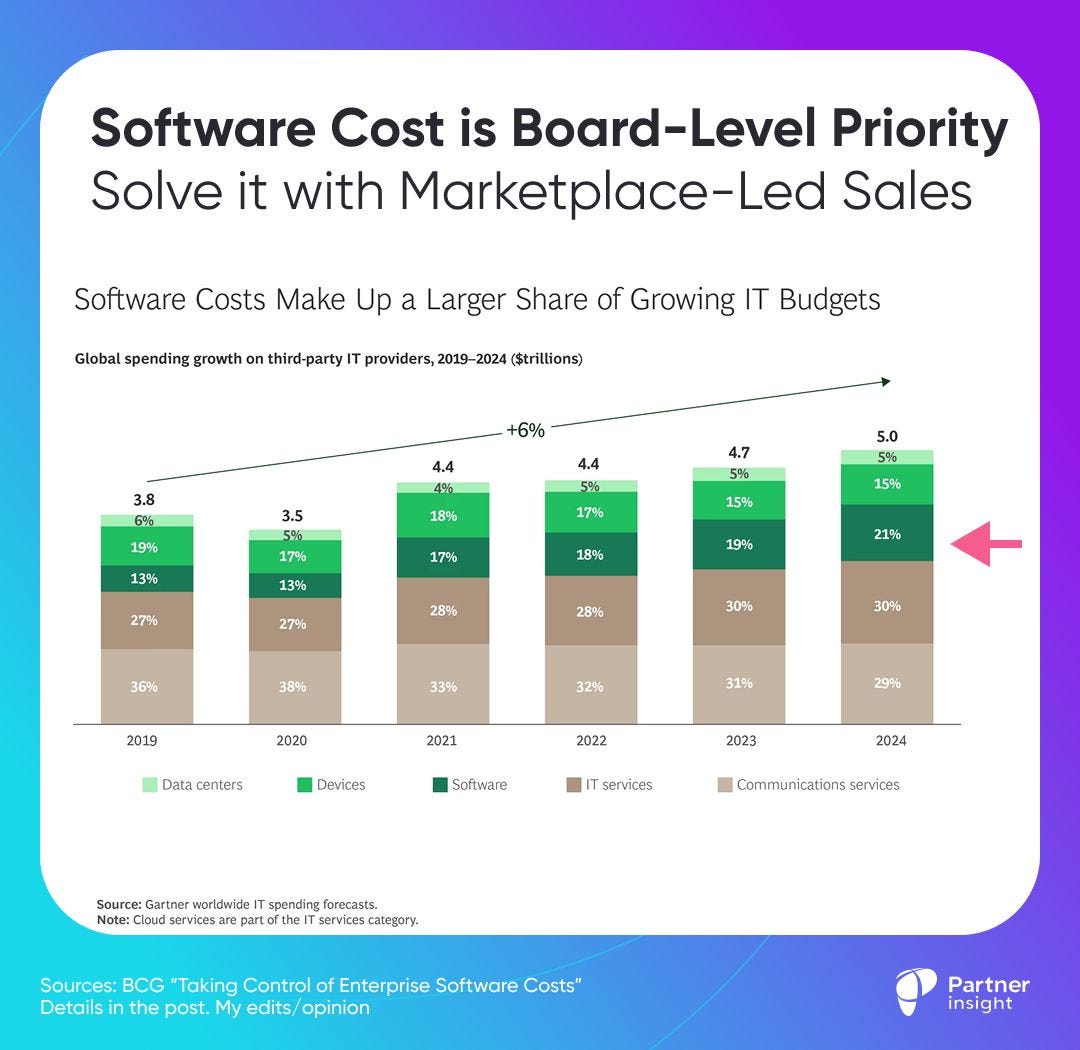
When BCG publishes a report on how to optimize enterprise software cost and cloud consumption, it means that growing software spend has become a board-level conversation.
Boston Consulting Group (BCG) doesn’t go into operational details unless the financial stakes are high to warrant C-suite attention.
My read in 4 bullets (and how alliance leaders can act):
1️⃣ Software is eating the tech budget
BCG recent highlights:
“Software costs increased by 50% as a share of the total tech budget, from 13% in 2019 to 21% in 2024” and “software spending rose even faster” than the overall 6% annual IT budget growth.
So what:
Software is outpacing overall IT growth, forcing finance to rethink procurement. Software scale and complexity accelerate with AI.
2️⃣ Cloud infra costs are the hidden multiplier (& opportunity)
Insight:
“As companies scale applications that run on public cloud platforms such as Amazon Web Services (AWS), Microsoft Azure, and Google Cloud, infrastructure costs rise accordingly.
Boosting the scalability and performance of many software solutions—including new GenAI offerings—requires increasing the amount of cloud resources available for data storage, compute power, and networking...”
So what:
Software purchases are driving significant cloud consumption that customers struggle to predict and manage. This creates natural alignment between ISVs and clouds.
3️⃣ Consumption pricing creates complexity (& opportunity)
Insight:
“Software vendors are also adopting newer consumption-based pricing models…. many companies are struggling to track consumption across the enterprise, increasing the risk of cost overruns.”
So what:
Enterprises lack visibility over consumption, creating friction in adoption. Vendors who bring clarity will win.
Result: Centralized governance is no longer optional
BCG advises to “create centralized oversight” and “manage all applications and contracts through a centralized system.”
Why marketplaces are the practical answer to all four:
Unified buying + one invoice tied to cloud commits
Native consumption tracking via hyperscaler billing
Centralized control with standard terms/approvals
TCO view of software + infra in one place
Playbook for Alliance Leaders:
With customers
Position marketplace (MP) offers as budget-friendly vs. direct procurement
Emphasize consolidation and spend tracking on MP
Target allocated budgets with commit burn-down strategies
With hyperscalers
Co-sell by showing how your solution drives cloud consumption
Offer bundled solutions to simplify procurement conversation
BCG’s message: software cost, cloud consumption and governance now move together.
Your advantage is to meet all three—in one marketplace-led motion.
PS. Cloud commits hit $531B — your customers have budgets to spend on AWS, Azure & GCP marketplaces.
250+ alliance leaders from GitLab, Citrix, Wiz used our 5-week Cloud GTM Leader course (15 expert sessions) to turn marketplace into revenue.
Cohort 13 starts Nov 18 (tomorrow) - join us
Unlock Your Growth on Cloud Marketplaces: Last Cohort of 2025 Starts on Nov 18
After guiding 250+ cloud alliance leaders to marketplace success on AWS, Microsoft and Google Cloud, our last cohort of 2025 Cloud GTM Leader course opens Nov 18th.
With software sales on cloud marketplaces projected to reach $163B in just 5 years (Jay McBain’s projections), mastering them has become essential for companies looking to scale.

Why is it more relevant today than ever before?
The playbook to grow on cloud marketplaces isn’t obvious and constantly evolving.
Cloud commitments hit a record $531 billion in committed customer spend and growing.
Co-sell, PLG, free trials, and co-marketing with hyperscalers are becoming more critical than ever.
The AI agent explosion is rapidly accelerating cloud adoption and turning marketplaces into “everything stores” for SaaS, data, and agents - right before our eyes.
That’s why we’ve been partnering with 50+ exceptional speakers and mentors who share their actual battle-tested strategies in our courses.
Why join this Cohort?
Learn directly from VPs of Partner of the Year winners, hyperscaler experts and our incredible mentors
Master co-sell tactics that drive real pipeline ($0 to $200K+ in sales and $7M pipeline in 8 weeks for one alumni)
Get practical frameworks to get your entire org on-board and accelerate cloud GTM together
Join a growing community of 250+ cloud alliance leaders
But don’t just take my word for it.
Here’s what our alums are saying:
“I came in knowing almost nothing and now I feel equipped to have in-depth conversations with leadership and stakeholders.”
“The highlight was learning a clear, actionable GTM framework and how to align teams around cloud buyer needs through ecosystem partnerships.”
Our alums loved the “open discussion with peers from different business functions and companies covering SaaS, Cybersecurity and Hyperscalers” and the “tactical elements and measurement tools to measure progress.”
“People with real experience sharing the how - how did they win, how did they fail, how did they tackle challenge X or Y.”
“Finding Partner Insight’s Cloud GTM Leader course was exactly what I needed. Roman is so well connected, bringing key players across AWS, GCP and Microsoft. I really appreciated hearing from both large and small companies on their selling journeys in the marketplaces.”
Ready to transform your growth on cloud marketplaces? Cohort 13 kicks off on November 18 - last cohort of 2025.
Don’t miss your chance to join this program recognized by Jay McBain of Omdia as a Top Education Program for Channel & Partnership professionals.
P.S. If you found these insights valuable, please forward it to your alliance lead or cloud/GTM counterpart - it’s how this community shares what works.