
Microsoft partners earn $6.26 per $1 on Marketplace: Capturing the multiplier

Hi, it’s Roman Kirsanov from Partner Insight newsletter, where I deconstruct winning Cloud GTM strategies and the latest trends in cloud marketplaces.
This week we’ll break down key Microsoft Ignite insights and how marketplaces are becoming the default route to enterprise buyers:
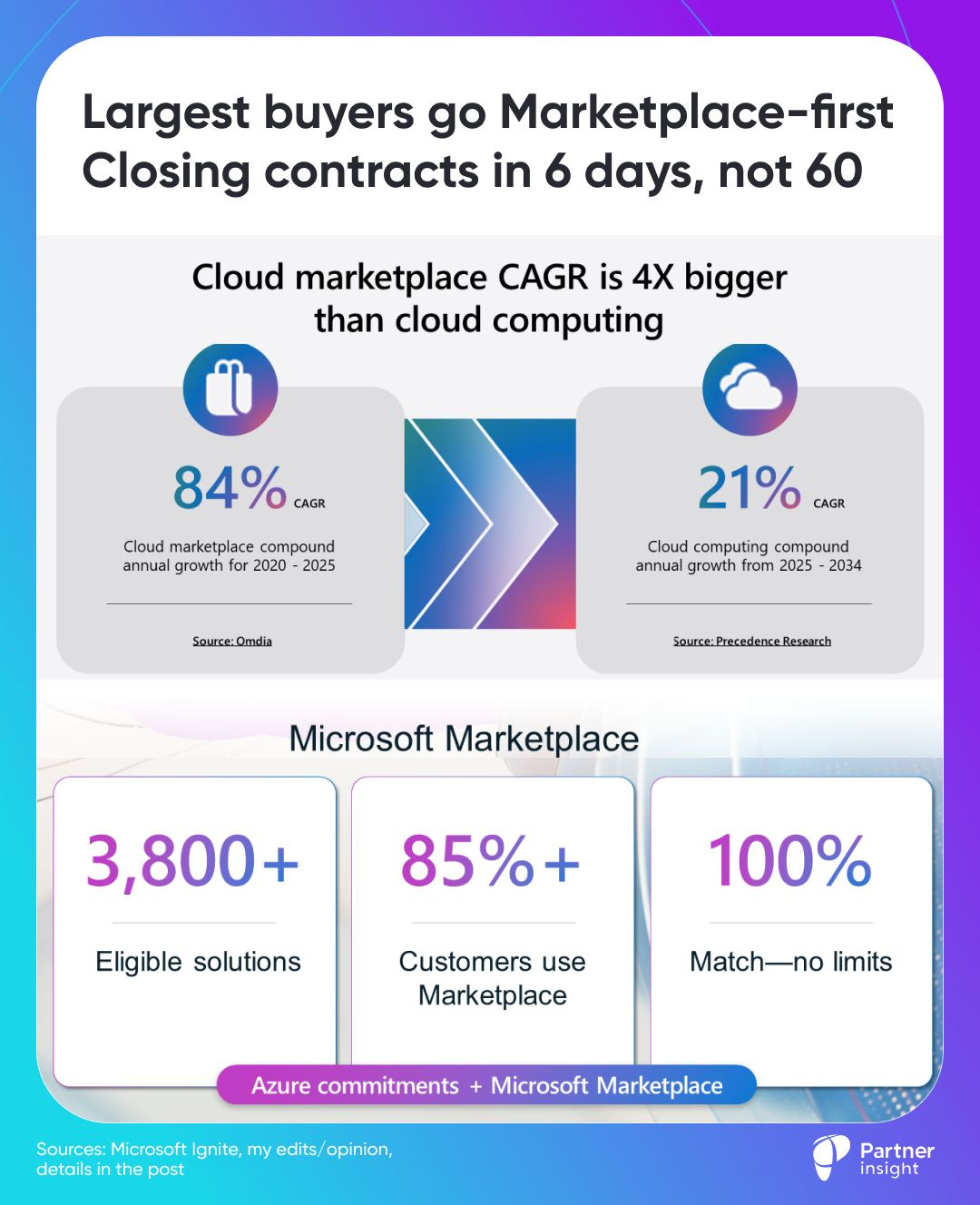
Largest buyers go Marketplace-first – why marketplaces are growing 4X faster than cloud computing (84% vs 21% CAGR) and how enterprises like Mars cut contract cycles by 90% by making Marketplace their procurement policy.
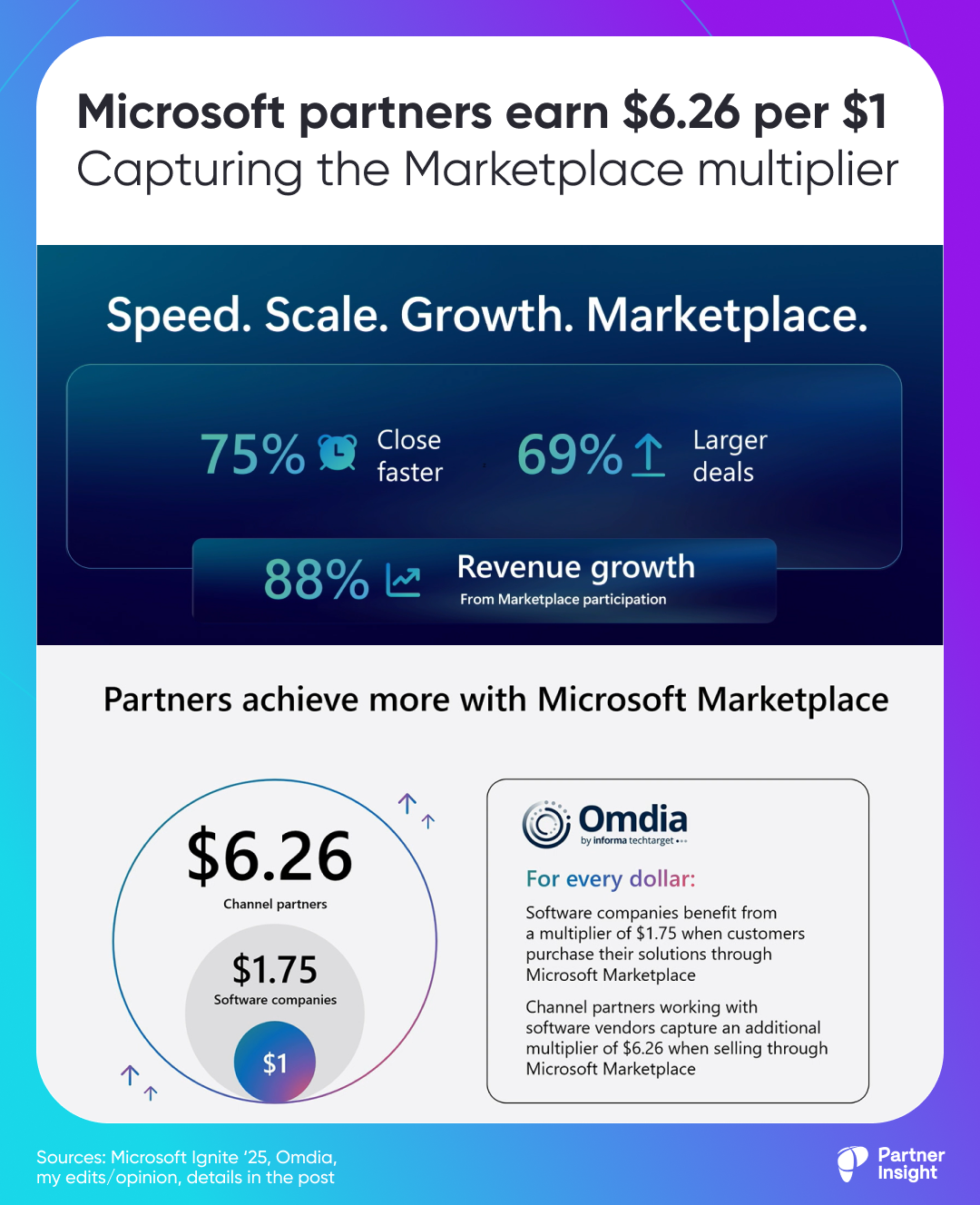
Microsoft’s $6.26 partner multiplier – new data shows ISV + channel motions on Microsoft Marketplace are growing 3.5X, producing deals 75% larger than average, and why channel partners capture $6.26 in extra value for every $1 transacted.
Inside our Ignite breakfast in SF – what Microsoft leaders and ISVs shared on growing via marketplaces, accelerating co-sell and channel, and the operations you need once Marketplace becomes your primary revenue engine.
Before we dive in:
If you’ll be at re:Invent next week, I’m hosting an invite-only, early-morning marketplace leaders breakfast in Vegas on Thursday, Dec 4 to digest the week’s biggest marketplace + partner announcements and turn them into concrete GTM moves for ISV alliance leaders (limited spots).
Largest buyers go Marketplace-first: Closing contracts in 6 days, not 60
Microsoft Ignite made one thing brutally clear for alliance leaders: if you’re not treating Marketplace as a key GTM motion, you’re leaving MACC dollars and deal velocity on the table.
Here are some of the insights I’m taking away from sessions with Will Kearl, Elizabeth Beals and Rajesh Ramankutty:
1. Marketplaces are outgrowing cloud and becoming the default route to buyers
Cloud is growing 21%, but cloud marketplaces are growing about 4x faster at 84%.
The message was simple: Average enterprise runs ~600 apps and the only realistic way to bring that ecosystem with you to the cloud is through marketplaces.
Over the last year, Marketplace sales grew 2X (doubled), and customers who use Marketplace increased their average spend by 75%.
2. Being MACC-eligible and discoverable is now table stakes
If the customer has a Microsoft Azure Consumption Commitment (MACC), you’re selling against pre-committed budget, not net-new spend – and Marketplace becomes the easiest way to use it.
Microsoft already has >3,800 MACC-eligible solutions, and 85% of MACC customers are transacting through Marketplace.
3. Use 100% MACC drawdown as your strategic lever
100% MACC drawdown on eligible Marketplace deals isn’t new, but today Microsoft is the only hyperscaler still doing 1:1 (no cap), while others cap marketplace usage at ~25%
This was called “one of the most generous benefits” for customers
4. Marketplace is becoming a procurement engine – and in some enterprises, a policy
Mars’ procurement lead explained that Marketplace cut contracting time from 60 days to 6 days (90% faster).
If an offer is in Marketplace, they know controls are in place via standard contracts and security, so procurement now operates as Marketplace first – even for low spend.
They also use large SaaS renewals (Databricks, Citrix) through Marketplace to balance against MACC consumption and adjust renewal strategy to optimize MACC drawdown.
5. Marketplace is an extension of Azure security – and a new observability layer for spend
Marketplace is an extension of your Azure environment: the same security model and policies apply.
On the finance side, buyers are using Marketplace as an observability layer for software: one place to see vendors, overlap, and MACC impact.
6. Discovery now happens inside Teams, Copilot and Azure – your listing is your new SEO
Marketplace offers now surface directly in Teams, Microsoft 365 Copilot, Foundry and Azure Portal. You can ask Copilot in Azure what you need and get Marketplace recommendations with links straight to listings.
So your listing metadata, categories and value prop serve as your in-product SEO across the Microsoft estate.
If you lead alliances, takeaways are simple:
Treat Marketplace as the front door for AI and cloud deals
Build your commercial story around Marketplace, commits and procurement value
Align with how buyers are already standardizing their AI, cloud and apps spend
Microsoft partners earn $6.26 per $1: Capturing the Marketplace multiplier
Channel partners have been asking hyperscalers for a seat at the Marketplace table. Microsoft Ignite’s message last week: channel is not just at the table — you are the growth driver.
Here’s what I took away from sessions focusing on Marketplace + Channel + AI opportunities.
1) Marketplace is driving impressive growth
Nicole Dezen framed Marketplace as “our scale growth engine for the ecosystem”, backing it with recent Omdia data:
75% ISVs say deals close faster
69% land larger deals
88% see recognizable revenue growth tied to Marketplace
This makes the Marketplace a natural place for ISVs and channel partners to drive GTM, co-sell and invest in growth.
2) ISV + channel on Marketplace is where the biggest deals live
When an ISV and a channel partner come together on Marketplace:
That slice of the business is growing 3.5X, and
Producing deals that are 75% larger than the average Marketplace deal.
Jason Rook highlighted that not only is the marketplace overall doubling, but the ISV + channel subset is compounding on top.
Translation: any Marketplace strategy that doesn’t include ISV + channel is leaving serious growth on the table.
3) The Marketplace multiplier heavily favors partners
New Marketplace study by Omdia quantified the upside of using Microsoft Marketplace:
ISVs see $1.75 of additional value for every $1 transacted via Marketplace
Channel partners see $6.26 of extra value for every $1
That extra value comes from service attach, renewals, bundling, etc. – where channel partners are strongest.
4) Deal economics are shifting toward partner-funded, AI-heavy motions
Jay McBain forecasts that 59% of Marketplace deals by 2030 will include partners. That aligns with Microsoft’s broader pattern: ~95% of their deals are partner-assisted already.
Jay also highlighted that the majority of customers already use partners for agentic AI - 47% rely on partners (+24% adopt hybrid approach).
Result? Marketplace is the place where AI, partners and commercial flows are wired together.
5) Resell Enabled Offers (not so) quietly put channel back in control
This was the most “channel-changing” piece for me. Darren Sharpe explained that with Resell Enabled Offers (now GA worldwide):
ISVs keep one public transactable listing
they authorize specific partners to run a reseller version
the partner controls price, terms and lifecycle, sends the offer directly to the customer, and owns the relationship
Microsoft bills the customer and pays the partner, who then pays the ISV
This is Microsoft re-creating traditional channel power structures inside Marketplace:
partners keep contracting primacy and can add other services & products – but now on Marketplace rails.
What this means for Alliance leaders:
Marketplace is the platform for how Microsoft, ISVs and channel do business together.
The next wave of growth with Microsoft will be captured by partners who are both AI and Marketplace-fluent.
Insights from our Marketplace Strategic Breakfast at Microsoft Ignite San Francisco
Marketplace is now at the center of Microsoft’s GTM – and in the early morning last week in rainy SF, 40+ ISV and Cloud GTM leaders joined us to compare notes on what actually drives revenue. Here’s what we learned.
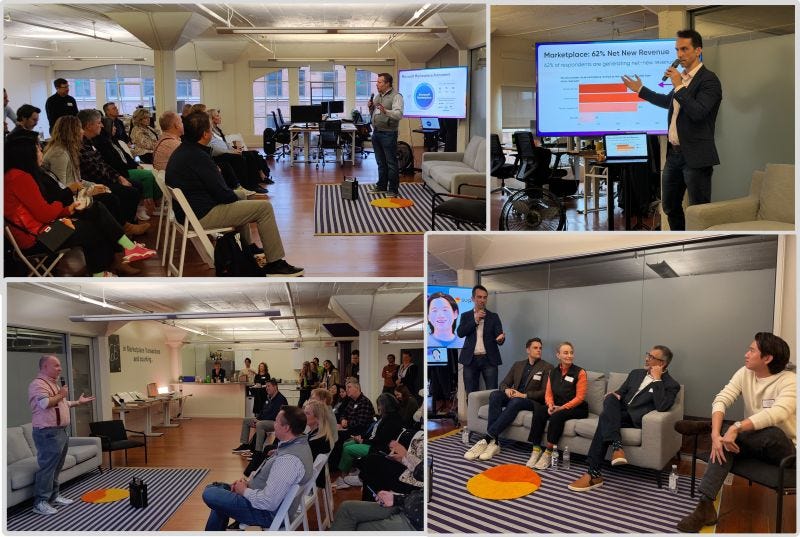
From Microsoft, we had an incredible lineup of marketplace leaders:
Will Kearl – Senior Director, Microsoft Marketplace
Darren Sharpe – Microsoft Marketplace Channel Lead
Joined by a panel of leaders from Datadog, NetApp, Contentsquare and Suger.
The conversation was honest: what’s working, what’s improving, and where the biggest upside is.
Marketplace is at the center of Microsoft strategy
Marketplace is now the “platform for partnering” – embedded into co-sell, channel, and increasingly distributors.
Major updates: global rollout of resale-enabled offers + marketplace integrations with Arrow, Ingram Micro, Pax8, TD SYNNEX and Crayon.
ISVs can now:
Authorize partners to resell via PO, while controlling geos, pricing, and partner selection
Plug marketplace even deeper into how the channel already sells
ISVs with marketplace muscle are pulling ahead
ISVs were clear: when you build marketplace muscle and lean into Microsoft, growth looks different.
Laura Ripans from Datadog described this velocity shift. Microsoft’s strength in the enterprise turns into much larger deals and better access to strategic accounts.
Manik Rane from NetApp shared how they went from minimal marketplace presence to making it their primary revenue engine.
The customer pull to transact on marketplace is now absolutely real.
But growth isn’t automatic.
You have to keep educating your sales teams, learn how to co-sell, and integrate marketplace into your org:
Make marketplace and co-sell easy for sellers with clear plays.
Lean on customer value in cloud conversations. Even when your product looks “competitive,” show cloud sellers how it drives consumption of native services – it changes the conversation.
Channel is the next frontier & ops are key
As marketplace becomes distributed across channel, for ISVs, working with partners who already have marketplace practices is one of the fastest ways to grow.
Mike Marzano from Contentsquare underscored that strong operations are essential. The more you sell via marketplace, the more you need automation across listing, co-sell, private offers & billing – this is where platforms like Suger come in, and why having them host us mattered.
What impressed me most
How open Microsoft marketplace leaders were with the ISV community to share what’s working and what’s evolving
How strong the marketplace momentum feels at Ignite – number of ISVs, scale of the ecosystem, and the energy in the room this morning
How much value comes from putting operators in one room before the main conference starts
My view: we’re still early in marketplace growth, with huge growth potential ahead.
Big thanks to our incredible speakers, to Suger for hosting, and to everyone who joined us that morning.
AWS Marketplace Strategic breakfast @ re:Invent
If you’ll be in Las Vegas for re:Invent, I’m hosting a curated AWS Marketplace breakfast on Thursday, Dec 4 at The Venetian.
We’ll meet early to digest the key AWS Marketplace + partner announcements from the week and translate them into concrete GTM moves for ISVs.

The session is aimed at ISV alliance / marketplace leaders who are scaling their AWS business. Spaces are limited and attendance is by approval only.
P.S. If you found these insights valuable, please forward it to your alliance lead or cloud/GTM counterpart - it’s how this community shares what works.